Your LLM Judge Is a Confident Liar: Building Better Verifiers — Browserbase
Browserbase and Microsoft Research unveil their Universal Verifier for computer-use and web agents, addressing the critical flaw of inaccurate LLM-as-judge benchmarks that yield "confident liars." They detail its four guiding principles, demonstrating how it drastically cuts false positives and provides high agreement with human evaluations, leading to better training data. An auto-research experiment highlights the synergy between AI and human expertise in developing robust evaluation systems.
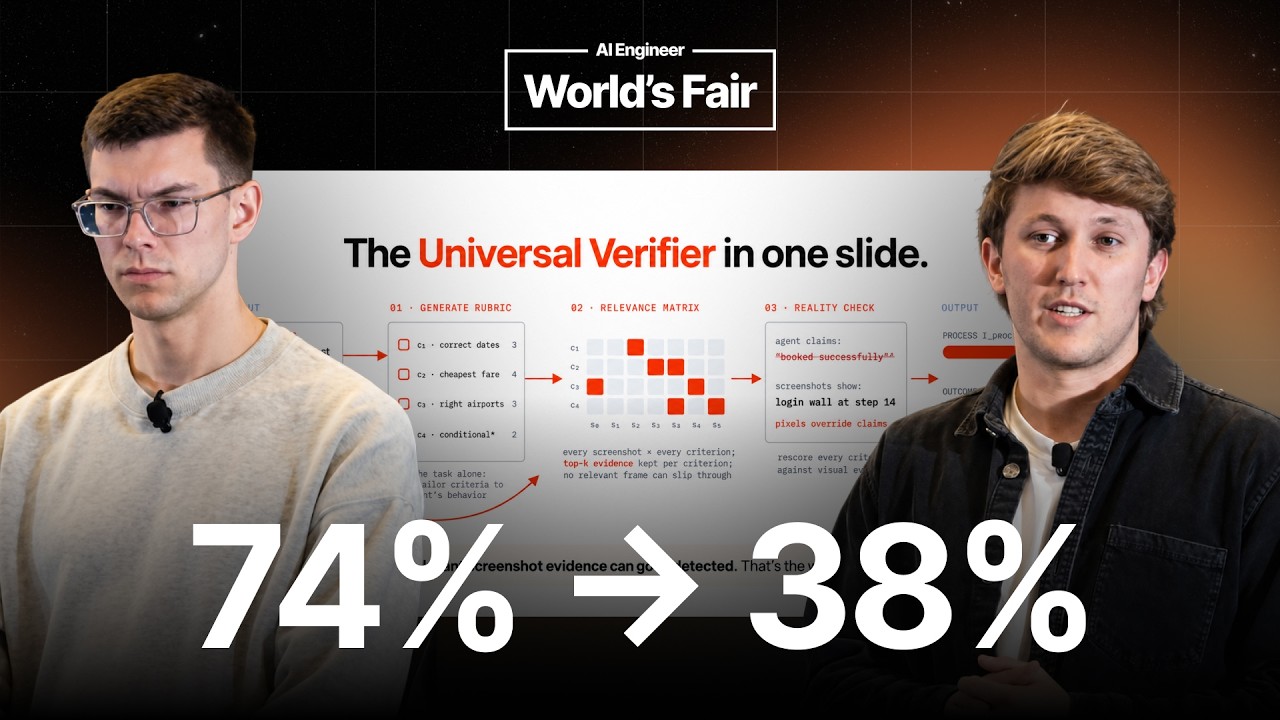
The presentation by Miguel González Fernández (Browserbase) and Corby Rosset (Microsoft Research) addresses the critical challenge of accurately evaluating computer-use and web agents. They argue that traditional deterministic evaluations for agents have ceased to scale effectively with increasing model capabilities, primarily due to the dynamic and open-ended nature of the web. Compounding this issue, popular web benchmarks like WebVoyager, which rely on LLM-as-judge verifiers (e.g., GPT-4o), often provide confidently incorrect assessments. This leads to a detrimental cycle where training agents against these flawed judges results in “more competent liars” rather than genuinely improved agents. As an example, the official WebVoyager judge reported a 74% success rate for a FARA 7B model, while their proposed Universal Verifier measured a mere 38%.
To bridge this significant gap between reported success and actual performance, they introduce the Universal Verifier, designed with four core principles:
- Grade only what was asked: Rubrics must be precisely aligned with the task, avoiding extraneous criteria that can artificially deflate scores. For instance, a bad rubric for finding a hotel might ask for the total price when not explicitly requested, penalizing the agent for not performing an unasked action.
- Don’t cascade errors: In multi-step tasks, a mistake in one criterion should not unfairly penalize subsequent criteria if the agent can still perform correctly. For example, if an agent misidentifies the person with the longest last name but correctly reports that person’s net worth, it should only be penalized for the initial identification error, not the subsequent correct action.
- Check the ground truth screenshots: Agents frequently overconfidently claim success without actual evidence. The verifier critically examines relevant screenshots from the agent’s trajectory to confirm actions and outcomes, contrasting them with the agent’s self-reported actions. This is crucial for catching subtle hallucinations.
- Separate controllable from uncontrollable failures: The verifier distinguishes between agent failures (e.g., hallucinating information) and environmental limitations (e.g., an item being out of stock on a website). If an agent correctly identifies an out-of-stock item, it receives credit for its best effort, even if the overall task outcome is not met due to external factors.
The Universal Verifier operates by first generating a task-specific rubric with multiple criteria. It then analyzes the agent’s trajectory, ranking the most relevant screenshots as evidence for each criterion. This evidence is used to determine if a criterion was met, identify contradictions, and output a “process score” (partial credit) and an “outcome boolean” (overall task success). This approach effectively reduced false positives from nearly 50% to zero and demonstrated a Cohen’s Kappa agreement with human labels that was comparable to inter-human agreement.
The quality of the verifier directly impacts the quality of training data. Experiments showed that filtering training trajectories using the Universal Verifier’s process score resulted in significantly higher quality models compared to using a less accurate baseline verifier.
A notable side project explored whether an autoresearch loop could autonomously build such a verifier. While humans took three weeks to develop the Universal Verifier, an AI-driven autoresearch loop could perform a similar number of experiments in a single day. However, the AI-built verifier only achieved about 70% of the agreement quality compared to the human-refined version. This suggests that while autoresearch can drastically accelerate experimentation and provide a strong baseline, human intuition and refinement remain crucial for achieving state-of-the-art results. The most powerful recipe combines human intervention with autoresearch loops.
The research is open-sourced, including the paper “The Art of Building Verifiers for Computer Use Agents” on arXiv, the Fara + CUAVerifierBench GitHub repository with golden labels, and code for experiments. This work has also yielded a new benchmark designed to expose significant gaps in current model capabilities, serving as a robust daily driver for evaluating agent progress. Future work includes extending this verifier approach to desktop tasks, incorporating additional telemetry like terminal logs. Rigorous methods, including holding out two-thirds of human-labeled trajectories for independent validation, were employed to prevent overfitting the verifier to human labels.