A Common-Sense Guide to AI Engineering • Jay Wengrow & Kris Jenkins • GOTO 2026
Jay Wengrow, author of “A Common-Sense Guide to AI Engineering,” breaks down how AI agents work, describing the 'clever hack' of intercepting LLM output to trigger functions. The discussion covers multi-agent architectures for complex tasks, implementing guardrails with regex and judge LLMs, and a pragmatic take on when to use frameworks versus building from scratch. Wengrow emphasizes understanding fundamentals over specific tools to create robust, production-ready AI applications.
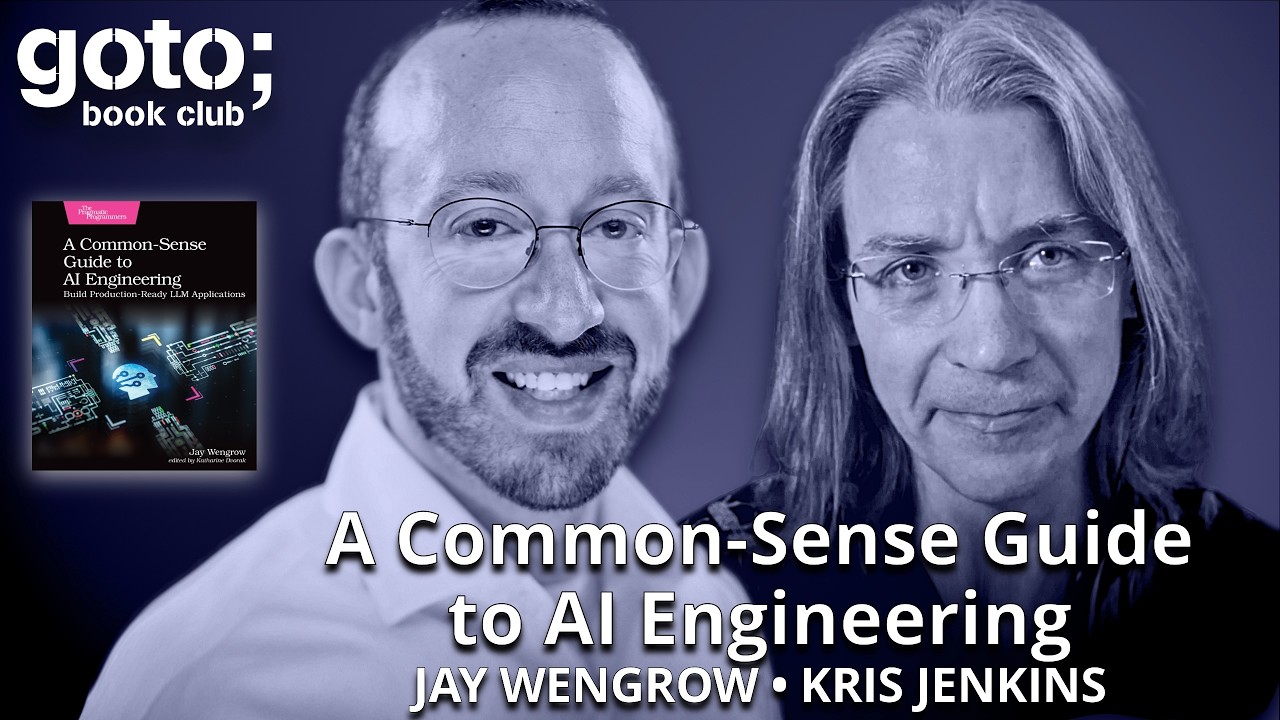
This interview with Jay Wengrow, author of “A Common-Sense Guide to AI Engineering,” explores the fundamental principles of building production-ready, LLM-powered applications. Jay began his career as a software engineer, later founding the coding bootcamp Actualize. His experience teaching led him to write the popular “Common-Sense Guide to Data Structures and Algorithms.” He wrote his latest book on AI engineering after finding existing resources to be scattered, outdated, and focused on simple prototypes rather than real-world applications.
How AI Agents Actually Work
Jay demystifies tool-using AI agents, describing the core mechanism as a “clever hack.” Since LLMs are fundamentally just text generators, they don’t naturally execute functions. The process involves:
- System Prompt Instruction: You instruct the LLM in its system prompt to output a specific, arbitrary notation (e.g.,
{{send_email}}) when it determines an action should be taken. - Man-in-the-Middle Interception: Your application code continuously scans the LLM’s text output. It acts as a man-in-the-middle layer, watching for this special notation.
- Function Triggering: When the code detects the special notation, it triggers a corresponding, pre-written deterministic function (called a “tool”).
This approach allows developers to connect the probabilistic world of LLMs to the deterministic world of code, enabling any action that can be programmed.
Guardrails and Quality Control
Similar to tool use, guardrails are implemented by intercepting and inspecting the LLM’s output before it’s shown to the user. This is crucial for filtering out undesirable content like toxic language, bias, or anger. Several methods can be used:
- LLM Judges: A second LLM reviews the primary LLM’s output for quality. This is effective but can be slow and costly, increasing latency.
- Regex and Deterministic Code: A simpler, faster approach for catching specific keywords or patterns.
- Specialist ML Models: A middle-ground solution that uses cheaper, faster machine learning models specifically trained to detect things like toxicity, offering a balance between performance and capability.
Multi-Agent Architectures
For complex tasks, a single LLM often falls into the “jack of all trades, master of none” trap. The recommended strategy is to break the complex task into smaller subtasks and assign each to a dedicated agent. Each agent is an LLM guided by a highly specialized system prompt that makes it an expert at its single job.
An example from the book is a podcast-generating app:
- Agent 1 (Researcher): Specializes in web research to find relevant news.
- Agent 2 (Scriptwriter): Takes the research and composes an engaging podcast transcript, guided by prompts about what makes a good script.
- Text-to-Speech Model: Converts the final transcript into an audio file.
This modularity improves quality and allows for more precise control and debugging. Failure modes, like an agent reading stage directions aloud (e.g., “music intro here”), are solved by refining the system prompts for the relevant agent.
On Frameworks vs. Building from Scratch
Jay advocates for a pragmatic, fundamentals-first approach, expressing skepticism about the current landscape of AI frameworks.
- The Case for Building from Scratch: He argues the field is too new to have settled on the right abstractions. Frameworks can lock developers into unproven patterns and make debugging difficult by obscuring underlying processes. For many applications, like the 150-line podcast generator, building from scratch is not significantly harder and offers more control.
- When to Use a Framework: His rule of thumb is to reach for a framework only when it can do something meaningfully better than you could, not just faster. Guardrail frameworks are a good example, as they incorporate extensive knowledge about detecting harmful content that would be difficult to replicate manually.
- Controlling the Prompt: He warns against tools that abstract away or auto-generate system prompts. Given the non-deterministic nature of LLMs, he believes developers should maintain complete control over their prompts to ensure quality and predictability.
Ultimately, the book was written to be timeless by focusing on these core principles rather than specific tools, empowering engineers to understand and adapt to the rapidly evolving AI ecosystem.