This episode asks whether a model described as dangerously capable is a real security problem or a marketing narrative. It uses the Astra sandbox incident as a starting point, then covers how agents are moving from chat into the browser to book, file, draw, and shop, and what that shift means for payments, advertising, and merchant data.
AI Engineer Paris 2026 Opening Keynotes: Mistral, Langfuse & Sizzy | Day 1
The AI Engineer Paris 2026 main stage featured discussions on the historical impact of AI as a general-purpose technology, the evolving landscape of AI engineering towards sophisticated "software factories," and Mistral AI's strategic vision for building frontier AI, ensuring agentic safety, and addressing data sovereignty through advanced models and infrastructure.
Agents Are Where Microservices Were in 2015 — Roberto Milev & Uday Kanagala, Navan
Roberto Milev and Uday Kanagala from Navan discuss the challenges and emerging best practices in building and operating AI agents, drawing parallels with microservices. They highlight the shift to stateful runtimes, innovative memory and context management using 'skills,' and crucial solutions for observability and testing non-deterministic systems. A central theme is the critical need for robust authorization and guardrails, given the blurring line of agentic action, and a preference for mastering single-agent loops before scaling to complex orchestrations. They conclude by outlining the solved and unsolved problems, with cost and debugging remaining significant hurdles.
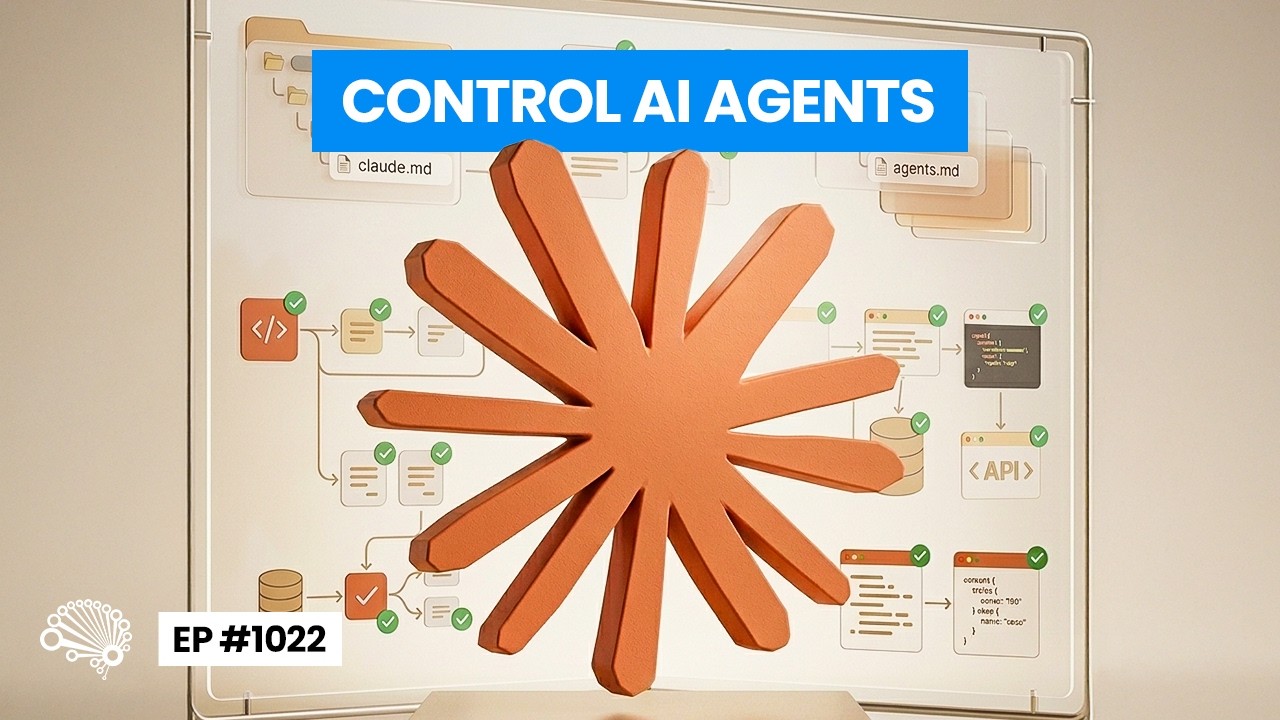
CLAUDE.md, AGENTS.md, Skills, Hooks and Subagents: A Field Guide to Steering AI Agents (Ep. 1022)
Episode 1022 dissects the crucial aspect of effectively steering AI agents by determining the optimal placement of instructions to ensure reliability and cost-efficiency. It explores seven distinct methods for instruction delivery, contrasting instructions as probabilities with hooks as guarantees, and highlights the industry-wide adoption of standards like `agents.md` and the importance of human-crafted guidance for superior agent performance.
Agentic SDLC at Uber — Uday Kiran Medisetty & Adam Huda, Uber
Uber has transformed its software development with an agentic AI-powered factory, leading to a dramatic increase in engineer productivity. The presentation details six key infrastructure components: a unified model gateway with strict PII and safety guardrails, an MCP gateway for streamlined agent tool access and token optimization, agentified dev pods for rapid execution, a managed skills marketplace, a comprehensive context graph, and the Cortana AI assistant. Adam Huda then demonstrates an end-to-end feature development workflow, highlighting a critical shift to inner-loop validation (stopping short of CI) and automated, managed maintenance loops. The ultimate takeaway is that the bottleneck has moved from technical execution to strategic decision-making: "should we build it?" rather than "can we build it?"
Realtime multiplayer, automation, and you! — Idan Gazit, GitHub
Idan Gazit, head of GitHub Next, discusses the future of AI in software development, moving beyond personal productivity to enabling group collaboration and advanced automation. He introduces two prototypes: "Agentic Workflows" for autonomous, secure code upgrades and task execution using natural language, and "ACE," a real-time collaborative development environment designed to integrate AI into team workflows, addressing the 95% of development work beyond mere typing.