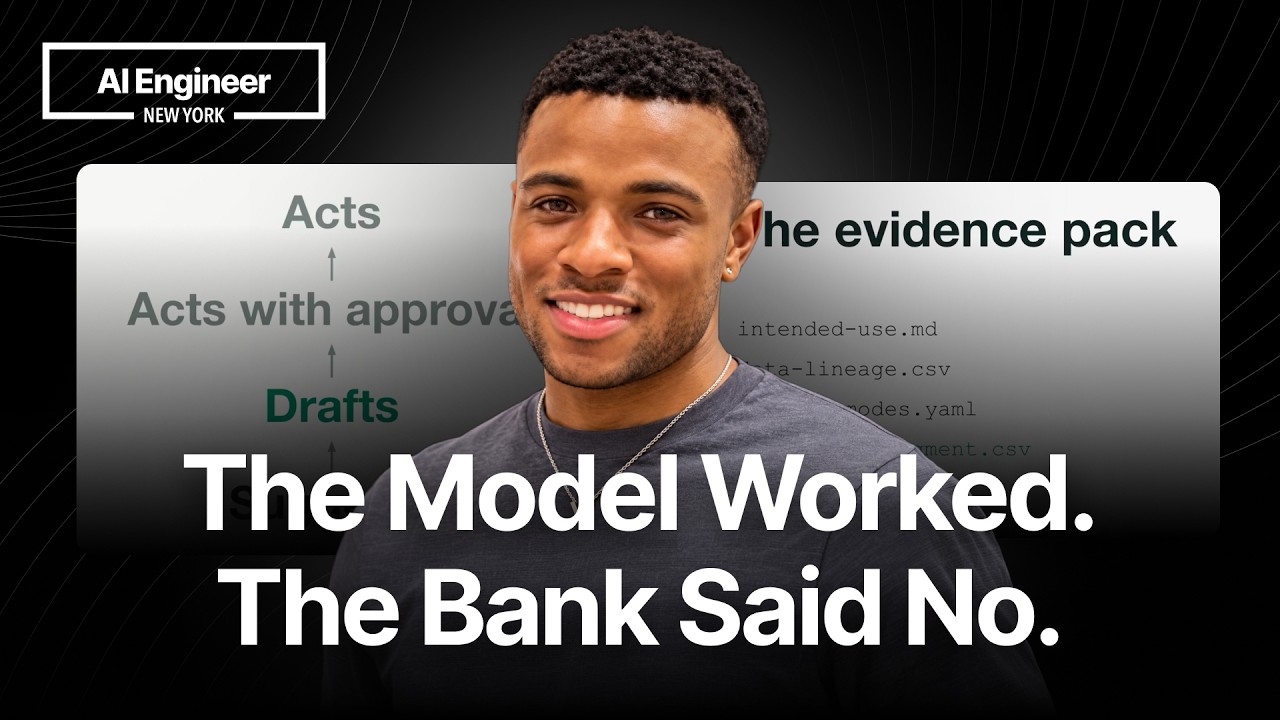
Deploying AI Inside a Bank Is Not an Engineering Problem — Paden Gayle, Applied AI Engineers
A bank's AI demo works but cannot ship due to non-engineering problems like security, data ownership, and risk approval. Paden Gayle outlines a method focusing on early stakeholder discovery, iterative workflow scoping, gradual autonomy, and a comprehensive evidence pack to build AI systems with a credible path to production, emphasizing that "discovery is the engineering."
AI Agents Aren't the Revolution. They're the Catalyst!
Sam Anthony argues that AI agents are not the revolution themselves, but rather a powerful catalyst for profound, lasting changes in the surrounding technology ecosystem. This includes modernizing data infrastructure, standardizing system design, enabling seamless interoperability, democratizing technology and expertise, and shifting human thinking towards outcome-based problem-solving.
Give the Agent a Budget, Not a Token — Sachin Malhotra, Anthropic
Sachin Malhotra's talk outlines a critical framework for safely deploying autonomous agents in production, moving beyond simple token-based access. He introduces 'asymmetric verbs,' refilling 'rate limits,' 'trip wires' for aggregate monitoring, and the 'undo test' as a lens. A central tenet is that infrastructure (via a proxy) must stamp an agent's identity, preventing agents from circumventing controls and ensuring accountability, thus providing a "budget" instead of an unbounded "token."
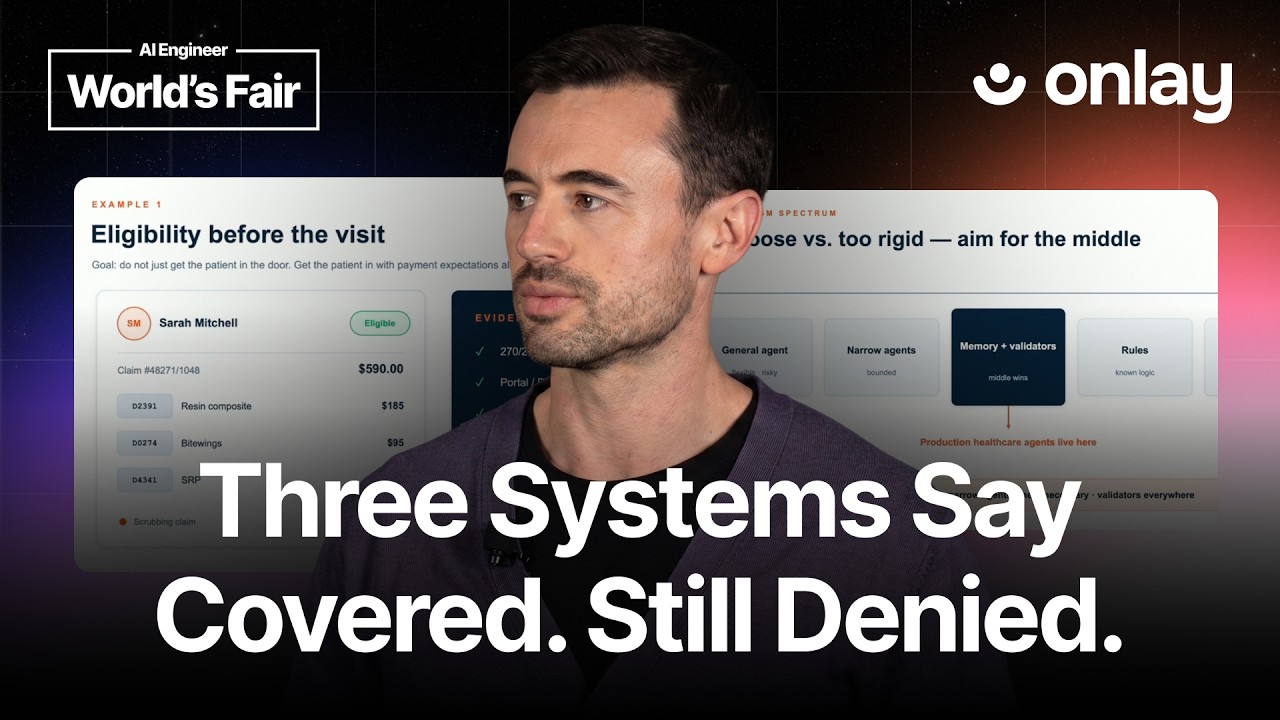
Healthcare’s Agent Bytecode: X12 as the Harness for AI Agents — Vasant Kearney, Onlay
Vasant Kearney presents a nuanced perspective on implementing AI in healthcare, particularly in insurance. He highlights that while AI is evolving rapidly, real-world application requires understanding that solving isolated problems doesn't equate to complex solutions. His core argument is the utility of X12 as a 'harness' for agentic AI, providing a structured, confining framework for LLMs in healthcare. This approach acknowledges that X12 defines the contract between providers and payers, and even phone calls can be seen as X12 transactions. However, he cautions that X12, or any payer data, isn't ground truth due to disparate system origins, necessitating an internal 'semi-correct' representation. Kearney advocates for a balanced "AI pilled and AI skeptical" stance, embracing AI's potential while remaining cautious about its inherent limitations, cost, and the necessity for robust system design and evaluation.
This session details the transformation of the MCP protocol to a stateless design, addressing previous scaling challenges by externalizing session state to a database and eliminating the need for sticky sessions and complex infrastructure. The presentation includes a live demo comparing stateful and stateless architectures, highlighting benefits in scalability and simplified deployment. It also covers considerations for security and data resiliency within this new paradigm.
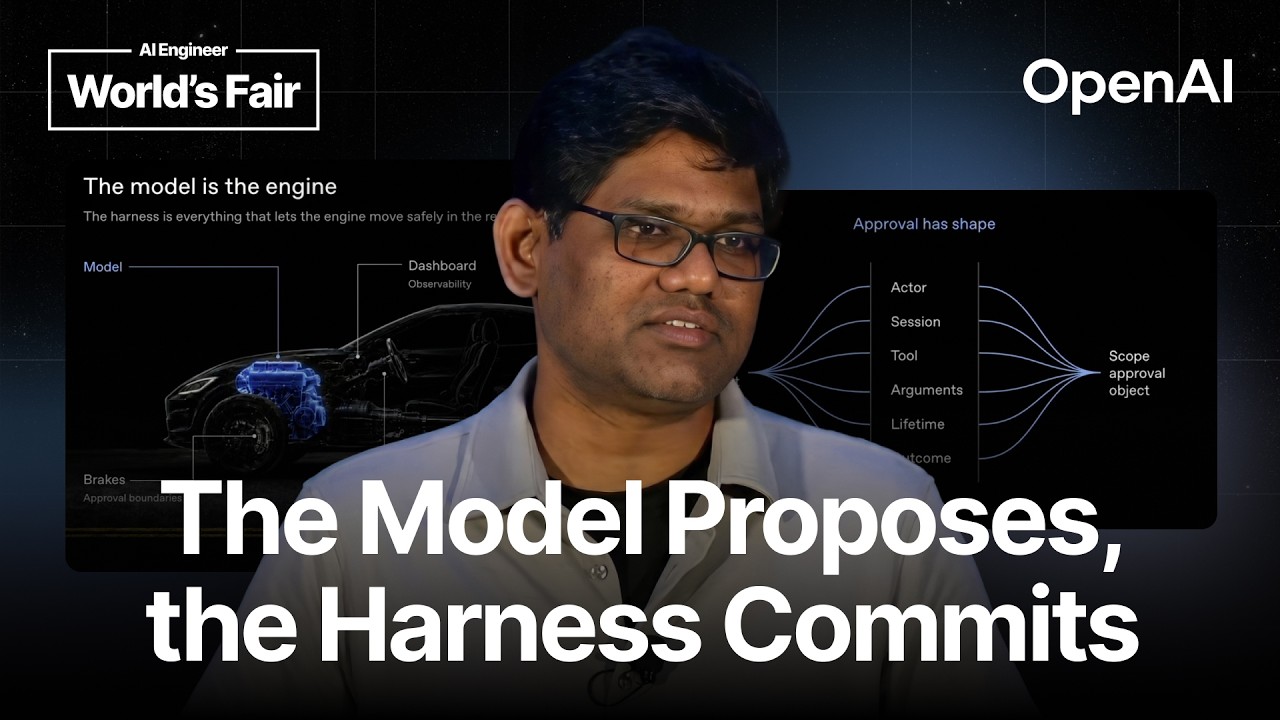
Your Agent Didn't Fail. Your Harness Did. — Vinoth Govindarajan, OpenAI
Vinoth Govindarajan's talk addresses critical 'harness failures' in AI agents, arguing these, rather than model errors, are the root cause of most production incidents. He introduces the core contract: 'A model proposes, the harness commits, and a receipt proves it,' and outlines five key boundaries (state ownership, ordering, deadlines, authority, user-visible proof) that lead to failures like silent success and incomplete reality. The talk culminates in a practical 'run receipt audit' with five questions to diagnose and ensure reliable agent behavior.