Large language models

The Benchmark With No Instructions — Tufa Labs (ARC-AGI-3)

The Benchmark With No Instructions — Tufa Labs (ARC-AGI-3)

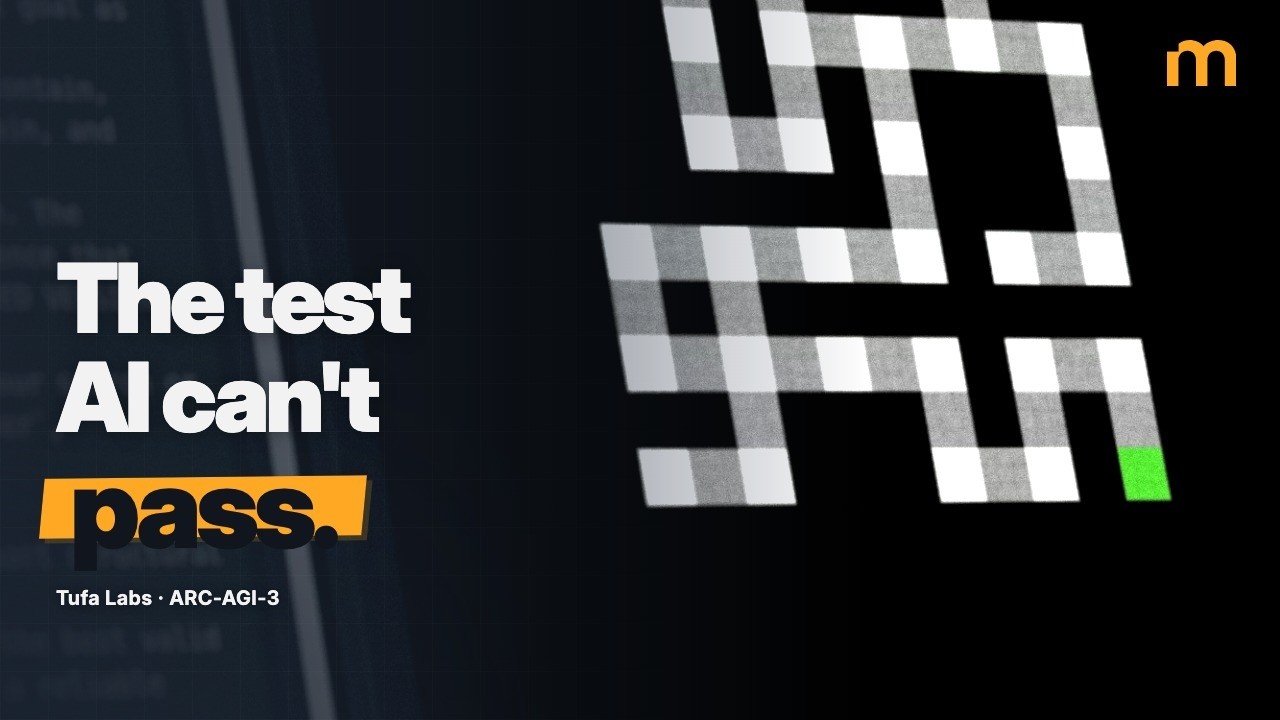
Tim Scarfe visits Tufa Labs to explore their top-ranking ARC-AGI-3 system, a benchmark for agentic intelligence that challenges LLMs in goal discovery and action efficiency. The team delves into the complexities of fractured representations, the role of human priors, and whether LLMs truly plan or merely simulate it effectively, all while balancing the bitter lesson with AI safety concerns.
What Is AI Code Review? Fixing Slow PRs & Broken Workflows with AI

What Is AI Code Review? Fixing Slow PRs & Broken Workflows with AI

Anna Gutowska explains how AI code review enhances software development by addressing the slowness and inconsistency of traditional methods. The video delves into the benefits of AI in accelerating reviews, improving code quality, fostering developer learning, and reducing technical debt. It covers the underlying technologies like static/dynamic analysis and LLMs, discusses critical considerations such as over-reliance and context, and provides best practices for integrating AI while emphasizing the indispensable role of human oversight.

Using Spec-Driven Development for Production Workflows - Erik Hanchett, AWS

Using Spec-Driven Development for Production Workflows - Erik Hanchett, AWS

Erik Hanchett discusses spec-driven development (SDD) as a structured approach to building complex software features with AI coding assistants. He explains how to guide AI "interns" through distinct phases of requirements, design, and implementation, emphasizing context management, the use of "skills," and the crucial role of the human in the loop for review. Hanchett highlights AWS's Kiro tool, which automates much of this process, and the Model Context Protocol (MCP) for integrating external data sources, offering a pathway to higher-quality code and more effective AI collaboration.

OpenAI Codex lead on the new shape of product work | Andrew Ambrosino

OpenAI Codex lead on the new shape of product work | Andrew Ambrosino

Andrew Ambrosino, Product and Engineering Lead for the Codex app at OpenAI, details how AI is transforming product development, shifting focus from implementation to curation and the crucial role of "taste." He discusses AI's current limitations in design, the evolving nature of product roles, and OpenAI's "zone defense" approach to product management. Ambrosino shares his personal workflow with Codex and outlines the vision for it as an intelligent "home base" that orchestrates work across various applications, exemplified by a story of Codex building a Premiere Pro extension.

The Promptware Kill Chain: How Prompt Injection Becomes AI Malware

The Promptware Kill Chain: How Prompt Injection Becomes AI Malware

Promptware introduces a new class of AI malware leveraging prompt injections to exploit architectural flaws in LLMs. This summary details The Promptware Kill Chain, covering stages from initial access and jailbreaking to persistence, lateral movement, and real-world impact. It emphasizes the critical need for a Zero Trust approach, treating AI agents as hostile runtimes to defend against these sophisticated AI-native threats.

Memory and Continual Learning: Engram's Dan Biderman and Jessy Lin

Memory and Continual Learning: Engram's Dan Biderman and Jessy Lin

Dan Biderman and Jessy Lin of Engram introduce their "always training" paradigm, focusing on baking a team's knowledge directly into a model's weights to achieve true memory and continual learning. This contrarian approach, which they call a "RAG killer" for specific use cases, promises up to 100x token savings and superior performance by internalizing context rather than relying on ever-larger context windows or external retrieval, envisioning a future where everyone has their own continually learning, personalized AI model.