From $0 to $11B: The ElevenLabs Story
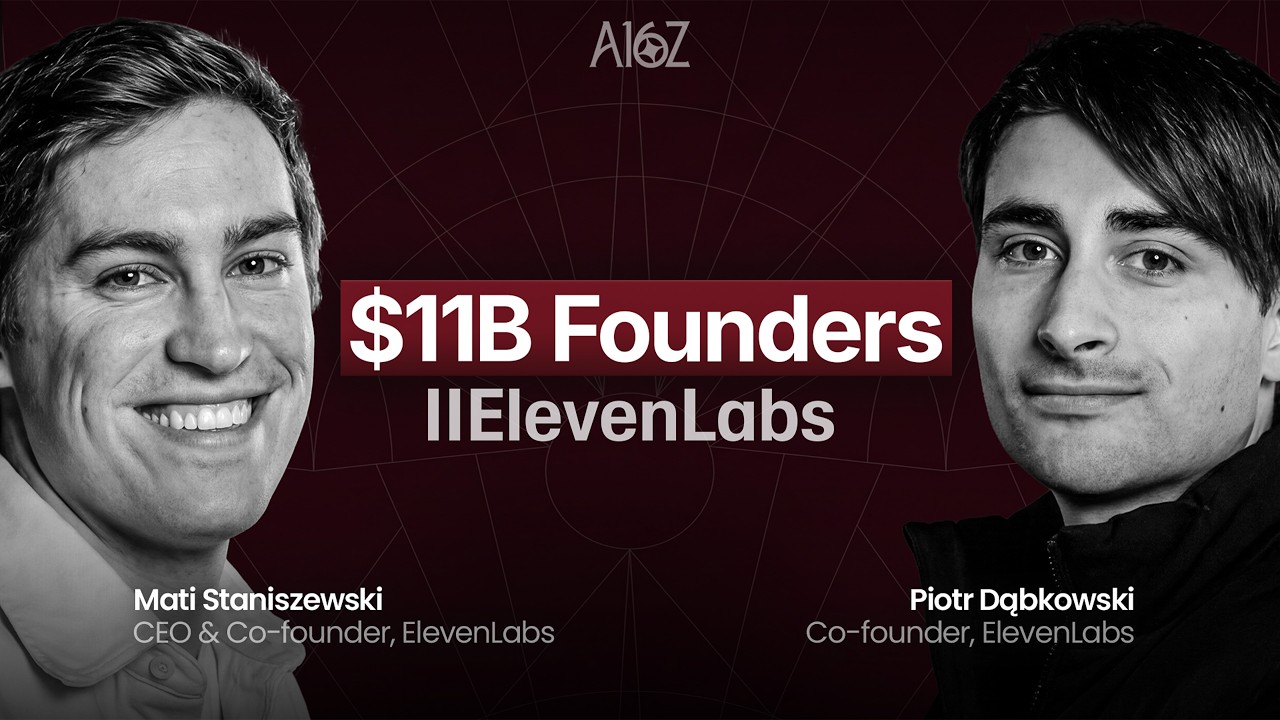
Mati and Piotr, the founders of ElevenLabs, discuss their journey from a weekend project to a major player in voice AI. They cover their unique remote-first culture, their philosophy of combining product and research, and their vision for voice as the next fundamental human-computer interface, aiming to create AI that can pass a 'vocal Turing test'.
The Vision: Voice as the Next Fundamental Interface
The development of synthetic human voices has a long history, from early digital synthesizers to modern assistants like Siri. However, these technologies have consistently failed to cross a critical threshold: “actually sounding like a human and actually making you feel something.” ElevenLabs was founded on the belief that voice is poised to become the next fundamental interface for human-computer interaction, joining the ranks of keyboards and touch screens.
This shift will enable a more present, less screen-focused existence. Imagine a future where learning is facilitated by an AI historian or physicist speaking directly to you, or where language barriers dissolve, allowing for true cultural immersion. The goal is to understand not just what is said, but how it’s said, fostering a deeper connection.
“There will be an interesting shift where voice will be a big part of the technology where today when you go to other countries, other cultures, you you cannot fully immerse inside the culture unless you know the language. And with voice and with technology suddenly this will will become possible.”
The Genesis of ElevenLabs
The idea for ElevenLabs originated from the founders’ experience growing up in Poland, where foreign films are often dubbed by a single, emotionless male voice, stripping the content of its original performance and “all the emotionality, all the intonation.”
Realizing this problem persisted, Mati and Piotr, then working at Palantir and Google respectively, began ElevenLabs as a weekend project. They started with a small group of users, iterating on the product based on feedback to find compelling use cases. The initial launch in January 2023 saw a waitlist of a few thousand users quickly balloon into hundreds of thousands, a scale far exceeding their expectations.
Product and Research Philosophy
ElevenLabs’ strategy is built on a tight, symbiotic relationship between product development and fundamental research. They aim to bridge the gap between companies that excel at one but not the other.
“There are companies who have the research, there are companies who have the product and we try to have the both… product can directly talk to the kind of provide the feedback what is needed to the research, research then immediately is able to to iterate on that.”
This feedback loop accelerates progress. The product team identifies real-world problems and user needs, which directly informs the research agenda. In turn, researchers can immediately test and deploy new models on the product, creating a virtuous cycle of innovation.
Building a High-Performing, Remote-First Team
From a two-person project, the team grew to seven by their Series A and to several dozen a year later, now numbering over 300. Their approach to building the team has been unconventional and central to their success.
Hiring for Excellence, Not Background
The company prioritizes hiring individuals who demonstrate a “proof of excellence,” regardless of their formal background. This could be an open-source project, a high rank in competitive gaming, or a personal text-to-speech project. This has led to a team with diverse experiences, from astrophysics and applied physics to working at the White House.
A Culture of Autonomy and No Titles
ElevenLabs operates with a “remote-first” philosophy to hire the best talent globally, especially since the pool of top-tier voice researchers is small (estimated at 50-100 people worldwide). Key aspects of their culture include:
- High Autonomy: Small, independent teams are trusted to operate without excessive oversight.
- Flat Hierarchy: The company famously removed all job titles. This serves two purposes:
- It filters out ego-driven candidates who are focused on status.
- It removes implicit bias, encouraging anyone to propose ideas or ask for help without being intimidated by a formal hierarchy.
- Focus on Ownership: They hire people who act like “mini-founders,” taking ownership and caring deeply about the product.
“If you have great people, there’s very little effort needed to to run the company because you can just trust these many founders.”
The Future of Audio AI
ElevenLabs has ambitious long-term goals that extend beyond text-to-speech into the realm of general audio models.
Towards a General Audio Model
The future of sound generation is envisioned as a single, unified model capable of generating any kind of audio—speech, sound effects, music. This model could translate voice into music or transform singing into sound effects. A key technical insight is that training on raw audio, rather than human-created text tokens, could unlock new levels of intelligence.
“If you can make a model that is smart in audio, you can imagine you can make a model that is smart in any raw data domain. That I think is one of the most interesting things.”
The Vocal Turing Test
The ultimate challenge is to create an AI that can pass the “vocal Turing test”—an AI that sounds indistinguishable from a human in a back-and-forth conversation, exhibiting intelligence and empathy. This is crucial because voice is a uniquely powerful modality.
“Voice is the only AI modality that can actually make you feel something… whether it’s a deep booming cinematic voice, it can really kind of transport you and make you feel make you feel alive.”