ElevenLabs CEO: Why Voice is the Next AI Interface
Mati Staniszewski, CEO of ElevenLabs, discusses the company's strategy for rapidly shipping research-grade AI. He covers their organizational structure of small, autonomous teams, a global and remote-first hiring philosophy, the transition from a creator-focused product to an enterprise platform, and the lessons learned in navigating complex licensing and scaling a go-to-market team.
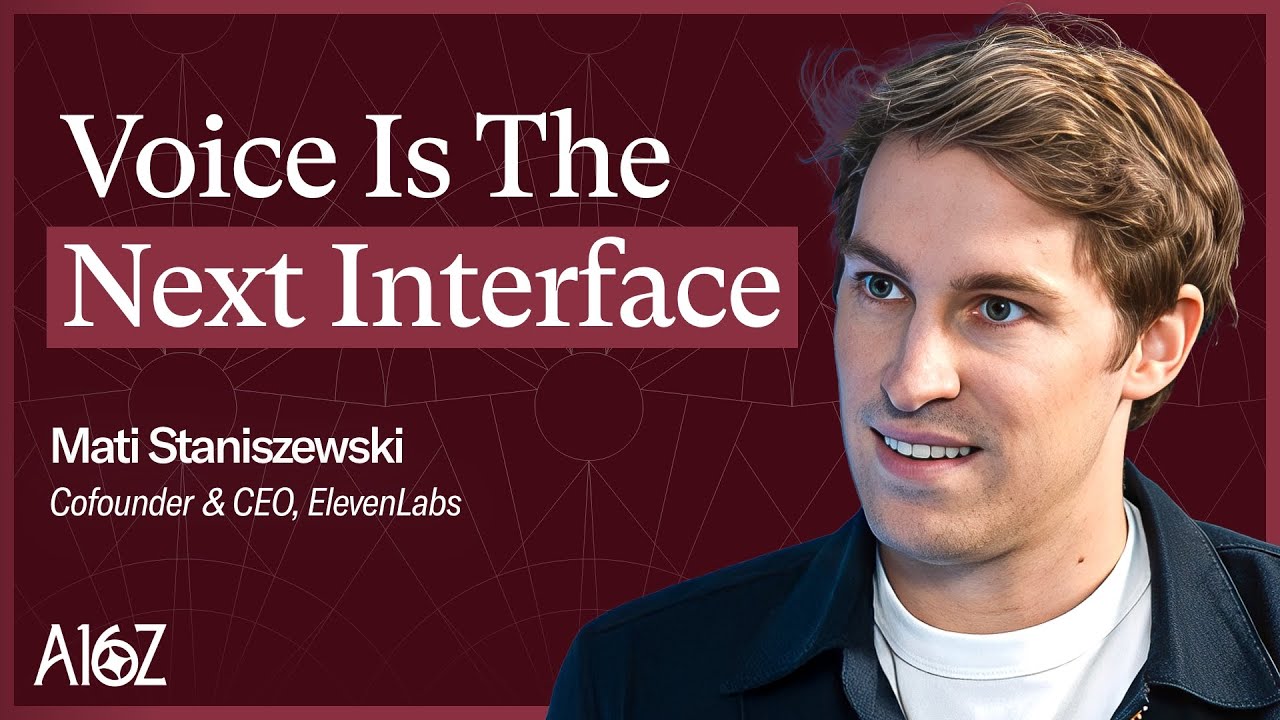
ElevenLabs combines foundational research with rapid product development, a strategy built on a unique organizational structure and a deep understanding of both creative and enterprise markets.
Shipping High-Quality AI at Speed
The core of ElevenLabs’ velocity lies in its structure of approximately 20 small, independent product teams, each comprising five to ten people. This model grants teams high ownership, empowering them to deliver and ship products quickly. While this can sometimes lead to duplicative work, the high degree of autonomy and responsibility is a key driver of their pace.
A primary challenge is balancing long-term research with immediate product needs. The company navigates this by setting a clear guideline: if a research initiative is projected to take more than three months, the product team is free to implement an alternative solution to address user needs in the short term. This prevents product development from being stalled by uncertain research timelines. For instance, after resisting the addition of a simple speed slider for nine months in hopes of a research-level solution, the team eventually implemented the product feature, learning a valuable lesson in pragmatism.
A Global and Unconventional Hiring Approach
ElevenLabs was founded between Warsaw and London, and its European roots were fundamental to its creation. The co-founders’ experience with poorly dubbed foreign films in Poland—where a single, monotone voice narrates all characters—sparked the initial idea. To solve this research-heavy problem, they knew they had to hire the best talent, regardless of location.
This led to a remote-first, global hiring strategy. The company actively seeks out talent from non-traditional backgrounds, citing an example of hiring a brilliant researcher who had developed an impressive open-source text-to-speech model while working in a call center. As the company scaled beyond 30 people, it introduced physical hubs in London, Warsaw, and San Francisco. This hybrid model allows junior employees to immerse themselves in the company culture while offering experienced, remote-first talent the flexibility they’re accustomed to.
Fostering a Flat and High-Ownership Culture
To further empower its teams, ElevenLabs adopted a flat organizational structure and removed titles a year ago. The goal is to ensure that an individual’s impact is not defined by their tenure. Smart, passionate people can quickly elevate themselves and take on significant roles within any team. This structure is managed by a layer of leads for each major subdivision (e.g., research, creative, agents, go-to-market), who are responsible for managing complexity and fostering cross-team collaboration.
Interestingly, the company learned that full transparency can be counterproductive. Giving employees access to all Slack channels often led to distraction. To enforce focus, they began strategically limiting access, ensuring teams could concentrate on their core mission.
From Creator-First to Enterprise Adoption
While ElevenLabs started with a creator-focused, product-led growth (PLG) motion, it saw significant inbound interest from enterprises early on. The initial attempt to have engineers handle sales proved ineffective, leading the company to build a dedicated, albeit still technical (80% sales, 20% engineering), go-to-market team.
Working closely with early enterprise customers like Hippocratic AI revealed the need for a full orchestration layer combining speech-to-text, LLMs, and text-to-speech for creating robust voice agents. This pushed ElevenLabs to expand beyond its core text-to-speech offering to provide the entire infrastructure for building, deploying, testing, and monitoring production-grade voice agents. A key cultural challenge during this transition was bridging the gap between the fast-paced PLG mindset and the long, 6-to-12-month sales cycles of enterprise deals. The leadership team had to shield the product teams from the uncertainty of these long cycles until the strategy proved successful.
Navigating the Creative and Licensing Landscape
From day one, ElevenLabs focused on working with the creative industry rather than disrupting it. To empower voice actors, they launched the Voice Marketplace, a platform where creators can share their voices and earn revenue. The marketplace now features nearly 10,000 voices, and the company has paid out over $10 million to its creator community.
Engaging with the music industry to license music for their AI generation model was a more complex challenge. It took an 18-month negotiation process with major labels to reach an agreement. Key to this success was:
- Establishing Forcing Functions: Setting deadlines to create urgency and drive decisions.
- Educating Partners: Spending significant time with label members to demonstrate the technology and explain the long-term vision, helping to overcome the initial “AI is bad” reaction.
- Leveraging Expertise: Working with specialized music lawyers who understood the industry players and could bridge the communication gap.
Lessons in Scaling
As a CEO navigating the different phases of a company—product, sales, and scaling—the biggest realization has been the power of incentive structures. In the early days, passion drove the company. As the go-to-market team grew, it became clear that commission structures directly drive behavior, sometimes in ways that diverge from the overarching strategy.
The key lesson is to ensure that incentives (a lagging indicator) are tightly aligned with strategy (a leading indicator). The company now explicitly tells its sales team that if a deal feels wrong—even if it’s incentivized by the commission plan—they should raise it. In one recent case, a foundational model competitor wanted to license ElevenLabs’ models. Despite the potential commission, the team brought the issue to leadership, and the deal was killed. The salesperson was still granted the commission, reinforcing the principle of prioritizing long-term strategy over short-term gains.