Ai models

Why Top Founders Are Racing Into AI Infrastructure

Why Top Founders Are Racing Into AI Infrastructure

a16z's new Machine Age Fund addresses the unprecedented demand for AI infrastructure, shifting the bottleneck from models to the foundational hardware. The discussion highlights surging Hyperscaler CapEx, component supply crunch extending to 2028, and the exponential compute needs driven by reasoning and agents. It explores how AI turns engineering problems into capital/compute challenges, identifying opportunities for new infrastructure companies in chips, power, and data center redesign, and the emergence of experienced "systems founders" to rebuild the computing stack for this new era.

The State of AI: Models, Moats, and the Consumer Renaissance

The State of AI: Models, Moats, and the Consumer Renaissance

Anish Acharya and Jen Kha delve into the evolving AI landscape, dissecting the model layer with its emerging multiple winners and the strategic choice between frontier and open-weight models. They explore how the application layer captures value through model aggregation and specialization, ultimately ushering in a renaissance for consumer AI with personal agents, coding tools, and new economic models, urging founders to think big.

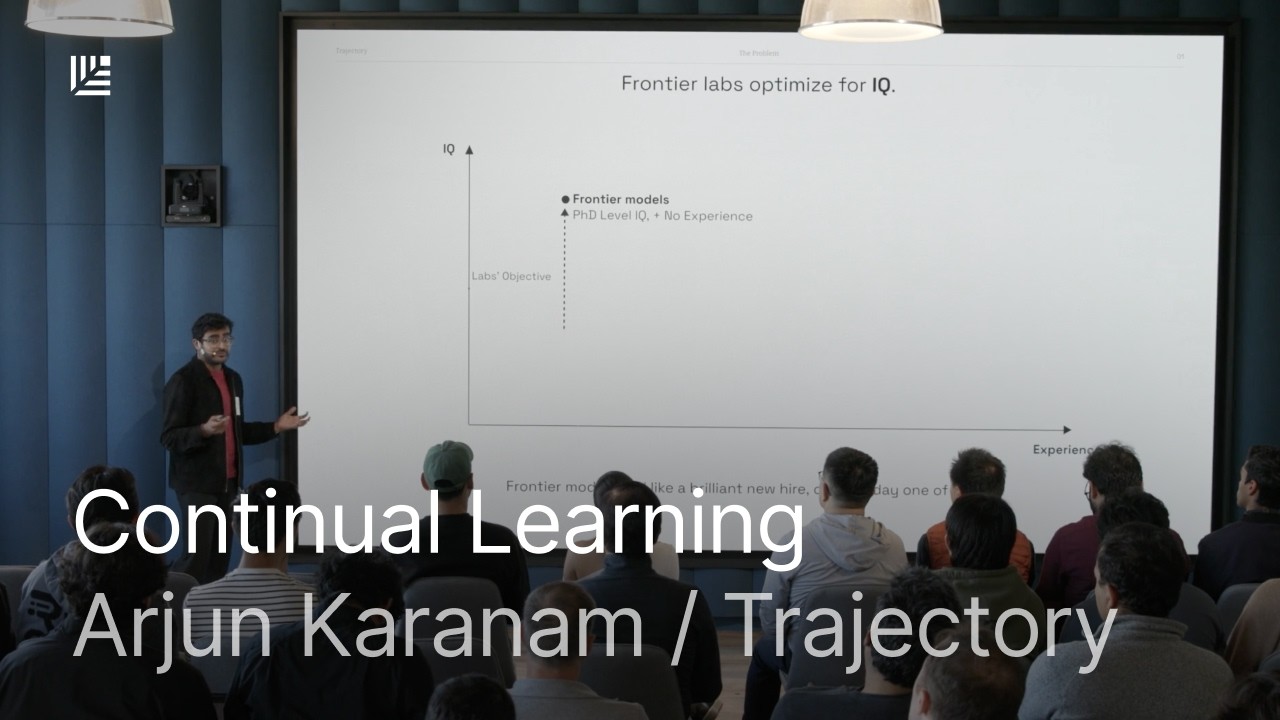
Continual Learning: How AI Agents Get Better With Every Use | Arjun Karanam, Trajectory

Continual Learning: How AI Agents Get Better With Every Use | Arjun Karanam, Trajectory

Arjun Karanam from Trajectory discusses the "experience gap" in AI, where models excel in intelligence but lack real-world experience, advocating for continual learning. He outlines four key areas for the agent ecosystem: robust traceability including corrective actions, evaluations drawn from production traffic, harnesses that orchestrate rather than constrain, and comfort with open-weight models. Trajectory aims to provide a platform for companies to own and continuously improve their AI intelligence.

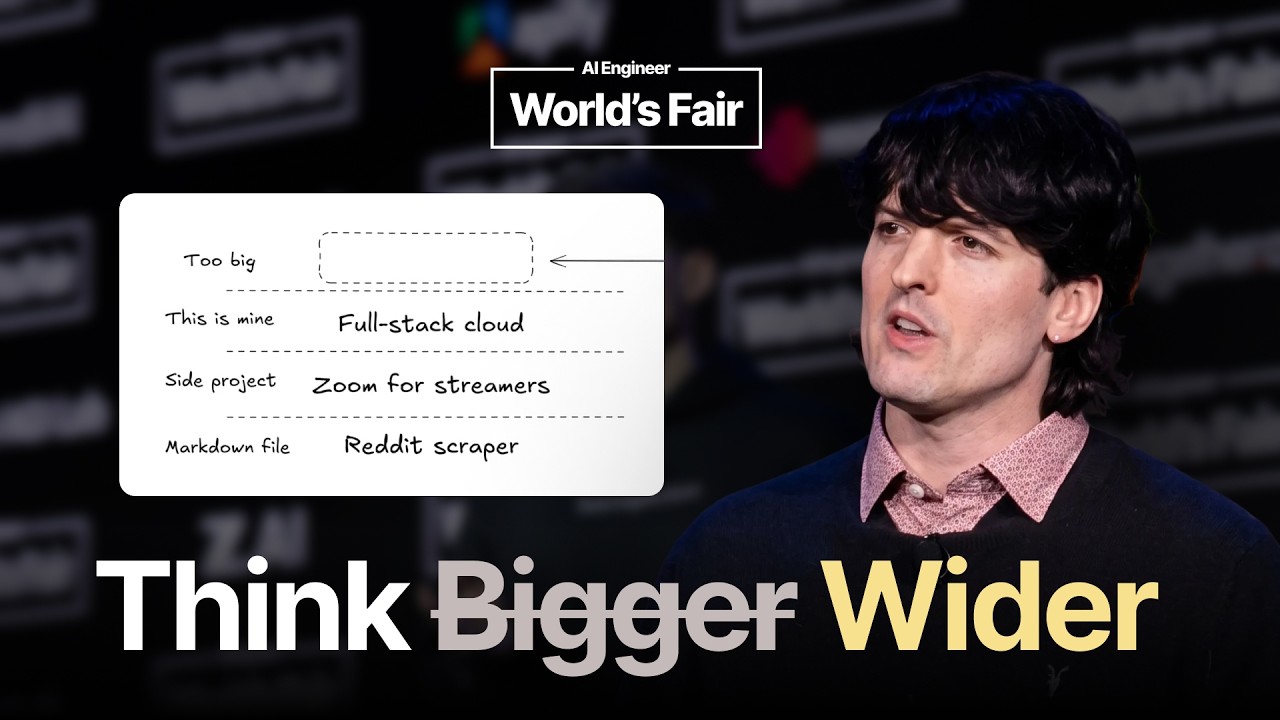
What do we build now? — Theo Browne, @t3dotgg

What do we build now? — Theo Browne, @t3dotgg

Theo Browne's keynote from AIEWF2026 urges software engineers to fundamentally change product development in response to rapidly evolving AI models (Sonnet 3.5 to Mythos). He advocates for rejecting legacy mental models and tools (skeuomorphism), embracing a new "Markdown tier" for projects, and thinking "wider" instead of just "deeper" by building extensible platforms that can challenge industry giants. The core message is to be more ambitious, as AI has drastically lowered the barrier to entry for complex, broad-reaching solutions.

Fable 5, GPT-5.6 and the high stakes of AI safeguards. Agentic ransomware, ClickFix reigns supreme

Fable 5, GPT-5.6 and the high stakes of AI safeguards. Agentic ransomware, ClickFix reigns supreme

This podcast explores the critical role of safeguards in frontier AI models like Anthropic's Fable 5 and OpenAI's GPT-5.6 Sol, analyzing the tension between powerful capabilities and misuse prevention. It also dissects the emergence and debate around agentic ransomware, specifically Jade Puffer, and covers the rise of ClickFix as a dominant social engineering attack targeting developers. Finally, it provides an in-depth analysis of UnregStealer, a credential-theft campaign impacting Latin American financial institutions, detailing its attack chain and mitigation strategies.

The State of Frontier Post-Training Recipes | Conversation with Finbarr Timbers

The State of Frontier Post-Training Recipes | Conversation with Finbarr Timbers

This discussion with Finbarr Timbers reviews the evolution of frontier post-training recipes, highlighting the shift from simpler SFT-DPO-RL to complex multi-teacher on-policy distillation (MOPD). It covers the organizational challenges of building models like Olmo, the rise of synthetic data and reasoning-focused RL in DeepSeek, and the complexities of integrating expert teachers, while also exploring open questions on environments, specialized APIs, and career strategies in the rapidly changing AI landscape.