The Dirty Secret of Forward Deployed Engineering — Natalie Meurer, Sierra
Natalie Meurer discusses the "dirty secret" of Forward Deployed Engineering (FDE), arguing that its definition has broadened so much it has lost specific meaning, yet remains critical in the age of AI. She traces its evolution at Palantir from pure DevOps to data integration, custom solutions, and enablement, highlighting customer accountability as its enduring core. Meurer contends that as AI makes code cheap, the focus shifts to integrating data, understanding customers, and achieving outcomes—making agent engineering a direct descendant of FDE under a new name, especially evident in the move towards outcome-based pricing models.
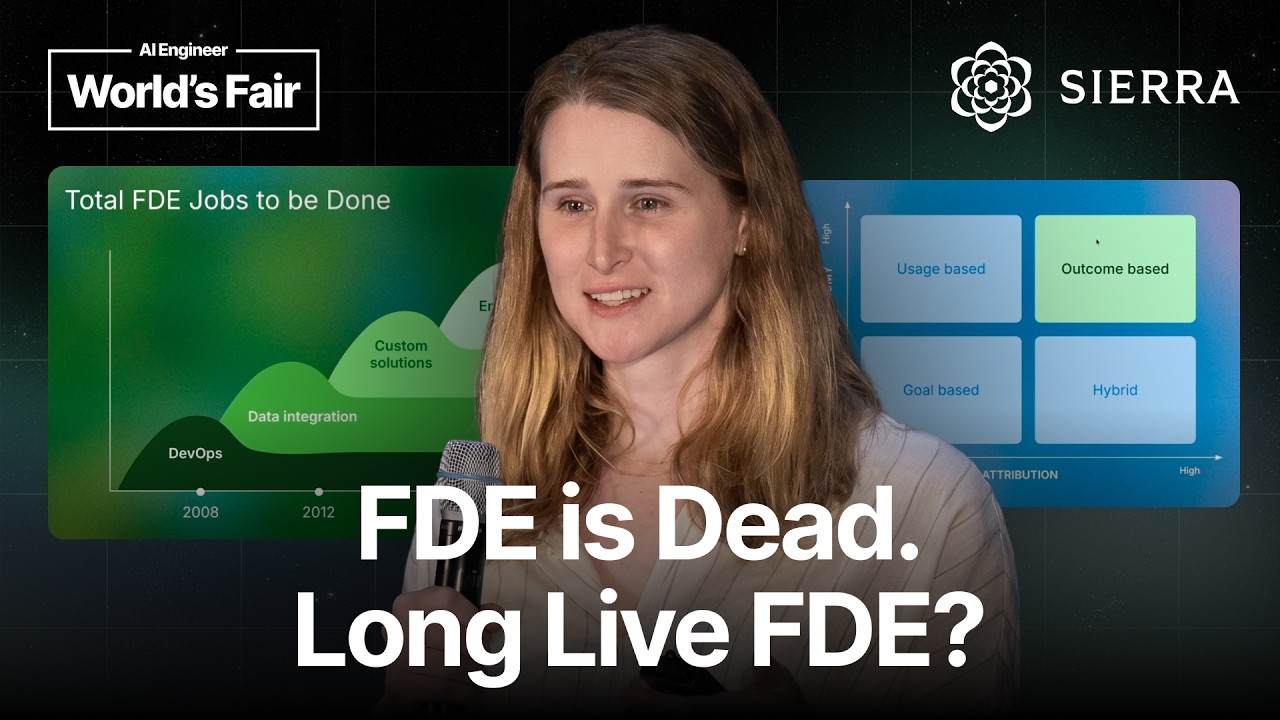
Natalie Meurer dissects the “dirty secret” of Forward Deployed Engineering (FDE), positing that while the term has become so broad it seemingly means everything and nothing, its core principles are more vital than ever, especially in the context of agent engineering and the increasing accessibility of AI-driven code generation.
The Evolving Landscape of Forward Deployed Engineering at Palantir
Meurer traces the origins and evolution of FDE, particularly through her experience at Palantir, where the role’s responsibilities continually expanded:
- Early Days (2008-2012): The “Location” and DevOps Focus. Initially, “forward deployed” was a literal description, meaning physical presence at the customer’s site. The primary job was akin to DevOps: ensuring platform stability and deployment on-premise. Meurer’s own onboarding project involved deploying software on an EC2 instance, highlighting the early focus on keeping systems operational.
- Data Integration and Ontology Work (2012-2016): As platforms stabilized, the challenge shifted to integrating customer data into Palantir’s systems. FDEs became crucial for understanding customer environments, integrating disparate data sources (often written in Java), and building “ontologies”—Palantir’s term for a data taxonomy to model and make sense of customer data.
- Custom Solutions and Dashboarding (2016-2020): With integrated data, the next step was making it useful. FDEs leveraged tools like Palantir Slate (a drag-and-drop builder akin to Retool) to create custom solutions and dashboards. This required deep customer understanding to translate data into actionable insights and tools. This era eventually transitioned to Foundry, Palantir’s main platform, aiming to move “from data to decision-making.”
- Customer Enablement and Platform Building (2020-Present): Leading up to Palantir’s IPO, the company sought to scale by empowering customers to perform more FDE-like work themselves, reducing the need for constant on-site deployments. FDEs became responsible for customer enablement, training thousands of engineers on platforms like Foundry (e.g., Airbus’s Skywise initiative). Today, Palantir’s AIFTE platform leverages Large Language Models (LLMs) to further automate and scale aspects of this work.
Meurer emphasizes that these phases weren’t discrete; the total FDE responsibilities “increased over time,” making the role a “best training ground for generalists.” She introduces the concept of “FDE vintage,” suggesting that different companies or roles might align with a specific historical era of FDE responsibilities.
The “Dirty Secret”: FDE as Everything and Nothing
The central “dirty secret” is that “forward deployed engineering doesn’t exist” as a singular, well-defined role. It encompasses so many tasks—from DevOps to data integration, solution architecture, and customer enablement—that the label has lost specific meaning. Yet, paradoxically, it’s identified as “the hottest job in AI,” highlighting a fundamental challenge in hiring for roles that demand an impossibly broad skillset (e.g., “staff eng for eight years with six years of direct sales experience and four years as a solution architect”).
The Enduring Through-Line: Customer Accountability and Outcome Focus
Across all its historical iterations and diverse responsibilities, the one constant for FDE has been “accountability to the customer.” Whether for platform stability, data integration, solution building, or enablement, the FDE is ultimately responsible for delivering value to the client.
Meurer argues that this customer accountability becomes even more critical “when code becomes cheap.” As AI and coding agents make software development increasingly efficient and accessible, the durable, high-value aspect of the job shifts away from mere code writing. Instead, it focuses on:
- Integrating data: Connecting disparate systems and making data actionable.
- Understanding the customer: Deeply grasping their needs and challenges.
- Being accountable to an outcome: Ensuring the deployed solution actually solves the customer’s problem and delivers measurable value.
This shift means FDEs are now positioned to be “way more impactful in product development,” capable of building “end-to-end solutions with coding agents.” Furthermore, the lines are blurring, with product engineering becoming more client-facing, and FDEs stacking more skills, merging with traditional engineering roles.
Pricing Models: The Ultimate Test of Outcome
The shift in value is also reflected in pricing models:
- Seat-based pricing: Assumes a tool is being sold, making outcome attribution difficult.
- Usage-based pricing: (e.g., for foundation models) charges based on consumption, but still doesn’t directly link to business outcomes.
- Outcome-based pricing: Meurer champions this model, where a software platform is paid for the “value that that software delivers.” This directly ties to the FDE’s core responsibility: guaranteeing the outcome.
Agent Engineering: FDE Reborn
Meurer concludes that what the industry now calls “agent engineering” is essentially FDE under a new name. Initially, she viewed agent engineering as a “subdiscipline of AI engineering” with a strong focus on customer accountability and outcomes. However, her perspective has evolved: “everything is trending that way.”
Agent engineering, like product, AI, solutions, and customer engineering, embodies the core FDE functions of enablement, DevOps, solution building, and data integration—all performed “on behalf of customers.” The ability to build, deploy, and ensure AI agents deliver specific outcomes necessitates the same customer-centric, outcome-driven approach that has always characterized FDE.
In essence, while “forward deployed engineering as a concept… lacks a coherent definition,” it is the fundamental approach that “allows us to enable those outcomes.” Meurer summarizes this transformation with a powerful statement: “Forward deployed engineering is dead. And long live forward deployed engineering.”