Why AI Compute Comes in Rectangles — Erik Bernhardsson, Modal
Erik Bernhardsson, CEO of Modal, traces his path from building Spotify's recommendation system to founding a serverless GPU cloud, and explains how Modal aggregates demand, secures GPU capacity, weighs renting against owning, and sees agent sandboxes becoming a major product line.
AI Agents Cut 3-Day Portfolio Builds to Minutes — Jack McDonald, Apollo & Michael Manapat, Rowspace
Jack McDonald of Apollo's Redding Ridge and Michael Manapat of Rowspace discuss where AI becomes mission-critical in structured credit and CLO management. They cover compressing portfolio construction from days to minutes, automating the weekly trade reconciliation, and why embedding engineers with front-office teams, rather than relying on generic LLMs, is what earns trust in financial data.
High-Performance Engineering: Forward Deployed at Aston Martin F1
A session on CoreWeave's forward deployed engineering partnership with the Aston Martin Aramco F1 Team, covering why Formula 1 is an unforgiving environment for AI, and three projects: a unified data platform for aerodynamic and telemetry data, Delta to Map, a small transformer model that reduces the gap between wind tunnel predictions and track measurements, and Radio Insights, a fine-tuned speech-to-text and agentic system that makes sense of 40 live radio channels. The discussion extracts lessons applicable to any team moving AI from experiment to production under fixed deadlines.
Why Building an AI Agent Is Easier Than Deploying One
Vladimir Keil, co-founder and CEO of Lio, joins Seema Amble and Elena Burger to explain why AI-native startups can beat incumbent software vendors even when those vendors own the customer, the data, and the system of record. The discussion covers the work that happens outside systems of record in enterprise procurement, Lio's multi-agent architecture spanning retrieval through principal agents, how buyers learn to trust agents with consequential negotiations, and what happens when suppliers and buyers both run agents.
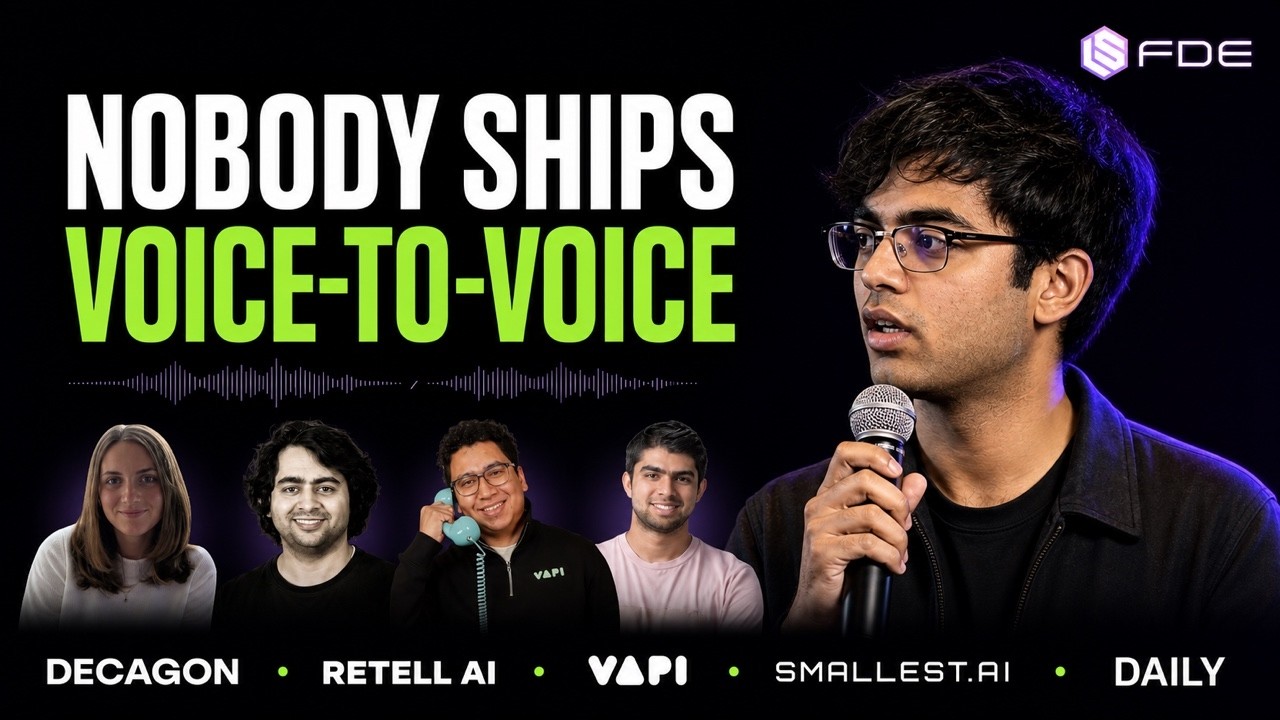
⏭️ Forward Deployed: Voice AI on what works in 2026
This podcast episode delves into the pragmatic realities of building and deploying voice agents in enterprise. Featuring leaders from Decagon, Vapi, Retell, Daily, and Smallest AI, the discussion uncovers why the current state-of-the-art relies on cascaded pipelines (STT -> LLM -> TTS) instead of direct voice-to-voice models. Key challenges explored include managing latency versus intelligence, ensuring system reliability through fallback models, the complexities of turn-taking, and architectural strategies to overcome LLM context limitations and optimize costs. The experts also touch upon the differences between inbound and outbound use cases, multilingual considerations, and the potential future of hybrid voice agent architectures.
Decagon’s Playbook for Building Enterprise AI Applications
Jesse Zhang and Ashwin Sreenivas, co-founders of Decagon, discuss their company's transition to open-source models for enterprise AI, emphasizing how fine-tuned small models outperform frontier models on specific tasks. They delve into the role of application-layer companies in an AI-first world, their product-driven 'glass box' approach for enterprises, and the transformative power of their 'Duet Autopilot' agent, which builds other AI agents. The conversation also covers AI's impact on jobs, highlighting the Jevons Paradox in customer support.