Agentic Data Management and the Future of Enterprise AI — with Rohit Choudhary
Rohit Choudhary, CEO of Acceldata, discusses the imminent 10x annual growth of enterprise data and how most organizations are unprepared. He introduces Acceldata's agentic data management platform, designed to make data self-aware, self-optimizing, and AI-ready. He emphasizes the 1000x cost difference of fixing data early versus late, the need for operational, real-time data governance, and why clear thinking and deep domain expertise, not just programming skills, will be most valuable in the age of AI.
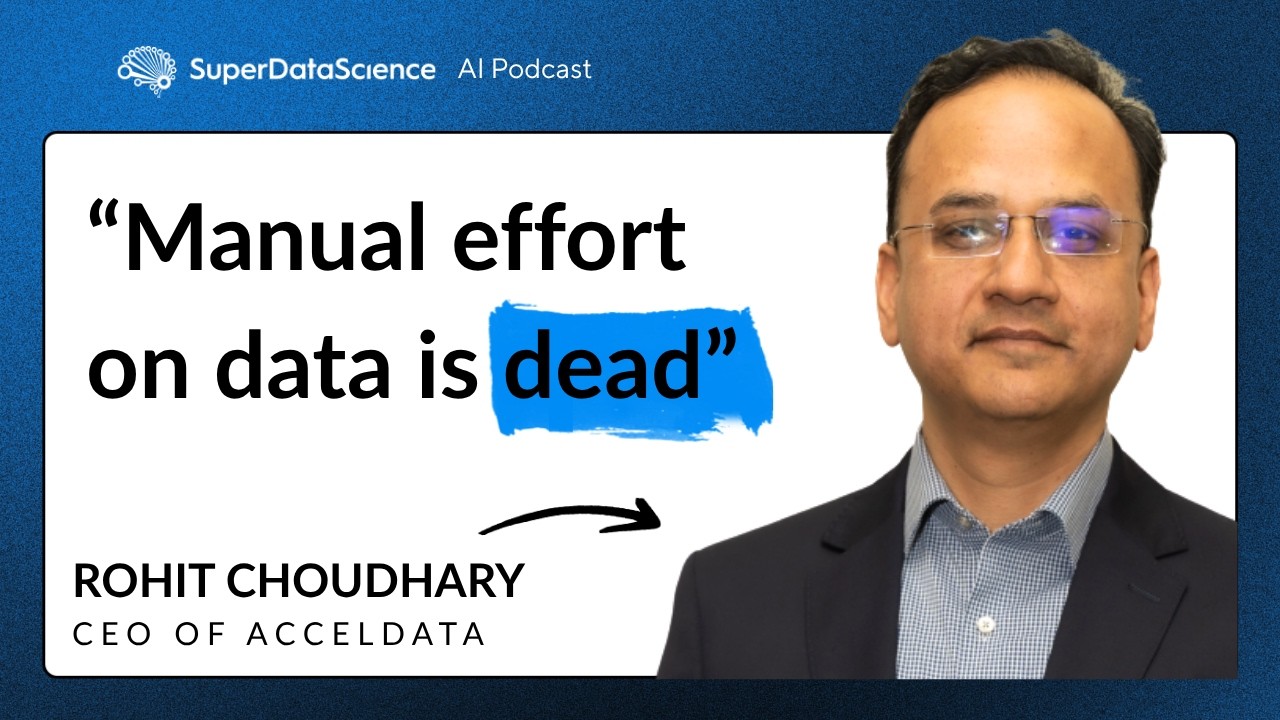
The discussion with Rohit Choudhary, founder and CEO of Acceldata, begins by challenging the common statistic that the world’s data doubles annually. Rohit posits that enterprise data is set to grow at an unprecedented rate, soon reaching close to 10x per year, a surge for which most organizations are gravely unprepared. Acceldata aims to address this by making increasingly vast amounts of enterprise data self-aware, self-optimizing, and AI-ready through its agentic data management (ADM) platform.
The Genesis of Data Observability and Agentic Data Management
Rohit recounts pioneering the term “data observability” in 2018, stemming from his background as both an application and data engineer. He observed a significant lag in operational support, production visibility, and real-time insights for data pipelines compared to the advanced state of application observability. This gap presented a clear opportunity to build a substantial company. The initial focus on data observability—covering infrastructure, pipelines, quality, and monitoring—has since evolved into the comprehensive vision of an agentic data management platform. The “ChatGPT moment” served as a catalyst, demonstrating the power of deep research on data by synthesizing signals across infrastructure, user, and application layers, which Acceldata’s platform now enables.
The Criticality of Early Data Quality and AI Readiness
A core tenet of Acceldata’s philosophy is that fixing data at the point of consumption is “1000x more expensive” than addressing issues as data enters the system or moves through the pipeline. Rohit likens this to the cost difference between braking to avoid a crash and dealing with its aftermath. Bad data leads to regulatory issues, poor decision-making, and stifles innovation, consuming 70-75% of data engineering effort on “solving old problems” rather than modernization.
For data to be “AI-ready,” it must meet several criteria:
- Technical Accuracy: Data types must conform (e.g., numbers are numbers, strings are strings).
- Business Context Compliance: Facts in structured and semi-structured databases must align with the broader business context, policies, and regulatory requirements, which are often found in unstructured data.
Acceldata’s ADM platform is designed to identify critical datasets, recommend and apply data quality rules, execute them on the data plane, and suggest remediation steps. This automation is crucial for converting vast backlogs of data, previously unsuitable for machine learning, into AI-ready assets by intelligently structuring unstructured enterprise data and marrying business context with factual data.
Rethinking Human Judgment, Governance, and AI Adoption in the Enterprise
The advent of AI heralds a shift from purely human-centric systems to a collaborative environment where humans and agents work in tandem. Agents are expected to automate mundane tasks, freeing humans to focus on high-quality decision-making. This requires a new approach to data governance, moving beyond one-time compliance exercises to “operational first” and real-time active governance. Traditional governance stacks with disconnected metadata are obsolete; data observability provides the unified metadata foundation necessary for real-time, model-centric governance. Similarly, application monitoring paradigms are ill-suited for the scale and complexity of modern data platforms.
Rohit emphasizes that in the age of AI, the most valuable professionals will possess “clearest thinking,” “deepest domain expertise,” and “curiosity” rather than merely being the best programmers. These individuals will excel at articulating precise outcomes and leveraging AI systems. He also addresses the challenges of enterprise AI adoption, noting that while AI excites in consumer and prosumer spaces, it faces hurdles in enterprises due to data availability, defining critical use cases, and organizational buy-in. He predicts a surge in enterprise AI adoption within the next 12-18 months, mirroring the maturation curve of cloud adoption.
The Inevitable Divide: Data and AI Haves vs. Have-Nots
Rohit highlights a growing distinction in the market: “AI haves” and “AI have-nots.” Companies with robust AI capabilities and a willingness to drive AI-first revenue are gaining significant advantage. The explosion of data, driven not only by human users but increasingly by millions of AI agents generating queries and activity, will exacerbate this divide. The ease of building and deploying applications further contributes to this data deluge, stressing existing infrastructure and necessitating a unified control plane for managing data at massive scale.
The Acceldata Journey: Building a Category-Defining Company
Rohit describes the entrepreneurial journey as an “Ironman triathlon followed by an ultra-marathon,” emphasizing that it takes 6-7 years for a product to achieve mainstream status, requiring continuous education of analysts, buyers, and users. Acceldata’s success is rooted in a “product-first, customer-anchored philosophy,” born from Rohit’s deep appreciation for the problems faced by enterprise operators and engineers. The company aligns its vision with customer needs, abstracting these for broader industry application, and focusing on building superior products and fostering strong customer relationships.
Cultivating a Product-Driven Culture and Team
Central to Acceldata’s growth is its approach to team building. Rohit notes that products with global appeal attract talent naturally, as individuals are drawn to a compelling mission. He stresses the importance of mission-driven people who value crafting high-quality work and possess the clarity and curiosity essential for innovation. Acceldata fosters a culture of “builders at heart,” committed to genuine, respectful, and humble interactions, both internally and externally.
Recommended Readings for Growth and Perspective
Rohit offers three book recommendations:
- “Zero to One” by Peter Thiel: Valued for its insights into startups and life stages.
- “The Beginning of Infinity” by David Deutsch: Explores the concept of abundance and the continuous, relentless, rational pursuit of knowledge and progress. Rohit links this to adopting a “beginner’s mindset,” especially pertinent in the rapidly evolving AI landscape.
- “The Gospel of Ramakrishna”: A spiritual text recommended for finding satisfaction and contentment in life.