Data governance

Deploying AI Inside a Bank Is Not an Engineering Problem — Paden Gayle, Applied AI Engineers

Deploying AI Inside a Bank Is Not an Engineering Problem — Paden Gayle, Applied AI Engineers

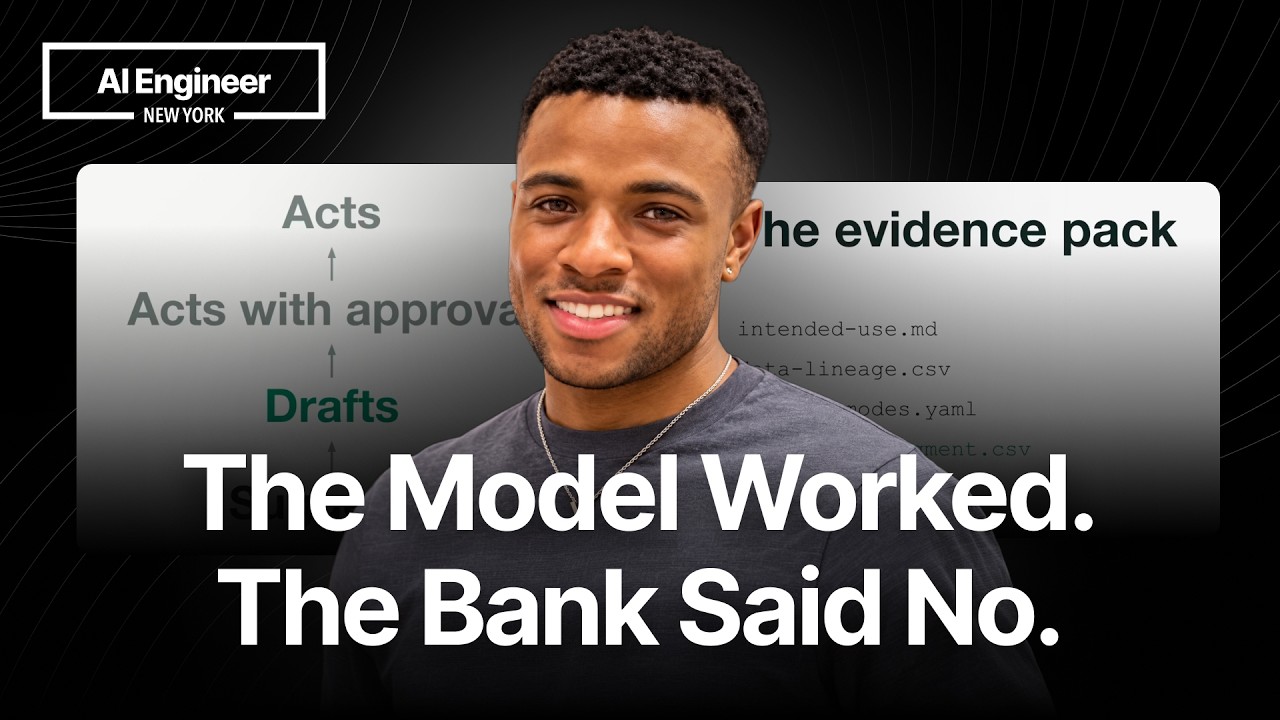
A bank's AI demo works but cannot ship due to non-engineering problems like security, data ownership, and risk approval. Paden Gayle outlines a method focusing on early stakeholder discovery, iterative workflow scoping, gradual autonomy, and a comprehensive evidence pack to build AI systems with a credible path to production, emphasizing that "discovery is the engineering."


In Case You Missed It in August 2026 (Ep. 1024 with Jon Krohn)

In Case You Missed It in August 2026 (Ep. 1024 with Jon Krohn)

This episode explores the critical gap between AI investment and return, featuring insights from industry leaders. It covers why most organizations fail to see ROI from AI, the crucial role of mathematical optimization in agentic AI to ensure constraint adherence, practical strategies for structuring AI skills in tools like Claude for quality output, and a 10-20-70 budget framework emphasizing upskilling. Additionally, it delves into the growing importance of the semantic layer for analytics agents to ensure consistent data interpretation and efficiency in large enterprises.

Rethinking Legacy Data Infrastructure with Eon Co-Founders Ofir Ehrlich and Gonen Stein

Rethinking Legacy Data Infrastructure with Eon Co-Founders Ofir Ehrlich and Gonen Stein

Eon co-founders Ofir Ehrlich and Gonen Stein discuss the critical role of data as a protective moat in the AI era, exemplified by Google's purchase of Spirit Airlines' data. They explain how Eon addresses the challenges of scattered enterprise data by providing tools for mapping, classification, and secure access, enabling its use in AI workflows. The conversation also delves into the emerging threat of autonomous AI agents with legitimate system permissions, the fundamental shifts required in enterprise data infrastructure, and how the rapid, fear-driven adoption of AI contrasts sharply with the slower cloud migration era.

AI & Data Science Periodic Tables: How They Work Together

AI & Data Science Periodic Tables: How They Work Together

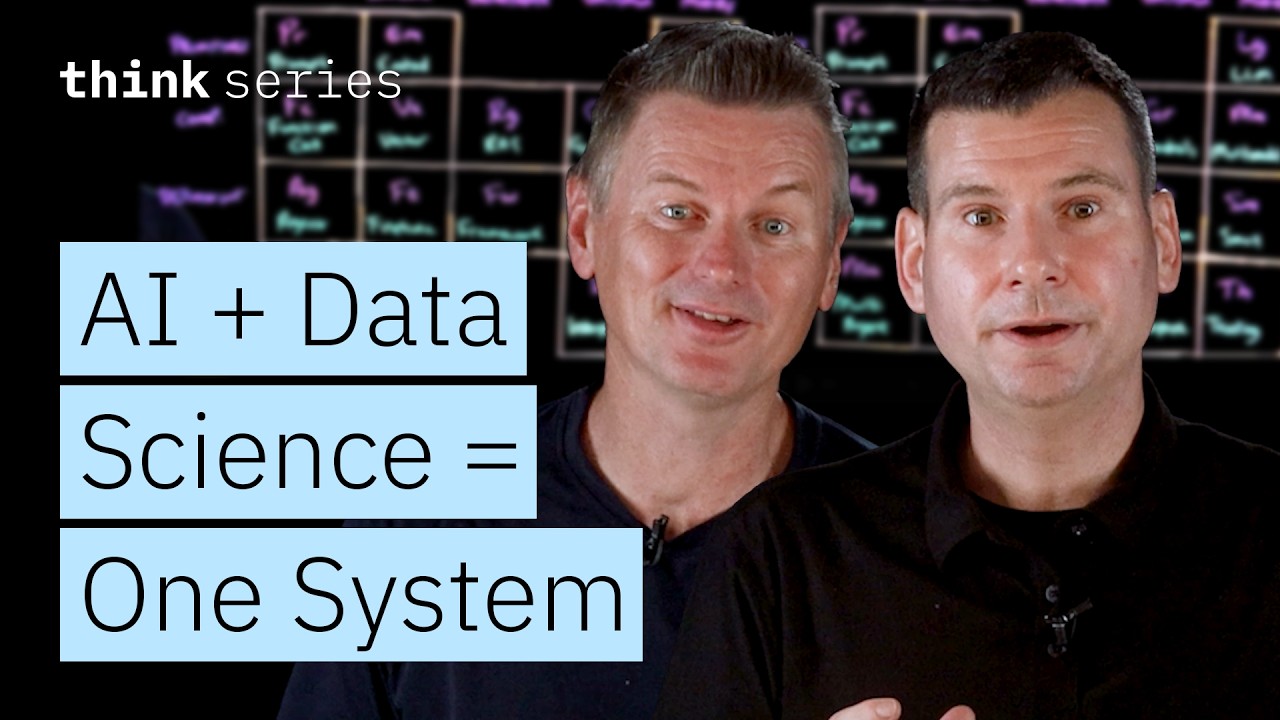
Aaron Baughman and Martin Keen present a unified framework using "periodic tables" to integrate AI and Data Science. They illustrate how elements like pipelines, embeddings, and RAG combine to build real-world AI applications, using a detailed document Q&A system example. The discussion emphasizes the critical interdependence of data science in grounding AI models and ensuring continuous improvement through an innovative feedback loop.

Enterprise Agents Have a Structure Problem - Ishita Daga, Tesla

Enterprise Agents Have a Structure Problem - Ishita Daga, Tesla

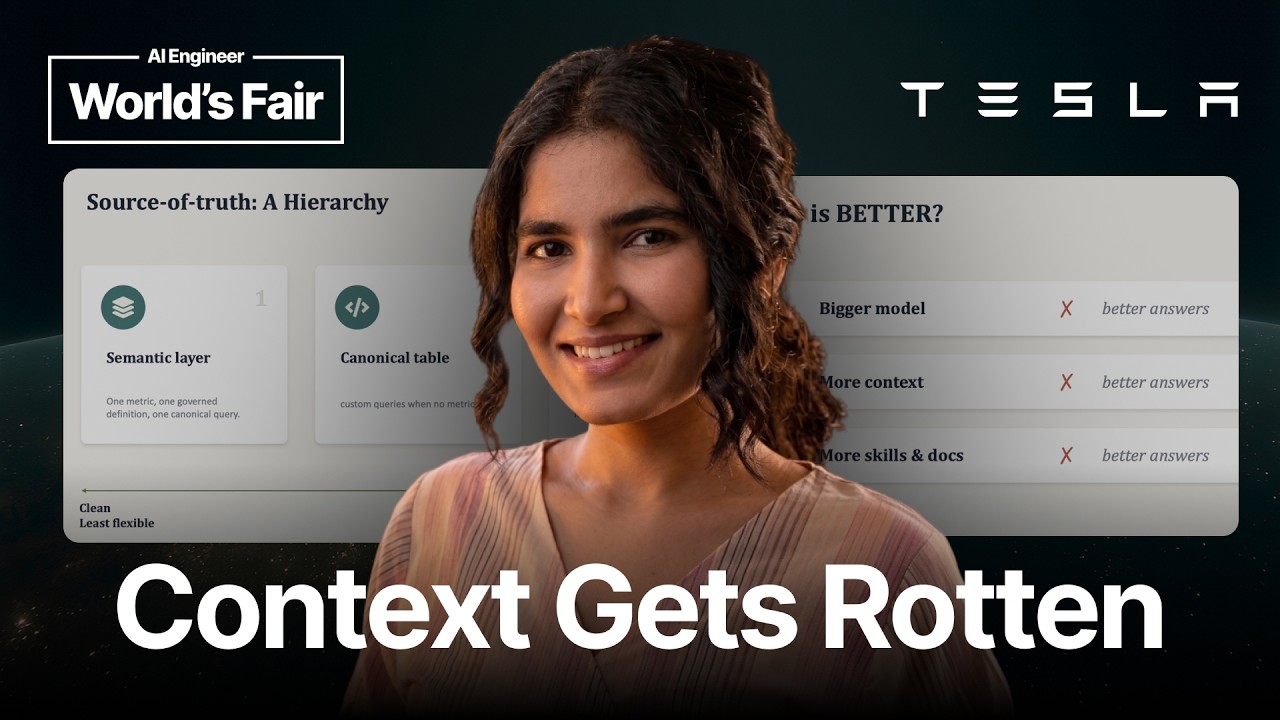
Ishita Daga, a Senior ML Engineer at Tesla, explains why enterprise AI agents fail, highlighting that current fixes like larger models or more RAG are insufficient. She identifies ambiguity, staleness, and user preference as key structural problems. Daga proposes a solution built on semantic retrieval infrastructure: a hierarchical approach to knowledge sources, including a curated semantic layer and metadata graphs. She also details a robust context life cycle with live data sources and continuous feedback loops to combat staleness. The challenge of integrating individual preferences, requiring agents to reason over business concepts rather than raw schemas, is also discussed.

WTF Is the Context Layer? The Missing Infrastructure for Production Agents — Prukalpa Sankar

WTF Is the Context Layer? The Missing Infrastructure for Production Agents — Prukalpa Sankar

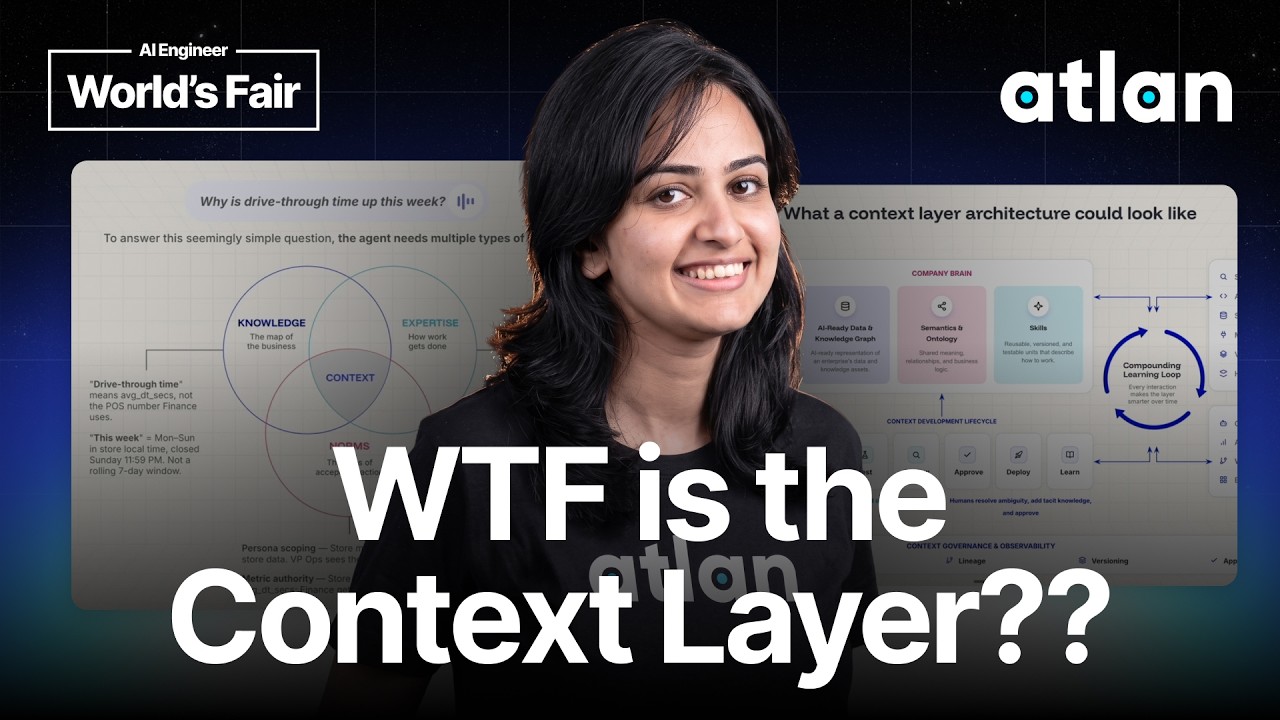
Prukalpa Sankar argues that while AI models are increasingly intelligent, their practical business utility is limited by a lack of contextual intelligence. She proposes a "context layer" as a crucial solution, akin to a "GitHub for context," to centralize and manage business knowledge, expertise, and norms. This system aims to provide AI agents with the shared, versioned, and continuously learning context necessary to overcome the challenges of isolated systems and context sprawl, ultimately differentiating companies in an AI-driven world.