The AI Space Podcast-Live!: 2026 AI Market Outlook & Playbook | Panel Discussion + Q&A | Dallas, TX
In this live podcast episode, a panel of AI founders and investors unpacks the '2026 AI Market Outlook & Playbook.' They share practical strategies for startups to achieve real-world traction, focusing on the shift from experimental AI to outcome-driven agentic systems. Key topics include building multimodal experiences, the importance of a proprietary 'validation layer,' mastering customer pain points for growth, and the ethical responsibility of building the next generation of AI.
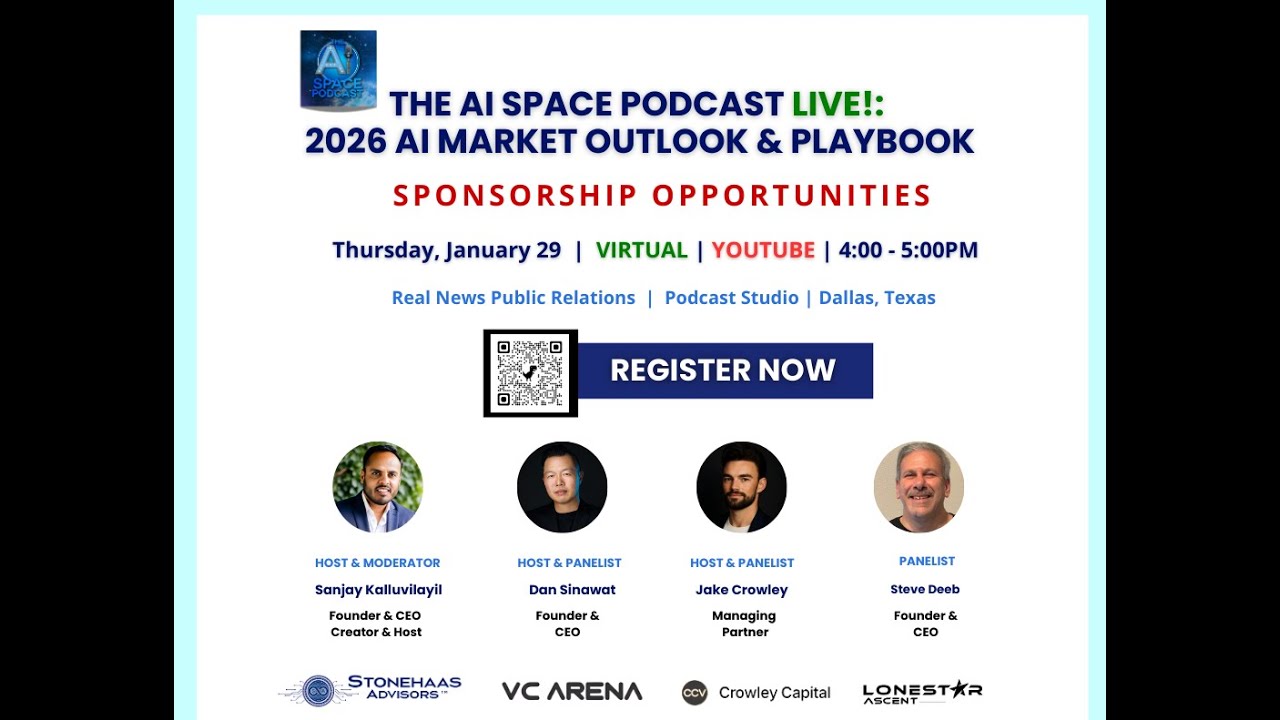
This panel discussion from The AI Space Podcast’s live event in Dallas dives into a tactical playbook for AI founders, builders, and investors, focusing on the market outlook for 2026. The conversation moves beyond theoretical hype to deliver practical strategies for achieving growth, virality, and tangible returns.
Key AI Trends for 2026
The central theme for 2026 is a decisive shift from experimentation to execution. The panelists agree that the focus is now squarely on delivering measurable outcomes.
- Dan Sinawat emphasizes the transition from traditional SaaS (Software as a Service) to what he calls “Service as a Software,” an outcome-based model where agentic AI performs operational tasks, complementing human workers who act as coaches or validators. The goal is to do more with less.
- Jake Crowley highlights the need for “precision.” For founders, this means precisely identifying and solving customer pain points. For investors, it means underwriting startups that can effectively capture their target market. At a technical level, it’s about reducing the “failure radius” of AI agents and focusing on pure execution rather than just chat features.
- Steve Deeb adds that beyond outcomes, the focus will be on “infusing experience into outcomes.” He provides an e-commerce example where the goal is not just to browse products but to curate a bespoke conversational experience, guiding the user through a unique narrative arc.
Lessons from 2025 & The Rise of Agentic AI
Reflecting on 2025, the panelists identified key shifts that set the stage for 2026:
- The Blue Ocean of Possibility: Jake Crowley notes that 2025 introduced a “vastness of blue ocean” with the advent of powerful LLMs. While 2025 was about exploration and learning, 2026 is about execution—capitalizing on that exploration to deliver results.
- From AI that Talks to AI that Does: Dan Sinawat states that the era of simple chatbots as a primary AI offering is over. The market is moving toward “agentic AI” that can operate and perform tasks, fundamentally improving business operations.
- Advanced Context Management: Steve Deeb points to Google’s research in 2025, particularly a concept called “memory folding,” as a critical development. This technology is crucial for managing context in long conversations, which is essential for building the narrative-driven experiences he envisions. This ties into the broader trend of moving from prompt engineering to “context engineering.”
Playbook for Growth, Virality, and ROI
The discussion outlines a multi-faceted strategy for building and scaling AI companies.
- Sales and Go-to-Market: The consensus is to start by mastering a single, high-impact workflow for a customer. Jake Crowley advises founders to “involve yourself in a pain point and… master that. That’s how you go zero to one.” Once embedded, growth comes from mastering distribution, which can mean anything from simple CRM integrations to becoming an influential player in a large cultural sector.
- Vision and Strategy: Storytelling is paramount. A leader must create a compelling narrative that aligns the team and resonates with the market. As Dan Sinawat puts it, “virality will become a product,” especially in a world of “day trade attention.” Jake Crowley adds that great leaders empower their development teams with creative utility, allowing them to co-create and innovate within the company’s North Star vision.
- Operationalizing for Value: The focus should be on value creation, not cost-plus pricing. Steve Deeb advocates for a model where you take “a percentage of the value you create for your customer.” He uses the Lean Business Canvas as a framework to map everything from problem-solution fit to customer acquisition pipelines.
The Tech Stack: Building for Experience and Validation
The panelists offer insights into building practical and scalable AI platforms.
- Multimodal Experiences: Steve Deeb is actively building multimodal systems that integrate text, voice, and visuals. He mentions using technologies like Google’s A2UI (Agent to UI) protocol to have an agent control both the voice conversation and the visual elements on a user’s device, creating a deeply immersive and state-managed narrative.
- The Importance of the Validation Layer: Dan Sinawat argues that the most critical proprietary component is not the underlying model but the “validation layer.” He states, “what would stay is that validation layer. How can you validate the result?” Companies should become an “AI factory” with robust quality control, using their domain expertise to validate outputs. This approach also prevents vendor lock-in, as the underlying tools can be interchanged.
- Refining Data into Value: Jake Crowley uses the analogy that “data is the new oil. However, everybody’s missed the boat on crude oil is not valuable until you refine it.” The true value lies in building the “refineries”—the systems that accumulate, cleanse, and strategically use data to power superior user experiences and drive ROI.
AI Governance and Democratization
The conversation concludes with the social responsibility of the AI community.
- AI as the Great Equalizer: The panelists believe AI has the power to democratize opportunity. Initiatives like AI education for underrepresented communities and tools that generate resumes for blue-collar workers are cited as examples of AI bridging gaps and empowering individuals.
- Responsibility of Builders: In response to an audience question, the panelists affirm their responsibility. Steve Deeb explains he designs systems with built-in guardrails to prevent unethical outcomes. Jake Crowley states he only invests in founders who are consciously working to move society forward. The consensus is that the community of builders and investors, not just legislators, must proactively ensure AI is developed responsibly.