Rivian’s Roadmap to AI Architecture and Autonomy with Founder and CEO RJ Scaringe
Rivian CEO RJ Scaringe discusses the company's complete pivot from a rules-based '1.0' autonomy system to a vertically integrated, neural network-based architecture. He outlines the essential ingredients for success in autonomous driving—from custom inference chips to a robust data flywheel—and explains why a software-defined vehicle architecture is non-negotiable for survival. Scaringe also touches on the upcoming R2 model, the importance of market choice, and how superior, proprietary data will be the key differentiator in the age of AI-driven vehicles.
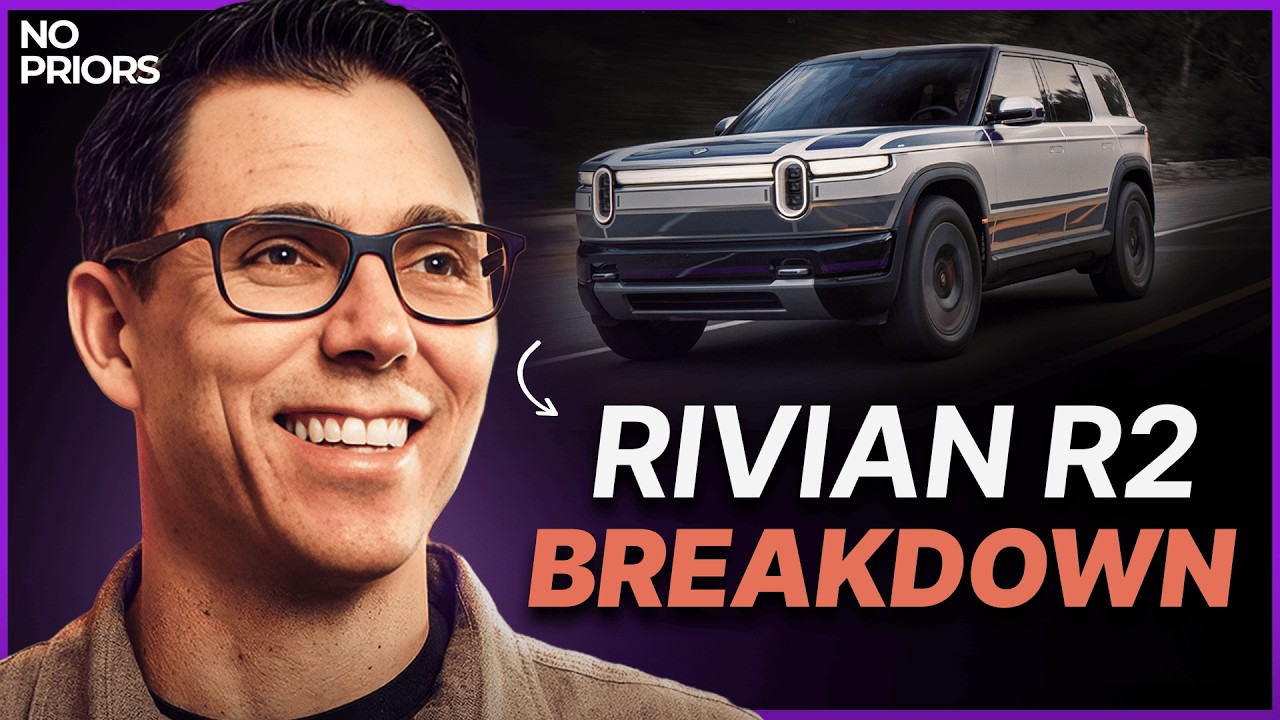
Rivian’s CEO, RJ Scaringe, believes the automotive industry is undergoing a fundamental transformation, moving from legacy, rules-based systems to truly AI-driven, software-defined vehicles. He predicts that the rate of progress in autonomy over the next three years will completely dwarf the advancements of the past three, making it “inconceivable to buy a car and not expect it to drive itself” by 2030.
The End of an Era: From Rules-Based to Neural Networks
When Rivian launched its R1 vehicle at the end of 2021, it used what Scaringe calls a “1.0 approach” to autonomy. This system was built on a traditional, rules-based framework where a third-party perception platform fed data into a planner that made decisions based on human-codified rules.
However, the team knew at launch that this was the wrong approach. In early 2022, they made the “easy decision” to completely reset the platform with a clean-sheet design, abandoning the legacy system entirely. Scaringe notes that with the rise of transformer-based encoding and neural networks, the old architecture was a “pure throwaway.” The new hardware platform, launched in mid-2024 as “Gen Two,” shares not a single line of code or piece of hardware with its predecessor.
The Necessity of a Vertically Integrated Stack
Scaringe argues that developing a competitive, neural net-based autonomy system is not an optional feature but a prerequisite for survival for any mass-market automaker. He believes fewer than five companies outside of China possess the necessary ingredients to succeed, and Rivian’s strategy has been to vertically integrate all critical components. The essential ingredients include:
- Full Control of the Perception Platform: Direct access to raw sensor data from cameras, radars, and LiDAR, with no intermediary processing. This allows for the richest possible data to be fed into the system.
- A Robust Data Flywheel: The vehicle must be able to identify interesting or difficult scenarios, trigger a data capture event, and upload large amounts of data for training.
- A Large, Active Car Park: Access to millions of miles of real-world driving data from a large fleet of customer vehicles is crucial for training and identifying corner cases.
- Massive Off-board Compute: A significant GPU infrastructure is required to train the models.
- Cost-Effective Onboard Inference: Every vehicle needs powerful, efficient compute to run the models. Scaringe highlights that inference hardware is “an order of magnitude more expensive than any of the perception stack.” To solve this, Rivian designed its own in-house chip to reduce costs and ensure the system could be deployed in every vehicle.
Software-Defined Architecture: The Foundational Layer
Before even tackling autonomy, a vehicle must have a modern, software-defined architecture. Scaringe contrasts this with the legacy “domain-based” or “function-based” architecture found in nearly every car today (with the exception of Rivian and Tesla).
- Domain-Based Architecture: A vehicle may have 100-150 individual Electronic Control Units (ECUs), each an “island of software” often written by different suppliers. This makes debugging, coordination, and updates nearly impossible.
- Zonal Architecture (Software-Defined): A small number of central computers run a single operating system, controlling all vehicle functions. This allows for simple, frequent over-the-air (OTA) updates. Rivian, for example, pushes a notable update with new features and refinements about once a month.
This architectural difference is so critical that Scaringe believes companies without it will “shrink to nothing.” This conviction underpins Rivian’s recent $5 billion software licensing deal with the Volkswagen Group, providing them with Rivian’s network architecture and ECU topology.
Data as the Ultimate Differentiator
Unlike large language models (LLMs) that are often trained on the same public internet data, autonomous driving models rely on proprietary data. There is no “internet of driving data.” Success, therefore, depends on the quality and richness of the data a company can collect.
Rivian’s strategy is to deploy a more capable perception stack than its competitors, including higher-resolution cameras with better dynamic range, radar, and eventually LiDAR in the R2 model. This turns the entire fleet into a high-fidelity “data acquisition machine.” Using LiDAR on every vehicle, for instance, provides a powerful tool for creating ground-truth data to train the camera-based vision models more effectively.
This superior data will also allow for more nuanced and personalized driving experiences. Beyond safety, differentiation will emerge in the user interface, with features like Rivian’s “Mild, Medium, and Spicy” driving modes and the potential for the car to learn and adapt to an individual’s driving preferences.
R2 and the Mass Market
The R1 platform has been a successful flagship, but its high price point limits its volume. The upcoming R2 model, starting at $45,000, is Rivian’s first true mass-market product. Scaringe believes the current EV market suffers from a “shocking lack of choice,” with many manufacturers simply trying to create their own version of the Tesla Model Y. He states, “The world doesn’t need another Model Y. The world needs another choice.” The goal of R2 is to offer a compelling and unique alternative that pulls customers from traditional internal combustion engine vehicles into the EV market.