🔬 The Limits of AI in Science - Why We Need Self-Driving Labs — Joseph Krause, Radical AI
Joseph Krause, CEO of Radical AI, details how his company uses Self-Driving Labs (SDLs) and AI scientists to overcome the experimental bottleneck in materials science. By automating the full loop of hypothesis generation, synthesis, characterization, and testing, Radical AI is accelerating the discovery of novel alloys for aerospace, defense, and semiconductor applications, achieving 10x the pace of traditional methods. Krause explains why materials science is uniquely challenging for AI, how human intuition trains the AI, and why experimental data, not models, forms the core competitive advantage in this rapidly evolving, geopolitically significant field.
Joseph Krause, founder and CEO of Radical AI, argues that the primary bottleneck in advanced materials (aerospace, defense, computing, consumer products) is not a lack of ideas but rather the slow pace of experimentation. Radical AI addresses this through “Self-Driving Labs” (SDLs)—closed-loop systems where an AI scientist generates hypotheses, and a fully automated lab synthesizes, characterizes, and tests materials.
The Unique Challenges of Materials Science
Krause emphasizes that materials science, particularly inorganic materials, differs significantly from fields like drug discovery or small molecules. Unlike biomolecules that can often be represented by text strings (e.g., SMILES), a material’s performance is dictated by a multitude of factors beyond just composition:
- Microstructure: How atoms arrange and form phases.
- Processing: Manufacturing techniques (e.g., additive vs. casting) and post-processing (e.g., annealing).
- Supply Chain & Cost: Availability and expense of constituent elements (e.g., hafnium price volatility).
- Application-Specific Requirements: Performance in extreme environments (high temperatures, pressures, corrosive/oxidative conditions).
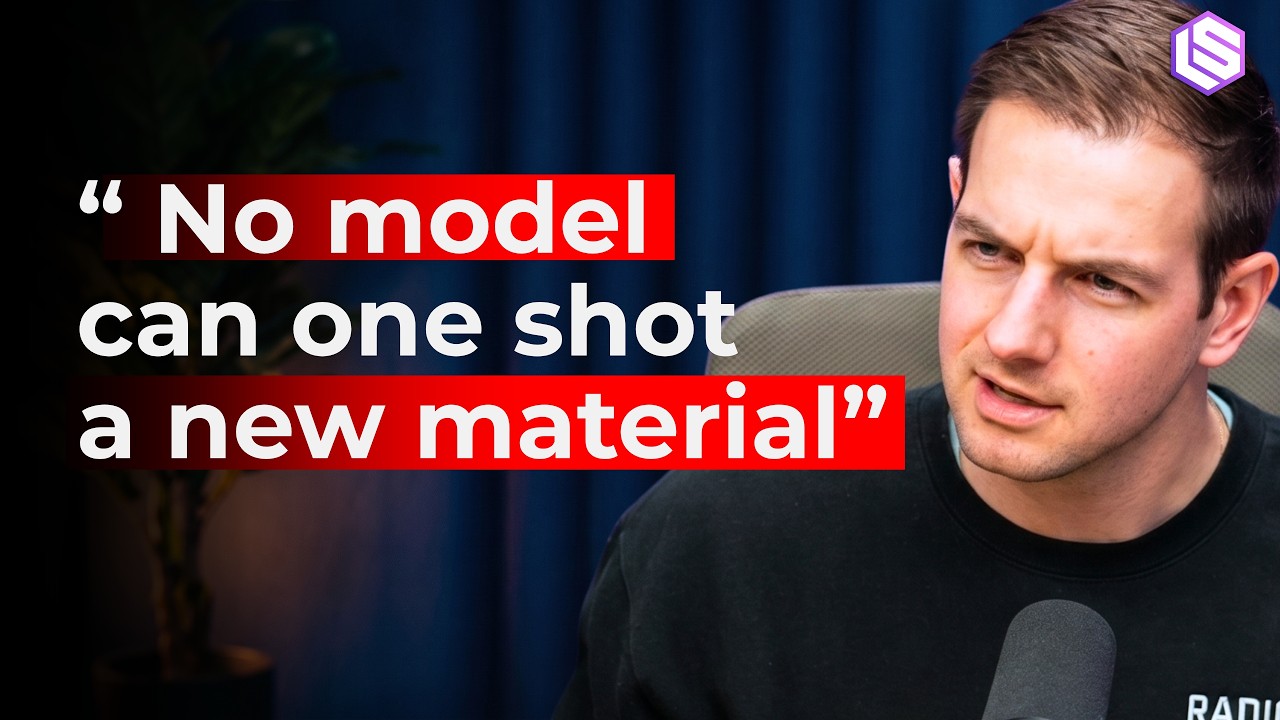
This complexity means “there is no one model that can one-shot a new material.” Ground truth lies in actually making, testing, and characterizing the material in a real application, a process that historically takes 15-30 years due to fragmentation between discovery, testing, and manufacturing.
Radical AI’s Self-Driving Lab Approach
Radical AI’s core thesis is to build a closed-loop system that integrates all stages of material development, creating a continuous feedback loop for its AI scientist.
The Process:
- Hypothesis Generation: AI scientists generate new material compositions, particularly for exotic alloys like high-entropy alloys (5-7 elements, equal atomic ratios) used in extreme environments (e.g., jet turbines, space applications).
- Synthesis: The lab autonomously synthesizes these compositions, producing “buttons” (small pucks).
- Characterization: A suite of automated tools (SEM, EDS, XRD, XRF, TGA) analyzes the material’s properties and microstructure. These tools provide different data points (e.g., elemental composition, crystal structure, thermal stability).
- Testing: Early-stage property testing is performed in-house, including oxidation performance and mechanical properties via tensile tests and microindentation (for Vickers hardness and a proxy for ductility). External labs are used for more specialized tests (e.g., wind tunnel tests).
This loop aims to capture data across the material’s entire lifespan, from hypothesis to early-stage performance, to eventually inform manufacturing and qualification. Radical AI has already produced 1,200 alloys in 5-6 months, with 300 novel compositions, and 10 showing promise for commercial applications—a nearly 10x acceleration compared to prior DARPA programs.
Human-in-the-Loop and AI Intuition:
Humans remain crucial for training the AI’s “scientific intuition.” For example, metallurgists annotate Scanning Electron Microscopy (SEM) images, identifying features like dendritic formations, which the AI then learns from. While characterization is largely automated, synthesis (e.g., plasma torch casting) still involves human PhDs, though full automation is targeted for summer.
Self-Driving Lab vs. Automated Lab:
Krause distinguishes between:
- Automated Lab: Performs experiments automatically, enabling high throughput, but still requires human direction (like hands-free driving).
- Self-Driving Lab (SDL): Runs entire research campaigns autonomously, making decisions and adapting based on results (like a Waymo car reaching its destination without human input).
Engineering Challenges:
Building SDLs involves significant engineering hurdles:
- Sample Manipulation: Designing custom actuators for robotic arms to handle fragile, high-temperature samples (e.g., removing alloy buttons from trays).
- Software Integration: Building an operating system for the lab to control tools, track samples, and make decisions (e.g., killing an experiment if synthesis fails).
- Tool Interfaces: Overcoming the historical lack of SDKs/APIs from tool vendors, who traditionally sold analysis software, not raw data access.
Vertical Integration and Impact Areas
Radical AI’s strategy is “vertical integration,” focusing on alloys and specific applications first, then expanding. Key impact areas include:
- Aerospace & Defense: Developing new alloys that enable concurrent engineering—designing materials alongside products (e.g., rocket boosters, jet turbines) rather than relying on decades-old materials.
- Semiconductors: Addressing material bottlenecks in interconnects for better efficiency and reduced energy consumption. New materials could offer 2-5x improvements in the near term, with potential for 10x in the future.
Overcoming Bottlenecks and Geopolitical Competition
Krause identifies several critical factors for success:
- Long Validation Timelines: Materials qualification (e.g., FAA, Mil-spec) can take 10 years. While sequential, efforts are underway (e.g., DARPA programs) to explore parallel qualification using advanced manufacturing.
- Negative Results: The active learning loop accounts for failed experiments, allowing the AI scientist to adapt hypotheses rapidly. The AI’s higher throughput (8-20 alloys/day, targeting 100/day) allows it to take more “shots on goal” and learn faster than human scientists (who might do ~50 experiments/year).
- Data Scarcity vs. Quality: Unlike some ML applications requiring millions of data points, Radical AI finds significant discoveries with relatively small, high-quality experimental datasets (e.g., 1,200 alloys yielding 300 novel ones), demonstrating that the bottleneck is experiments, not compute.
- Beyond Human Bias: The AI scientist explores elemental families and alloy combinations that human scientists, due to preconceived notions or intuition, would never consider, leading to novel breakthroughs.
- No “AlphaFold” for Materials: Krause agrees there’s no single model to predict a material’s performance from composition to final product due to the vast, complex, and intertwined variables of microstructure, processing, and application. Instead, “AlphaFold moments” may exist for specific sub-problems (e.g., segmentation models for SEM images).
- Geopolitical Race with China: China’s state-backed manufacturing innovation hubs pose a significant challenge. To compete, the US needs to:
- Increase Scientist Productivity: SDLs allow one PhD to manage 10 campaigns, a 10x productivity jump.
- Investment: Continued government and private sector investment (e.g., Genesis mission, national labs).
- Public-Private Partnerships: Leverage national lab HPC, researchers, and existing experimental data with private enterprise expertise to accelerate R&D, moving from a “25-year timeline” to a faster, more competitive model.
Call to Action for ML Engineers and Radical AI’s Stack
ML engineers are encouraged to leverage their specialized expertise, bringing a “first principles perspective” to scientific problems rather than trying to become material scientists. This cross-disciplinary approach can fundamentally change how science is done.
Radical AI’s AI stack features a multi-agentic “AI scientist” orchestrator that:
- Generates hypotheses.
- Incorporates industry-standard data (e.g., CalFad).
- Utilizes a custom-built literature review agent to extract relevant information from scientific papers.
- Feeds experimental data back into the learning loop.
A key component is Matrix, a Vision-Language Model (VLM) fine-tuned on scientific data. Matrix can extract scientific knowledge from experimental images (e.g., SEM) and, surprisingly, improves general scientific reasoning, suggesting that understanding experimental data makes an AI a better scientist overall.
Why Open Source?
Radical AI open-sources much of its work (e.g., Matrix model, Torch Sim) for three reasons:
- Community Building: To foster a community around this new way of doing science.
- Learning & Feedback: Gaining valuable feedback and ideas from the broader scientific and ML communities.
- Moat Philosophy: Radical AI believes that “experiments are the moat, not the model.” While models are essential tools that can be acquired or built, the unique data, infrastructure, and ability to run physical experiments efficiently are the true competitive advantages. This allows them to integrate the best available models (open-source or proprietary) into their stack to accelerate discovery.