🔬There Is No AlphaFold for Materials — AI for Materials Discovery with Heather Kulik
Professor Heather Kulik shares her hard-won perspective on applying AI to materials science, from discovering novel polymers with surprising quantum properties to the practical limitations of LLMs and the critical need for integrating deep domain expertise with data-driven methods.
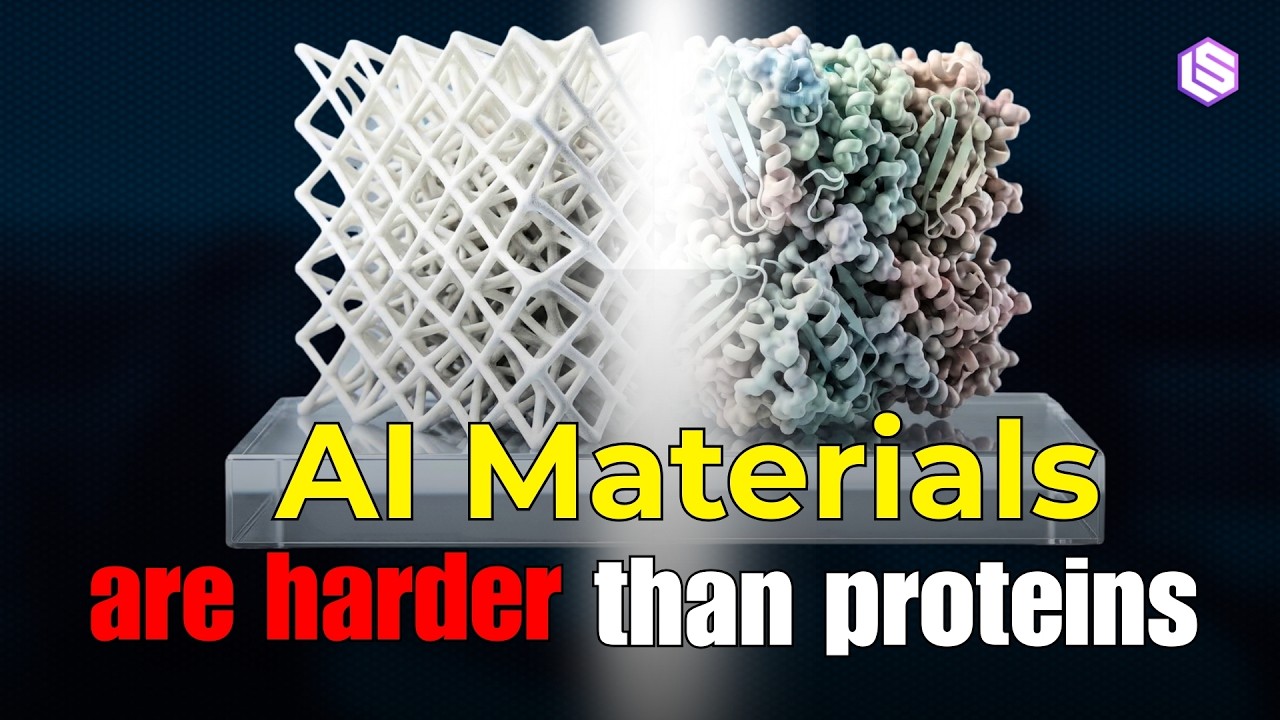
Professor Heather Kulik of MIT has long been at the forefront of combining data-driven methods with materials science. Her work focuses on accelerating the discovery of new materials by deeply integrating domain expertise with AI, moving beyond simply making existing computational models faster to uncovering genuinely surprising and novel chemical phenomena.
From Accelerated Prediction to Surprising Discoveries
Initially, AI was used to speed up predictions that would normally be made with slow, computationally expensive quantum mechanical models. However, the real breakthrough came when AI started generating insights that a human expert would not have anticipated.
In a recent success story, her group used AI to screen tens of thousands of potential materials for a polymer network—a task that would have taken months or years per experiment in a traditional lab. The process uncovered an unexpected chemical phenomenon that led to a material four times tougher than expected.
- The Challenge: The goal was to design molecules within a polymer that would break apart to dissipate force, making the overall structure tougher. The conventional chemical intuition was to design a “hinge” to make the molecule easier to peel open.
- The AI’s Solution: The AI proposed a different design. It discovered a quantum mechanical phenomenon where electrons would rearrange to stabilize the molecule at the moment it was about to break. This concept, while known in catalysis, had never been demonstrated in polymer materials.
- Validation: When presented with the design, experimental chemists were surprised and skeptical but were convinced to synthesize it. The resulting material was, in fact, significantly tougher, demonstrating AI’s potential to uncover non-intuitive design principles with real-world applications in creating more durable plastics.
The Power of Active Learning in Multi-Objective Optimization
One of the most promising areas for AI in chemical sciences is solving multi-dimensional challenges. Professor Kulik’s group uses active learning to navigate the complex trade-offs in materials design. For a project on Metal-Organic Frameworks (MOFs) for direct air capture of CO2, they are simultaneously optimizing for seven objectives:
- Cost
- Stability in humid environments
- Selectivity for CO2
- Mechanical stability
- Thermal stability
The promise of active learning is its ability to search for a “needle in a haystack” without waiting for models to be perfectly accurate, leveraging the 100- to 1000-fold speed-up ML provides for each dimension of optimization.
The Indispensable Role of Domain Expertise
A prevailing idea suggests that with tools like ChatGPT possessing “PhD-level understanding,” one might not need to learn fundamental science. Professor Kulik strongly disagrees, arguing that you must know enough chemistry to recognize when a model is wrong.
“ChatGPT is super good at Wikipedia-level chemistry knowledge… The thing I constantly do every time an LLM is updated is I just ask it, ‘please design me a ligand that has 22 atoms… I can never get an answer that has 22 atoms.’”
This simple but effective test highlights a critical gap. While LLMs can provide good introductions to unfamiliar topics, they often fail at specific, constrained tasks that an expert chemist could solve instantly. The models should be used as tools to augment knowledge, not replace it.
Current Gaps and Future Challenges for AI in Chemistry
Professor Kulik identified several key areas where machine learning needs to advance to better serve the chemical sciences.
1. The Data Problem: Quality and Diversity
The field is held back by a lack of large, diverse, and high-fidelity datasets.
- “Boring” Chemistry: Most existing benchmarks are for well-understood organic molecules, not for more complex and exotic phenomena like reactivity prediction, transition metals, or warm dense materials.
- Lack of Experimental Ground Truth: Unlike the CASP competition in biology, which uses experimental data and spurred the development of AlphaFold, many materials science leaderboards (e.g., Materials Project) are based on lower-fidelity computational data (DFT). This means models are often trained on data that may not fully reflect experimental reality.
2. The Model Reliability Problem
There is a trend of releasing “foundation models” or machine-learned interatomic potentials with significant hype, claiming they can replace traditional physics-based modeling like DFT. However, in practice, these models often fail when applied to new, real-world problems, with issues like molecules “falling apart” unexpectedly. There is a need for more rigor and transparency in evaluating whether these models are truly generalizable and reliable.
3. The “Bits to Atoms” Bottleneck
The interface between simulation and real-world experimentation remains a major hurdle.
- Autonomous Labs: While promising, high-throughput autonomous labs struggle with tasks that are easy for humans and have difficulty replicating the “serendipity” of human discovery.
- The Process is Key: A material’s properties depend not just on its structure but on the process used to create it. Professor Kulik notes, “we’re at ground zero” when it comes to using machine learning to understand and optimize the role of processing.
The Role of Academia and a Call to Action
In an era where large tech companies have access to nearly infinite compute, academics must be more creative, focusing on niche problems that cannot be solved by brute force alone.
Professor Kulik invites researchers and engineers interested in this space to engage with her group’s open-source software, molSimplify (and mofSimplify for MOFs). The tool, available online and on GitHub, is designed for generating and screening transition metal complexes and can serve as a gateway for those looking to contribute to this challenging but rewarding field.