Attention, World Models and the Future of AI — with Prof. Kyunghyun Cho
Professor Kyunghyun Cho, a co-author of the first paper on attention, discusses the future of AI. He argues that today’s models have already captured most correlations in passive data, making the real challenge about actively choosing which data to collect. He also explores the open debate around world models, the surprising lack of coding agent adoption among his students, and the foundational work that led to Retrieval-Augmented Generation (RAG).
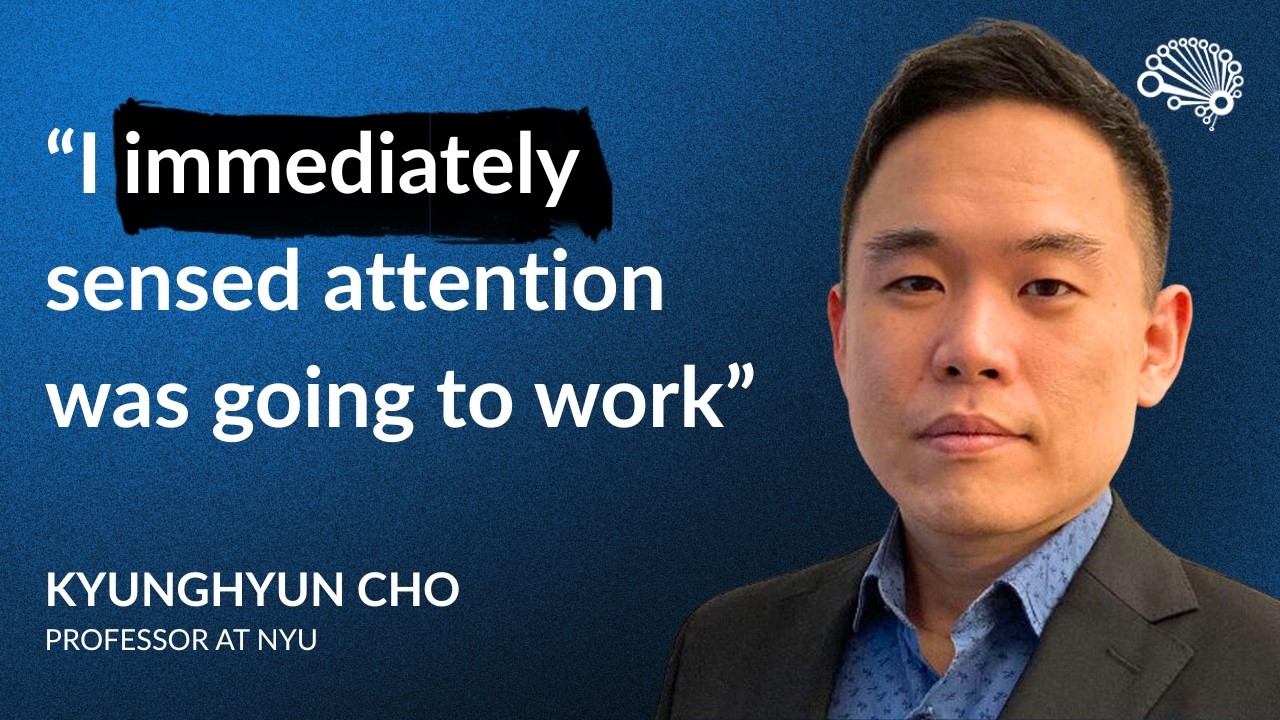
Professor Kyunghyun Cho, one of the world’s leading AI researchers, shares his perspective on the next significant advancements in AI capabilities, moving beyond the current paradigm of large-scale passive data consumption.
The Genesis of the Attention Mechanism
The journey to the now-ubiquitous attention mechanism began during Cho’s postdoc with Yoshua Bengio. Bengio had a strong conviction that machine translation was the next critical problem for the field to solve. This problem domain naturally surfaced key challenges, particularly the difficulty of training Recurrent Neural Networks (RNNs) on variable-length sequences, which exacerbated the vanishing gradient problem.
The breakthrough came from an intern, Dzmitry Bahdanau, who proposed the core idea of attention. The concept was so brilliant and intuitive that Cho recalls it as one of the very few ideas he had ever encountered where he could “sense immediately that it was going to work.” The initial implementation was validated in just a few days.
A powerful demonstration of this early model’s capabilities highlighted its ability to grasp world knowledge embedded in the training data. When given the sentence “UNK Korea is a friend of the United States,” where “UNK” was an unknown token, the model translated it as “South Korea.” When the context was changed to “enemy,” the model correctly inferred “North Korea,” showcasing that it had learned geopolitical relationships from the vast corpus of parliamentary proceedings and news articles.
Beyond Passive Data: The Future is Active Collection
A central theme of the discussion is the concept of sample efficiency. Cho argues that the conversation around it is often misframed. With modern Transformer architectures, we have become incredibly effective at extracting nearly all existing correlations from any passively collected dataset. Metrics like perplexity are already extremely low, indicating that we are approaching the limits of what can be learned from a fixed dataset.
The true challenge and the next frontier for a step-function improvement in AI is active data collection. Instead of asking how to squeeze more information from a given dataset, the critical question becomes: “Can I choose which data to collect so that I can learn the more important correlations more quickly?”
The goal is to create AI systems that can actively and intentionally seek out rare but informative events—the “aha moments”—to make learning more systematic and efficient, rather than just passively consuming whatever data is available.
World Models: High-Fidelity vs. Latent Planning
Active data collection requires a model to have some understanding of the world to know what data is important. This leads directly to the concept of world models, a topic of active debate and research. Two primary schools of thought exist:
- High-Fidelity Simulation: This approach posits that a model understands the world if it can generate a high-fidelity, step-by-step simulation of the future. This is the paradigm behind large-scale video generation models like OpenAI’s Sora. The computational regularity of this method makes it highly scalable with current hardware.
- Latent Planning: This alternative view, championed by researchers like Yann LeCun, argues that detailed, step-by-step imagination is unnecessary. Instead, intelligence operates on a high-level, abstract representation (a latent space) that allows for “skipping” intermediate steps. A human planning a trip to Paris doesn’t imagine every single step of the journey; they operate on abstract concepts. This is the foundation of architectures like the Joint Embedding Predictive Architecture (JEPA).
Cho believes the right path is still unclear, but the future likely involves operating in a latent space rather than directly in the high-dimensional pixel space.
The Foundations of RAG
Cho’s lab did foundational work that paved the way for modern Retrieval-Augmented Generation (RAG) systems. The work was spearheaded by his first PhD student, Rodrigo Nogueira, whose ultimate goal was to build an “AI scientist” capable of performing automated literature reviews.
They quickly realized that navigating the web link-by-link was unscalable. This pivoted their focus to information retrieval. Their key innovation was using large pre-trained models like BERT to re-rank documents retrieved by traditional systems. By fine-tuning BERT to assess the relevance of a document to a query, they created a system that was not only more accurate but also surprisingly efficient, challenging the notion that neural networks were inherently slower than sparse, traditional methods.
Teaching with Coding Agents
Shifting from research to education, Cho shared a surprising insight from his undergraduate “Fundamentals of Machine Learning” course at NYU. Assuming his junior and senior computer science majors would be avid users of modern tools, he designed the course around coding agents. However, he discovered that 80% of the 200 students had never installed or used a coding agent.
After helping the students get set up, he implemented a “vibe coding” teaching style. He first teaches a concept, then live-codes a complete web application using that algorithm with a coding agent, showing the entire process. Students then follow along, building the application themselves. This hands-on approach allows them to build entire systems from scratch and rapidly improves their practical skills and familiarity with AI tools.