What is Human In The Loop with AI? How HITL Shapes AI Systems
Exploring the concept of Human-in-the-Loop (HITL) AI, this summary details the spectrum of human involvement—from strict HITL to full autonomy. It covers how humans are integrated at different stages of the AI workflow, including training (Active Learning), tuning (RLHF), and inference (runtime oversight), to ensure safety, instill judgment, and build trust in AI systems.
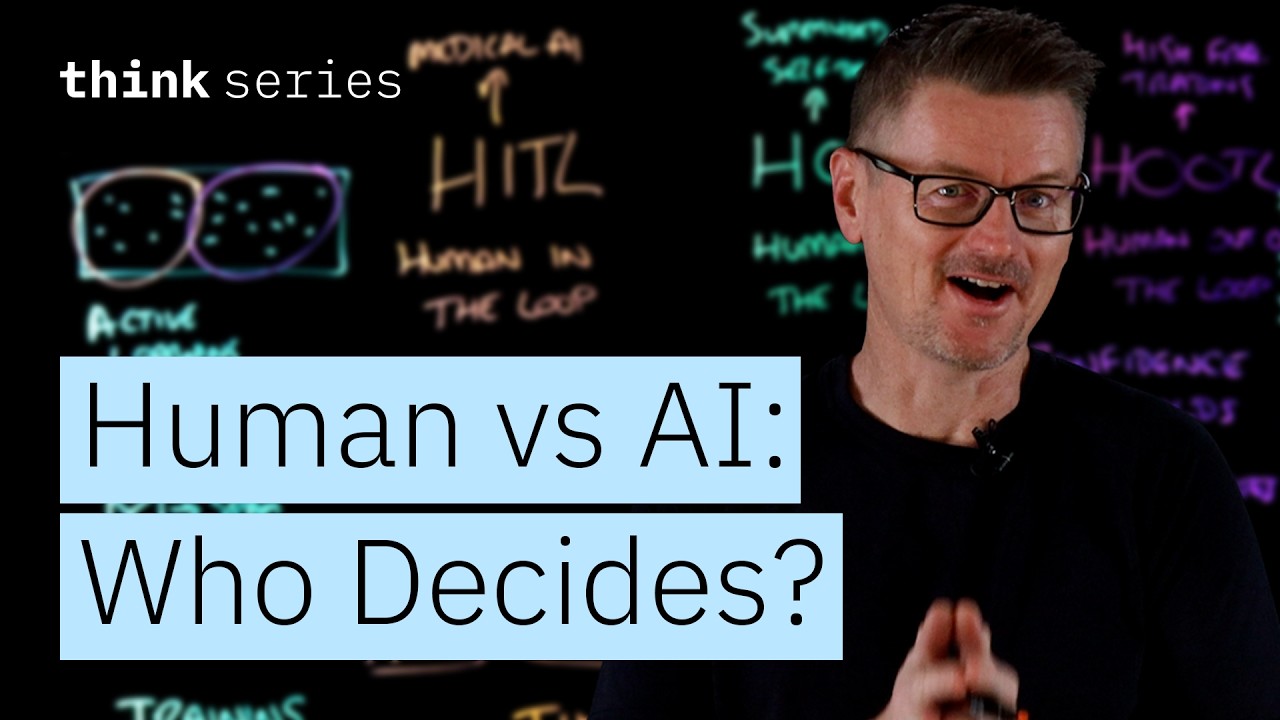
Human-in-the-Loop (HITL) is a framework built around the central question of how much autonomy an AI system should have. It proposes that humans should be strategically embedded within an AI’s workflow, with the level of involvement varying across a spectrum.
The Spectrum of Human-AI Collaboration
The degree of human involvement can be categorized into three main levels:
-
Human-in-the-Loop (HITL): This is the strictest form, where the AI system makes a recommendation or performs a sub-task but must stop and wait for explicit human approval before proceeding. The final action is always taken by a person. A key example is in medical AI, where a system might flag potential tumors on an X-ray, but a human radiologist must make the final diagnosis due to the high-stakes nature of the task.
-
Human-on-the-Loop: In this model, the AI operates autonomously, but a human continuously monitors its performance. The human has the authority to override the system or intervene if it begins to operate incorrectly. Supervised self-driving cars are a prime example, where the vehicle manages steering and speed, but the driver must remain attentive and ready to take control at any moment.
-
Human-out-of-the-Loop: This represents full AI autonomy, where the system senses, decides, and acts without any human intervention. This is often necessary in environments where decisions must be made at speeds beyond human capability, such as high-frequency stock trading algorithms that execute thousands of trades before a person could react.
Integrating Humans into the AI Workflow
Human involvement can be injected at three critical stages of an AI system’s lifecycle to solve different problems.
1. Training Time: Building Foundational Knowledge
Before a model can learn, it needs labeled data, a process known as supervised learning. This requires humans to provide the “ground truth” by, for example, tagging emails as spam or identifying objects in images. However, this is often slow, expensive, and requires domain expertise.
- Active Learning: To optimize this process, active learning allows the model to be trained on a small labeled dataset and then identify the most ambiguous or uncertain examples from a larger pool of unlabeled data. It then requests human input only for these “hard cases,” concentrating human effort where it is most valuable.
2. Tuning Time: Instilling Judgment with RLHF
For complex tasks like tuning a Large Language Model (LLM) to be helpful and harmless, a simple formula or rule is insufficient. Reinforcement Learning from Human Feedback (RLHF) is a technique used to instill nuanced human judgment into a model.
The process involves:
- The LLM generates two or more responses to a given prompt.
- A human evaluator reviews the responses and indicates a preference (e.g., “Response A is better than Response B”).
- Thousands of these preference pairs are collected and used to train a separate reward model.
- This reward model learns to predict which responses a human would prefer and is then used to coach the original LLM through reinforcement learning, effectively embedding human judgment into the system without needing a human present at runtime.
3. Inference Time: Ensuring Safe Operation
During live deployment (inference), especially with agentic AI that can take actions like executing code or modifying databases, humans provide crucial oversight.
Common patterns for runtime involvement include:
- Confidence Thresholds: The AI scores its certainty for each prediction. If the confidence score drops below a predefined threshold, the task is routed to a human for review. This allows the AI to handle the majority of easy cases while humans manage the uncertain ones.
- Approval Gates: The AI proposes an action but must wait for explicit human approval before executing it. This is common in coding agents before they make changes to a file system.
- Escalation Queues: The AI handles routine cases end-to-end but is programmed to flag edge cases or anomalies for human review.
By integrating humans at these stages, the AI system gains knowledge from labeling, judgment from preference tuning, and guardrails from runtime oversight.
Trade-offs and the Path to Autonomy
While essential, the HITL approach has trade-offs. Human involvement can create scalability bottlenecks and introduce inconsistency due to human factors like fatigue, bias, and subjectivity.
The ultimate goal of HITL is not to keep humans in the loop indefinitely. Instead, it is a maturity model designed to build trust. An AI system starts with significant human involvement (human-in-the-loop), and as it proves its reliability and safety, it can progressively move along the spectrum to human-on-the-loop and, in some cases, to full autonomy (human-out-of-the-loop). Every autonomous system begins with a human teaching, tuning, and monitoring it until it is ready to operate on its own.