AI Models as a Service: Powering Agentic AI, Privacy, & RAG
Cedric Clyburn explains the Models-as-a-Service (MaaS) pattern, detailing how organizations can build their own private AI infrastructure to deploy models like LLMs securely and at scale. He covers the benefits over public APIs, including cost control, data sovereignty, and lifecycle management, and outlines a technical architecture using Kubernetes, API gateways, and observability tools.
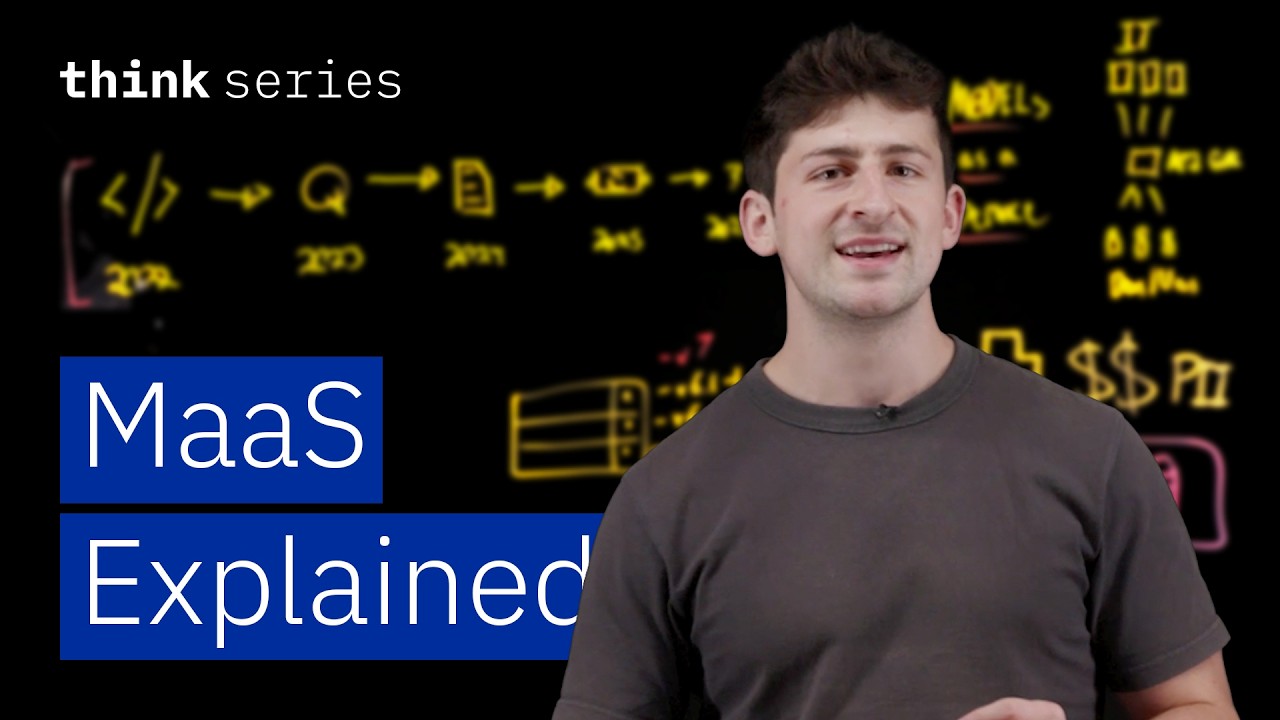
The evolution of generative AI usage—from IDE coding assistants to sophisticated techniques like Retrieval-Augmented Generation (RAG) and agentic AI—has predominantly relied on public, third-party APIs. This approach presents significant challenges for organizations, forcing them to send both their data and financial resources to external services. As enterprises seek to deploy private and sovereign AI solutions, they face critical concerns regarding cost management, data privacy, governance, and the ability to scale AI capabilities across entire teams, not just a handful of engineers.
Introducing Models-as-a-Service (MaaS)
A new architectural pattern, Models-as-a-Service (MaaS), is emerging as the solution to these challenges. Analogous to Software-as-a-Service (SaaS), MaaS provides a framework for serving multiple AI models, such as vision or language models, through a single, unified API. This API gateway becomes the central point of control, offering:
- Transparency: Clear insights into billing, GPU utilization, and overall costs.
- Data Governance: Ensuring data privacy and sovereignty by keeping sensitive information within the organization’s perimeter.
- Observability: Comprehensive monitoring of the entire system.
This model creates a clear distinction between roles: platform engineering or IT teams are responsible for serving and managing the models, while developers and end-users become the consumers, building applications on top of this stable, internal service.
Why Own Your MaaS? Control and Stability
While large AI providers already use a MaaS-like pattern to serve their models, the key difference is ownership. By running your own MaaS platform instead of renting a third-party service, you gain complete control over three critical areas: cost, access, and maintenance.
The control over the model lifecycle is particularly crucial. Public model providers frequently deprecate older model versions, sometimes with little notice. This forces developers to upgrade their applications, which can introduce breaking changes if, for example, a new model version uses a different prompt template. These changes can alter model behavior, introduce bugs, and create a cascade of downstream issues that consume valuable development time.
With an in-house MaaS, an organization controls the entire lifecycle. You can add new models from sources like Hugging Face and decide precisely when to deprecate older ones based on internal usage and needs, ensuring stability for production applications.
MaaS in High-Security and Air-Gapped Environments
For industries like healthcare and finance, which handle personally identifying information (PII) under strict regulatory scrutiny, sending data to a third-party LLM is often not an option due to the risk of data leakage. These organizations typically operate on-premise or in hybrid cloud environments.
MaaS allows an organization to become its own private AI provider. Large language models can be run locally, alongside on-premise applications and databases, creating a fully air-gapped and disconnected environment. This delivers secure LLMs for private RAG on internal documentation and enables agentic AI to interact with internal services, all without depending on a public cloud provider.
Architecting a MaaS Platform
A robust MaaS platform can be architected in layers using open-source technologies:
-
Infrastructure and Orchestration: The foundation is built on technologies like Kubernetes or OpenShift. This allows for the unification of diverse computing environments (on-prem, cloud, edge) and the dynamic scaling of resources like GPUs.
-
AI Platform Layer: On top of Kubernetes, an AI platform adds specialized capabilities. This includes inference engines like vLLM for efficient model serving and orchestration tools such as KServe, which manage LLMs with the same principles as microservices.
-
API Gateway: This is the entry point for all model consumption, providing essential enterprise features like rate limiting, user authentication, and usage tracking.
-
Observability Stack: For AI applications, observability goes beyond traditional metrics. It requires the ability to trace an LLM’s decision-making process (e.g., how an agent called a specific database). This can be achieved by applying familiar open-source tools like Prometheus, Grafana, and Jaeger to AI workloads.
This centralized infrastructure allows an organization to efficiently serve a variety of LLMs to multiple teams, enabling them to scale their AI efforts independently while maintaining strict cost control, data privacy, and governance. MaaS is rapidly becoming the de facto standard for building in-house and sovereign AI capabilities.