How Companies Are Building Their Own Intelligence | Sonya Huang, Sequoia Capital
Sonya Huang of Sequoia Capital discusses the strategic imperative for companies to embrace "sovereign AI" by owning their AI models and weights. She identifies cost, speed, performance, and controlling destiny as the four driving forces behind this shift. Huang argues that the competitive landscape is moving towards owning the intelligence layer, positioning application companies as the new innovation labs. She provides a practical, opinionated framework covering strategy (what to own vs. rent), team building, ensuring external legibility of research, and a technical roadmap for implementation, emphasizing how open-weight models now enable frontier-level performance through ownership and customization.
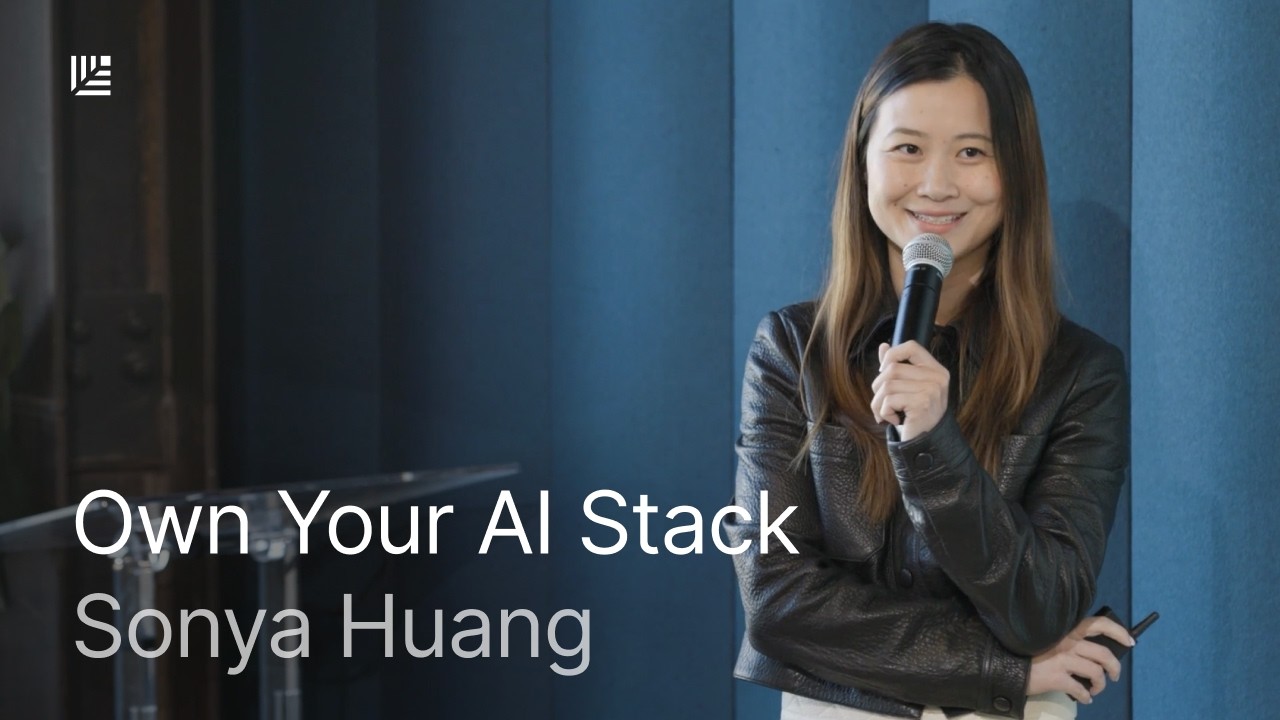
Sonya Huang from Sequoia Capital introduces the concept of “sovereign AI,” advocating for companies to own their intelligence, down to the weights, rather than solely relying on external dependencies. This isn’t about abandoning frontier APIs like GPT for all use cases, but about vertically integrating AI capabilities into core products where bespoke intelligence offers significant advantages.
Centralized vs. Decentralized Intelligence
Huang contrasts two future visions: a “centralized intelligence” model where a single, powerful AI becomes a black box powering much of the world’s GDP, sucking in data. She champions “decentralized intelligence,” where companies build their own intelligence on a solid core, tailored to their unique data, industries, and personalization needs, fostering a flourishing ecosystem where “individuality triumphs.”
Four Drivers for Owning Your AI Models
Companies are increasingly choosing to own their AI stack due to four primary forces:
- Cost: For companies with low or negative margins, sovereign AI is a necessity. Successful AI products often lead to prohibitively high AI COGS (Cost of Goods Sold), making ownership a path to cost optimization.
- Speed: In latency-sensitive domains like coding or security, smaller, custom-distilled models can significantly outperform larger, general models due to superior speed.
- Performance: This is a newer driver. Historically, open weights were seen as a performance sacrifice. However, with current open models, it’s now possible for domain-specific, fine-tuned open models to achieve or even surpass the performance of closed-source alternatives.
- Controlling Your Own Destiny: Companies desire independent control over their core intelligence, echoing the crypto-era mantra: “Not your keys, not your crypto.” Huang introduces the AI equivalent: “Not your weights, not your product.” True product ownership, she argues, requires custody and control over the underlying weights.
The Race for the Intelligence Layer
The competitive landscape is shifting from a “race for the application layer” to a “race for the intelligence layer.” It’s no longer just about who controls the UI or go-to-market, but who can own and shape better intelligence within the product. This has led to application companies becoming “neo labs,” conducting applied research across areas like evals, benchmarks, harness engineering, and new algorithmic techniques for fine-tuning.
Framework for Building Your Own AI: Zero to One
Huang provides a four-step opinionated framework for companies embarking on this journey:
Step 1: Strategy – What to Own vs. Rent
Sovereign AI is not binary. The decision of what to own is based on four factors:
- Cost: How critical is the cost line item to COGS?
- Speed and Latency: Is it a P0 requirement?
- Performance: Can tuning on proprietary data lead to superior domain-specific performance?
- Proprietary Data: Is the data used to improve the model highly specific and valuable to your business?
Examples include coding agents (often rented due to strong out-of-the-box performance) versus tab autocompletes (owned due to high frequency, cost, and speed requirements), cybersecurity (owned for speed and bespoke post-training), and bio companies (owned for proprietary data value).
Step 2: Assemble a Team
Successful lab leaders can come from diverse backgrounds (research like Nico from Apple/Google Brain, or engineering like Alex from Microsoft/Ramp). Crucially, organizations should avoid “shoehorning” sovereign AI responsibilities into existing AI platform teams. Instead, small, dedicated “de novo” teams are recommended, fostering frontier-level research and playing offense rather than just servicing internal teams. Harvey, for instance, has a team of seven that has published extensively.
Step 3: Legibility
External visibility of internal research is underestimated. In a market where every buyer seeks an “AI champion,” demonstrating sophistication through legible work is vital. This includes excellent technical marketing, potentially creating a separate branded labs or research group, and publishing high-quality research. This builds trust and positions a company as a knowledgeable vendor.
Step 4: Technical Roadmap
The journey typically involves:
- Strategy: Initial definition.
- Defining Evals: Crucial but unglamorous work to accurately measure intelligence.
- Model Routers & Harnesses: Initial experimentation for performance gains.
- Post-training: Significant performance gains from fine-tuning models on specific data.
- Mid-training/Pre-training: For rarer, more demanding cases.
- Feedback Loops: Setting up systems where live customer data continuously improves intelligence.
The AI Stack: Production vs. Development
Huang outlines the AI stack from an infrastructure perspective:
- Production Stack: User-facing intelligence, fundamentally a harness on top of a model. In closed model ecosystems (e.g., Opus, GPT), this is simpler but offers a “higher floor but lower ceiling” due to limited customization and inability to use production data for direct improvement.
- Development Stack: Tools and vendors used to refine intelligence. This becomes far more critical with owned AI, requiring careful eval monitoring, high-quality data (expert trajectories, synthetic data, RL environments) for post-training, and online learning systems for continuous improvement with user interaction.
Owning your stack, while introducing complexity (like “opening a Pandora’s box” compared to a clean API call), allows starting with frontier-level open-weight models (such as Kimmy K3 and GLM52) and, through advanced post-training, prompt harness engineering, and online learning, achieving “better than frontier performance.”
Context plays a vital role in performance, delivered through vector databases, enterprise knowledge graphs, open-source connectors, and even novel approaches to encoding context directly into weights.