Episode 16: Building AI for Life Sciences
OpenAI research lead Joy Jiao and product lead Yunyun Wang detail the development of specialized AI models for the life sciences. They discuss the new biochemistry-focused model series designed to accelerate research in genomics and protein understanding, the critical challenge of managing biosecurity risks through a "differentiated access" model, and the future vision of AI-powered autonomous labs that could revolutionize drug discovery and personalized medicine.
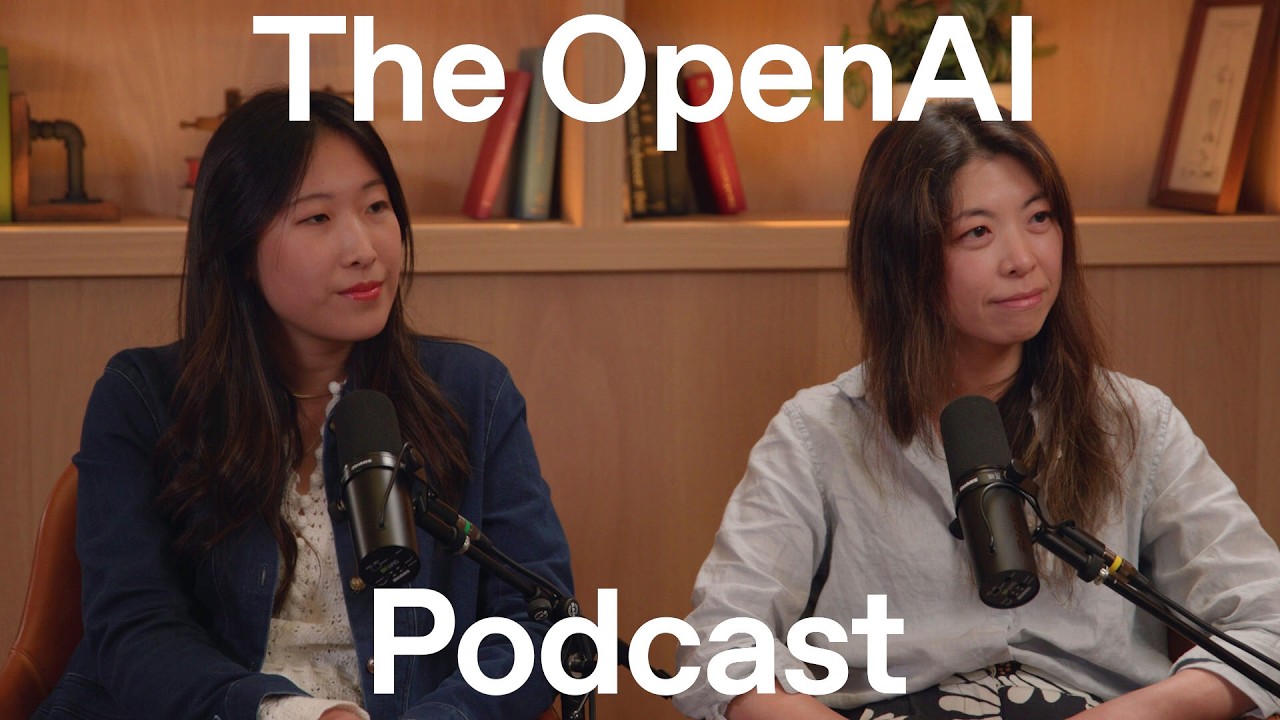
Research lead Joy Jiao and product lead Yunyun Wang discuss OpenAI’s initiative to develop specialized AI models for the life sciences, aiming to accelerate research and eventually cure diseases. The team’s motto is to “scale test time compute to cure all disease.”
The Life Sciences Model Series
OpenAI is building a new biochemistry-focused model series anchored on complex life science research workflows. The initial focus is on adding mechanistic understanding, starting with genomics and protein comprehension, to tackle bottlenecks in early discovery.
These models are deployed across various surfaces:
- ChatGPT: Used for literature synthesis workflows.
- Codex: Empowers long-trajectory, agentic workflows, allowing models to act like computational biologists using tools and open-source algorithms.
- Life Sciences Research Plugins: To ensure reproducibility, OpenAI is shipping plugins with over 50 templatized skills for repeatable workflows like pathway analysis or cross-evidence matching in papers.
Balancing Capability and Biorisk
One of the most significant challenges is the dual-use nature of this technology. The same steps a legitimate researcher takes can resemble those of a malicious actor, making it difficult to distinguish intent from a prompt alone. For example, a request to clone a gene could be for a harmless protein or a toxin.
To address this, OpenAI has taken a risk-averse approach with several layers of safeguards:
- High Safeguards: Models are designed to self-refuse requests that have potential for misuse, often providing a high-level overview instead of specific protocols. This can be a point of frustration for professional scientists.
- Differentiated Access: The key to unlocking the models’ full potential is a system of differentiated access. By verifying users as professionals at legitimate institutions (pharma, research labs), OpenAI can have confidence in their intent due to existing regulations and tracking of reagents. These verified users are granted access to more powerful capabilities than the general public.
AI in the Lab: Present and Future
Current Capabilities:
- Workflow Automation: Models assist with tasks ranging from simple (optimizing pipetting schedules to minimize manual labor) to complex (designing enzymes and analyzing experimental data).
- Experiment Design: The collaboration with Ginkgo Bioworks demonstrated that GPT-4 could design and execute biological experiments in a robotic lab, successfully producing proteins. This showed that AI could move beyond human bottlenecks to compute bottlenecks.
- Data Analysis & Collaboration: Models help scientists without deep statistical knowledge to rigorously analyze data, suggest hypotheses, and identify biases. Codex can build custom UIs for visualizing data, changing how researchers collaborate and share results.
Future Vision (10 Years): The long-term vision is a world with autonomous labs—robotic research institutes connected to AI, constantly working to cure diseases, create new materials, and solve personalized medicine challenges for rare diseases. In this future, scientists would set high-level direction, and AI agents would explore ideas, design experiments, and report back, democratizing science and enabling breakthroughs that are currently constrained by financial or regulatory hurdles. This also extends to biosecurity, with AI systems autonomously monitoring the environment for threats and developing medical countermeasures.
Advice for Adoption
- For Students: The nature of learning biology is shifting from rote memorization to creativity and exploration. Students should use AI to ask questions, perform deeper dives into papers, and connect disparate fields of research.
- For Researchers: To overcome skepticism and time constraints, start with low-lift, high-value tasks. Use AI to discuss research papers, fact-check understanding, and analyze experimental results. Starting with a passion project can also help in discovering the model’s capabilities without pressure. The key is to show value by doing and publishing, which lends credibility to AI’s role in science.