Introducing Claude for Life Sciences
Anthropic's Jonah Cool and Eric Kauderer-Abrams outline their vision for making Claude an indispensable AI research assistant for scientists. They discuss a multi-faceted strategy that includes enhancing model capabilities for long-horizon tasks, building a rich ecosystem through partnerships with companies like Benchling and 10x Genomics, and applying Claude across the entire R&D lifecycle—from bioinformatics analysis to navigating regulatory submissions.
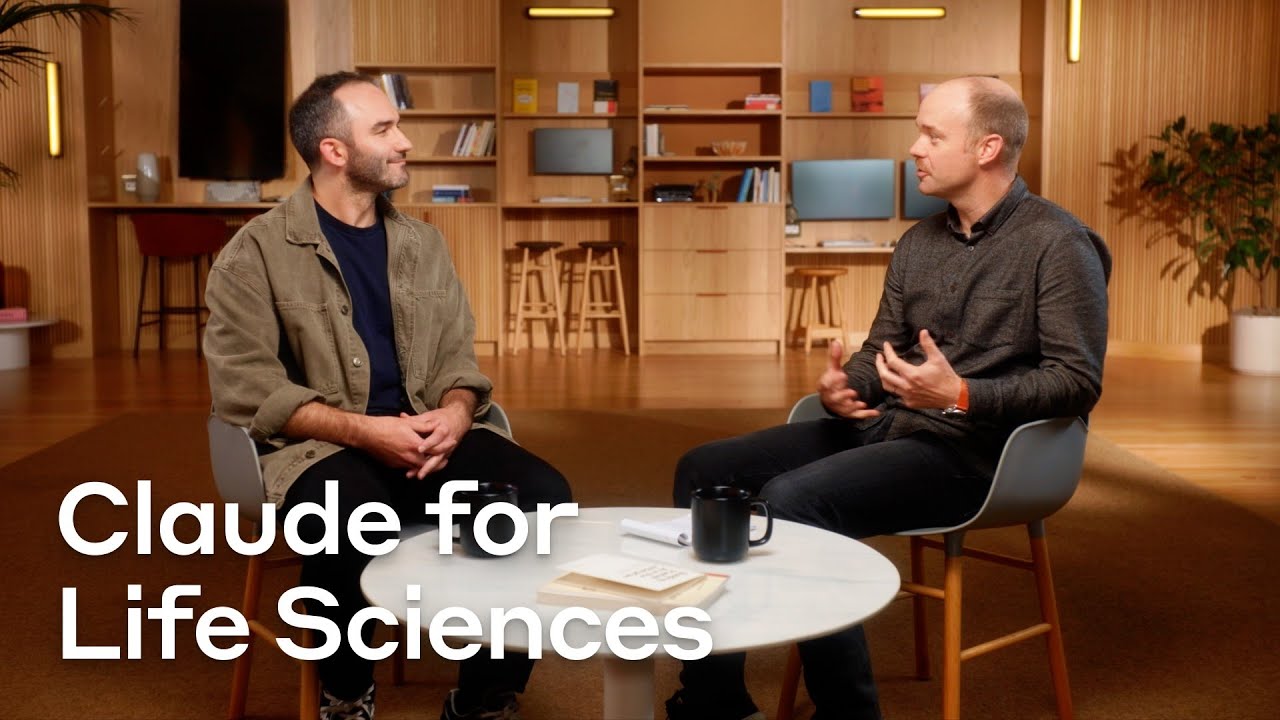
Anthropic’s primary mission for the beneficial application of frontier AI is centered on biology and the life sciences. The goal is to build tools that empower individual scientists, enhancing both their productivity and the creative experience of research by automating tedious tasks. This vision extends across the entire spectrum of scientific work, from early-stage discovery, like molecule design, to later-stage development and translation.
The approach is holistic, addressing the myriad of tasks a scientist performs daily: drafting, reviewing, and debugging protocols; performing complex bioinformatics analyses; and preparing results for publications and presentations.
Turning Claude into a Scientist’s Collaborator
The strategy for integrating Claude into the scientific workflow follows a “crawl, walk, run” progression, with the ultimate goal of creating a superhuman research assistant.
Foundational Ecosystem and Partnerships
The initial step is making Claude “conversant” with the essential tools scientists use daily. This involves building a robust ecosystem through strategic partnerships that embed Claude directly into existing workflows. Key collaborations include:
- Benchling: For laboratory notebook and experiment management.
- 10x Genomics: Integrating with platforms like Cell Ranger for single-cell experiment analysis.
- PubMed: For querying and reasoning over scientific literature.
- BioRender: To assist in creating publication-quality figures and diagrams.
The aim is to create a seamless experience where Claude becomes an embedded collaborator, capable of handling meaningful, multi-hour chunks of work autonomously.
Enhancing Model Capabilities: The Power of Sonnet 4.5
Sonnet 4.5 represents a significant step forward as Anthropic’s first model to undergo extensive scientific training. Two key advancements make it particularly powerful for life sciences:
- Broad Scientific Skills: The model’s improved capabilities in domains like mathematics generalize to enhance performance in computational biology.
- Long-Horizon Tasks: Sonnet 4.5 shows a major improvement in executing long sequences of tool calls, a critical requirement for running complex bioinformatics pipelines and workflows.
This power is not limited to a chat interface. Agentic tools like Claude Code are already proving highly effective for bioinformatics, literature reviews, and project organization, making complex computational tasks more tractable for scientists without a deep computer science background.
Real-World Impact and a Scientist-Driven Approach
The practical utility of Claude is demonstrated in its ability to solve concrete R&D problems. Eric Kauderer-Abrams shared a compelling example from his time running a biotech company:
“It took us three months, ultimately, lots of people working day and night in the lab to fix the problem. I posed this problem to Claude. I said, ‘Hey, what should we do to get unstuck?’ And just in one minute, you know, one response, Claude actually just one shotted the answer.”
This illustrates Claude’s potential to act as a “distilled version of the totality of scientific knowledge,” providing helpful, imperfect answers that get researchers unstuck—much like a trusted, experienced colleague. This capability is also being applied to streamline and accelerate the regulatory process, helping both industry and agencies like the FDA maintain consistent standards.
Anthropic emphasizes an approach grounded in the reality of lab work, aiming to solve the real bottlenecks scientists face rather than pursuing romanticized, abstract ideas about biology. By lowering the bar for computational analysis and making knowledge transferable across disciplines (e.g., from neuroscience to cell biology), Claude can help break down the silos that often slow scientific progress.
The Future: From Lab-in-the-Loop to Automated Execution
Anthropic’s research roadmap is focused on pushing beyond current capabilities to fundamentally accelerate the scientific process.
Bio-Foundation Models and Language Interfaces
There is a significant trend toward specialized bio-foundation models with “savant-like capabilities” in modalities like DNA and protein sequences. Anthropic is aggressively pursuing research to see if frontier-scale models like Claude, with the right training, can develop these capabilities natively. The key is to interface these deep biological understandings with natural language, making them accessible and actionable for every scientist.
Safety and Responsible Scaling
A core tenet of Anthropic’s identity is the deep integration of safety with capability development. In the context of biology, this means aligning with best practices in the biosecurity community and adhering to a responsible scaling policy. This approach mirrors the quality management systems used in therapeutics development, ensuring that powerful new tools are deployed safely and responsibly.
The Ultimate Vision
The long-term goal is to close the loop from hypothesis to data. This involves two critical research directions:
- Automated Experiment Execution: Moving beyond designing protocols to having Claude actually execute experiments in the lab, enabling a cycle where a scientist can design a plan with Claude and review the data the next morning.
- Lab-in-the-Loop Learning: Transcending the limits of human-annotated data by enabling models to learn directly from high-throughput biological measurements. As the throughput of experimental systems continues to scale, this will be essential for moving beyond human capabilities.
By integrating Claude into the core of the scientific process, from the classroom to the automated lab, Anthropic aims to make a 100-year leap in scientific progress possible in just 10 years.