Welcome Session - Microsoft Research India Academic Summit 2026
The Microsoft Research India Academic Summit 2026 opens with MSR India Lab Director Venkat Padmanabhan outlining the lab's collaborative research philosophy and Microsoft's evolution into an AI infrastructure powerhouse. He details MSR India's four core research pillars: fundamental AI advancements, specialized domain solutions, efficiency across the AI stack (including small language models), and the crucial diffusion of AI technologies for societal impact in India and the Global South, exemplified by diverse projects and collaborations.
The Microsoft Research India (MSRI) Academic Summit 2026, as introduced by Srinivasan Iyengar, is a two-day event designed to foster a “confluence of ideas” between MSR researchers and the academic community. The agenda is structured around intense learning, sharing, and collaboration, featuring multiple plenary talks, engaging sessions, and dedicated opportunities for discussion. Each day commences with a plenary talk, followed by parallel sessions, and concludes with another plenary, interspersed with breaks.
Venkat Padmanabhan, the MSR India Lab Director, elaborated on the summit’s evolution, particularly its post-pandemic reset three years prior. The objective was to create a “highly research-focused and technical forum” that drives engagement between MSR researchers and academic partners, including faculty and students. This approach has successfully led to collaborations, internships, and post-doc opportunities, with Padmanabhan strongly encouraging all attendees to leverage the event for new connections and idea exploration.
MSR India: Mission and Modus Operandi
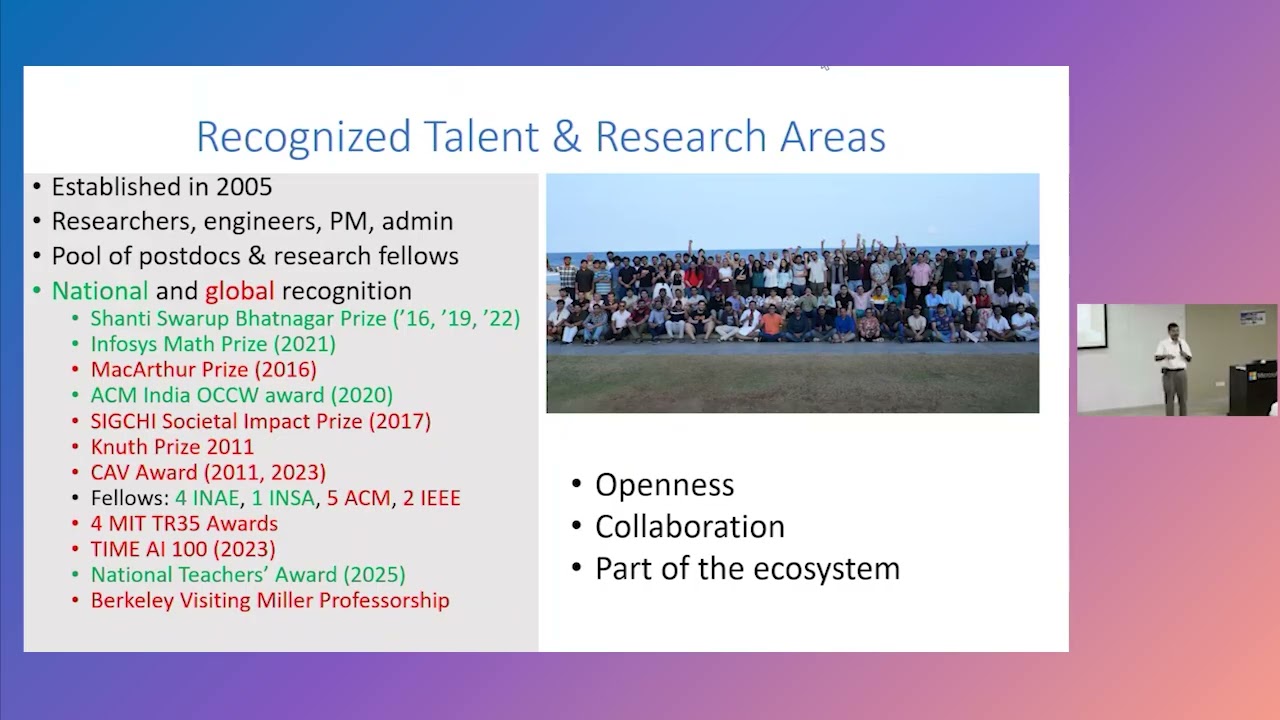
Padmanabhan provided an overview of MSR India, established 21 years ago in Bangalore. The lab boasts a diverse team of researchers, engineers, program managers, and support staff, complemented by its pioneering “research fellow program.” This program offers B.Tech or M.Tech graduates a two-year immersion in research, after which many pursue advanced studies or entrepreneurship. A notable alumnus mentioned was Bhavish Aggarwal (mispronounced as Bobby Shagar in the transcript) of Ola Cabs, who was a research fellow at MSR India.
The lab takes pride in its “amazing talent,” with researchers achieving national and global recognition, including prestigious awards such as the Infosys prize and the BNA prize. MSR India’s operational philosophy is underpinned by three key principles:
- Openness: Despite being part of Microsoft, the lab maintains an open approach, publishing extensively, contributing to open-source projects, and actively collaborating with external academia.
- Ecosystem Integration: MSR India positions itself as an integral component of the local research ecosystem. Many MSR colleagues hold adjunct appointments at academic institutions, co-advise PhD students, and serve on academic committees, embedding the lab deeply within the community.
- Collaboration: A significant portion of MSR India’s work is conducted in close partnership with external entities, reflecting its commitment to collective progress.
Microsoft’s Transformation in the AI Era
Padmanabhan underscored a significant transformation within Microsoft in the age of AI. While retaining its status as the world’s largest software company, Microsoft, alongside its industry peers, has effectively evolved into an “infrastructure company.” This shift is evidenced by staggering annual investments in AI infrastructure, “of the order of $200 billion a year,” with a projected trillion-dollar investment over five years—a scale that surpasses even that of major oil companies.
This monumental investment guides MSR India’s strategic imperatives, focusing on two critical objectives:
- Efficiency: Maximizing the utility and value derived from this vast AI infrastructure.
- Expanding Use Cases: Broadening AI’s applicability to serve more people and enhance its value for existing users.
Four Pillars of MSR India’s Research Focus
MSR India’s research endeavors are categorized into four broad areas:
-
Fundamental Advances in AI Capability: This pillar aims to “smoothen the jaggedness of intelligence.” Key areas include:
- Verification: Enhancing the reliability and trustworthiness of AI systems.
- Retrieval: Improving the efficiency and quality of feeding relevant information into AI models at reduced costs.
- Multimodal Reasoning: Advancing AI’s ability to integrate and understand information across diverse modalities (e.g., text, vision, audio).
-
Specialized/High-Value Domains: Research is directed towards addressing high-impact challenges within enterprise contexts. This encompasses needs in:
- Security.
- Data management and database solutions.
- Coding and software development, offering specialized solutions for specific industries Microsoft serves.
-
Efficiency: This focus extends beyond the infrastructure layer to encompass the entire technology stack, including AI models. Padmanabhan highlighted pioneering work on “small language models” by Ajay Kamar and her team, which aims to achieve comparable quality to larger models while significantly reducing computational costs.
-
Diffusion to India and the Global South: This pillar capitalizes on MSR India’s unique geographical location and strong ties within the local ecosystem to drive the impactful adoption of technology. Notable collaborations and projects include:
- Healthcare and Education: Initiatives with Asha workers and startups like Physics Wallah.
- Road Safety: A tripartite collaboration involving MSR India, a Nobel laureate, and Ola Cabs.
- Karya: A successful spin-off company that garnered significant media attention, including a cover feature in Time magazine.
- Policy and Standards: Kalika Bali’s instrumental role in the India AI mission and the “New Delhi Frontier AI commitments,” which advocated for the evaluation of AI models for multilingual and multicultural capabilities.
- Societal Good: A recent partnership with IIIT Bangalore (mispronounced as Triple IT Bangalore) to scale “society meaningful technologies” in areas like education, accessibility, and healthcare, leveraging IIIT’s expertise in platforms such as MOSIP.
This comprehensive approach underscores MSR India’s commitment to both foundational AI research and its practical application, particularly within the unique context of India and the Global South.