The AI Frontier: from FLOPs to Megawatts — Anjney Midha, AMP
Anjney Midha unpacks the critical bottlenecks in AI scaling beyond just GPU acquisition, advocating for responsible infrastructure, community-aligned data centers, and an independent system operator model for compute. He discusses the perils of research hoarding, the rise of researcher CEOs, and how Anthropic's culture of "preparedness" and "output maxing" led to its success, while also highlighting his personal mission to use AI for precise end-of-life prediction.
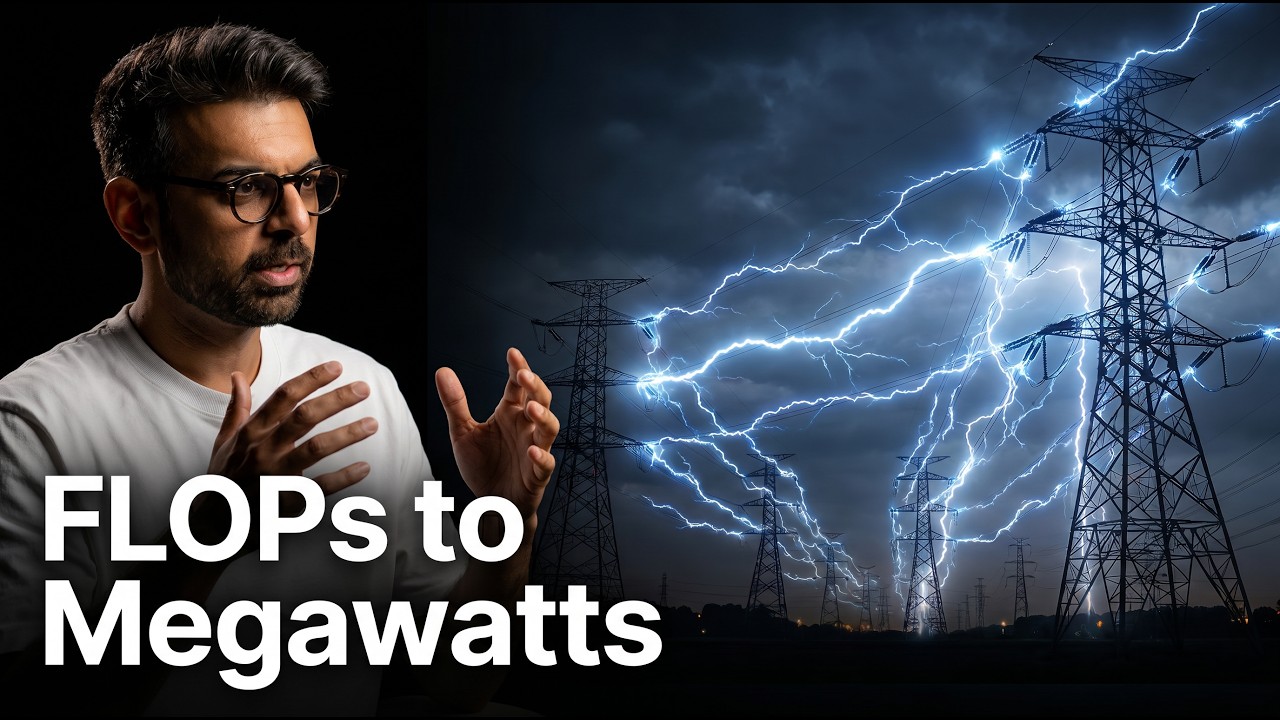
Anjney Midha, with a background building Discord’s developer platform and backing frontier AI companies, discusses the critical bottlenecks in AI scaling. He highlights that the AI race is not solely about acquiring more GPUs but about addressing fundamental infrastructure inefficiencies, fostering responsible development, and rethinking compute markets.
The Cost of Inefficient AI Infrastructure
Midha begins by contrasting the prevailing hacker mindset in AI with established infrastructure best practices. At Google, for example, 95% node utilization was considered an outage, with 96% being the standard. He stresses that in the AI domain, early-stage inefficiencies and misalignments in the supply chain between capital and cluster management compound rapidly at scale, leading to significant waste. This waste is not just economic; it also affects progress. He argues that “move fast and break things” is detrimental for AI data centers; instead, the industry needs to “move fast with responsible infrastructure” and embrace common sense, iterative bring-ups, and a premium on infrastructure quality.
The Need for Responsible Infrastructure and Community Buy-in
A significant challenge for AI scaling is community backlash against data center development, with up to 20% of projects at risk of not gaining local support. Communities are concerned about power grids and environmental impact, not just job creation. Midha proposes a “new AI deal” where a portion of compute revenue (e.g., an additional 50 cents per hour) or direct electricity bill reductions are given to local communities. This fosters a sense of partnership and public benefit, making data centers more reliable and sustainable. He also advocates for partnering with experienced, reliable data center providers (20+ years in the business) rather than new “neo-clouds” that often lack the necessary long-term expertise and trust.
AMP’s Vision: The Compute Grid as an Independent System Operator
Midha describes AMP Grid as an independent system operator (ISO) for compute, aiming to make megaFLOPS flow like megawatts. This is achieved through a horizontal pooling and utilization layer across various clouds and silicon, rather than full-stack integration (like XAI or OpenAI). AMP does not own the compute assets but coordinates demand and supply from diverse partners, much like an electricity grid’s ISO. This model draws inspiration from Google’s internal scheduling systems, which used “interruptible demand” and dynamic prioritization (credit-based bidding) to efficiently allocate compute resources for base workloads and research spikes. AMP aims to secure 1.3 gigawatts of base load capacity and 6 gigawatts of spike capacity over the next four years to support frontier AI labs.
Research Hoarding and Market Failure
Midha criticizes the current trend of research hoarding, exemplified by DeepMind’s 6-month paper embargo policy, which allows business teams to prevent the publication of impactful research. This creates an “adverse selection problem” where only less significant findings reach the public, resulting in negative externalities and a market failure. AMP’s capital arm, Foundry, actively seeks out and invests in researchers leaving large labs due to such misalignments, incubating new frontier AI companies (like Anthropic, Mistral, Periodic Labs) to unlock and accelerate this research.
Beyond Scaling: Output Maxing and Full-Stack Alignment
Midha champions “output maxing” as a new discipline, focusing on achieving optimal outcomes and maximizing utility from all available resources. He suggests a hypothetical “Department of Alignment” at Stanford to address the challenge of full-stack alignment in scaling systems. As organizations and systems scale, division of labor, specialization, and abstractions lead to communication loss at every API interface. To mitigate this, two approaches are crucial:
- Standards and Protocols: Developing standardized API specifications for lossless communication.
- New Capabilities: Unlocking entirely new technologies, such as room-temperature superconductors, that create such abundance they render previous bottlenecks irrelevant.
Compute Markets, Co-Design, and Non-NVIDIA Chips
He supports initiatives like SF Compute, which aims to standardize futures contracts for compute, seeing it as a potential open protocol to connect with AMP’s grid for both demand and supply. Regarding non-NVIDIA chips, he highlights Matrox as an example of smart co-design. Matrox leverages NVIDIA’s open reference architecture for data centers, focusing its innovation on the logic die and systems co-design rather than re-inventing the entire data center design. A key bottleneck for such chip teams is trust boundaries and gaining visibility into future model architectures early enough (given two-year tape-out cycles). AMP, through its deep involvement with frontier labs, can help bridge this trust gap.
The Rise of Researcher CEOs and the Nature of Leadership
Midha challenges the venture capital community’s tendency to underestimate researchers as CEOs. He argues that top-tier scientists like Dario Amodei (Anthropic), Robin Rombach (Stability AI), and Guillaume Lample (Mistral) are “star athletes of the mind” who possess the intellectual rigor, leadership, and performance capabilities required to be exceptional CEOs. Great CEOs, he asserts, must be willing to be confrontational “up and down the stack”—with their teams, customers, and partners. He emphasizes leading the frontier (pushing the state-of-the-art and capturing enough value to continue innovating) over merely “winning” in competitive narratives, encouraging first-principles thinking over outdated heuristics.
Anthropic’s Culture: Preparedness and Hardship as a Feature
Midha dismisses the idea that Anthropic’s success in cracking coding (e.g., Claude 1/2) was mere luck. Instead, he attributes it to their deep preparedness over four years, embodying the adage “luck favors the prepared mind.” He details how Anthropic’s early hardship—facing numerous rejections and operating with scarce resources—was a feature, not a bug. This forced them to define their “P0” (Priority Zero): safe AGI, specifically through cracking coding as a generalizable capability. Their culture, defined by actions aligned with this mission (especially safety), became a formidable, though fragile, moat. He warns that too much capital too early, without clear P0 definition, can make cultures brittle and lead to failure.
Periodic Labs and Silicon Valley’s Duality
At Periodic Labs, the primary constraint is fundamental physics, such as discovering new superconductors. Midha observes that Silicon Valley is both a “missionary” (driven by shared purpose) and “mercenary” (driven by money) place. He notes that early hardship and difficult choices help forge a strong culture, while an abundance of capital can sometimes make cultures fragile if teams haven’t learned to define their core mission and make tough trade-offs. He views money not as an end in itself but as a resource to pursue meaningful missions, referencing his own formative experiences in Rishi Valley and Singapore that shaped his perspective on material wealth.
Anjney’s Personal Mission: End-of-Life Prediction
Returning to his personal passion, Midha reiterates his 14-year commitment to leveraging AI for precise end-of-life prediction in healthcare. He frames this, alongside “net positive data centers,” as a bipartisan issue that can reduce taxpayer burden, empower patients through science, and ultimately improve the human condition. He actively seeks collaborators passionate about these missions.
- Tags:
- DeepMind
- Responsible AI
- Anthropic
- Machine Learning
- AI Infrastructure
- Healthcare AI
- Periodic Labs
- Data Center
- Mistral
- GPU Utilization
- Silicon Valley
- Frontier AI
- Foundry
- Compute Grid
- Independent System Operator
- End-of-Life Prediction
- Output Maxing
- Full-Stack Alignment
- Abstraction Loss
- Superconductors
- NVIDIA Reference Architecture
- Systems Co-Design
- Researcher CEOs
- AI Culture