Ex-Google Cloud AI Boss: Your Data Is the Real Moat
Andrew Moore, CEO of Lovelace AI, discusses YottaGraph, a rapidly growing, automatically constructed knowledge graph designed as a context engine for enterprise AI agents. He highlights Lovelace's differentiation from public knowledge graphs by focusing on integrating private enterprise data, the engineering challenges of entity resolution and fast multi-hop reasoning, and the critical importance of graph amendability and auditability for mission-critical applications. Moore also touches upon the future of computer science education, advocating for product management skills and emphasizing the strategic importance of domestically developed open-weights models.
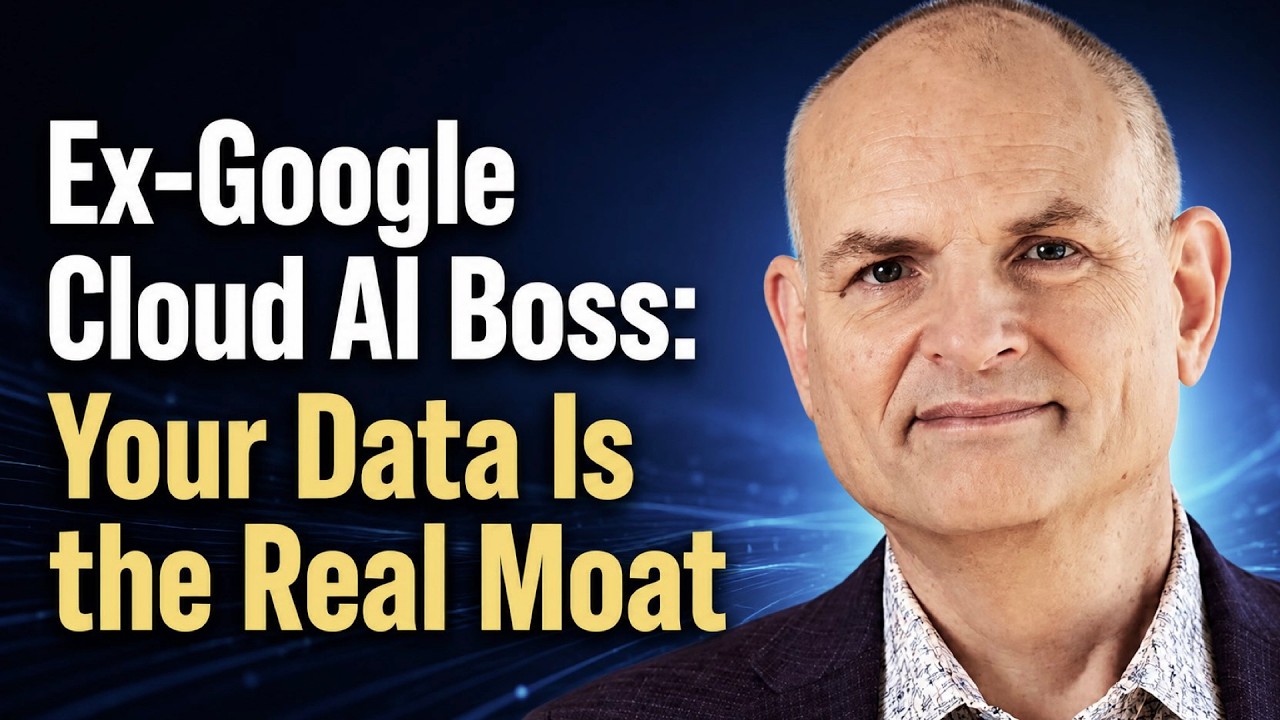
Andrew Moore, CEO of Lovelace AI and former head of Google Cloud AI and Dean of Carnegie Mellon’s School of Computer Science, introduces Lovelace AI as “the context engine for enterprise agents,” focused on mission-critical analysis. Lovelace’s core offering, YottaGraph, is a rapidly growing knowledge graph, currently expanding by approximately a billion facts weekly. It aims to be a comprehensive “system of record of human activity,” encompassing companies, global transportation movements (ships, aircraft), and events from news and social media. YottaGraph is designed for high-speed updates, often within minutes for dynamic data like vehicle movements, enabling AI agents to provide immediate answers to complex queries.
Unlike Google’s public web-focused Knowledge Graph, Lovelace focuses on providing “knowledge graph in a box” solutions for large organizations, including government, financial institutions, and startups. This allows them to integrate their sensitive, internal data with relevant public knowledge, addressing use cases such as wildfire monitoring, shipping safety, anti-money laundering, and anti-sex trafficking—domains where Google’s public scanning is insufficient. YottaGraph is engineered for extremely fast multi-hop queries, capable of traversing millions of nodes in under a second to perform inferences. This enables “blast radius” analysis, identifying patterns and impacts across vast datasets, crucial for threat detection (e.g., identifying hidden relationships in maritime activities, such as unusual fuel consumption pointing to weapon smuggling).
Recognizing the common enterprise challenge of lacking or struggling to maintain knowledge graphs (the “no graph” problem often faced by GraphRAG initiatives), Lovelace champions completely automatic knowledge graph construction. At a scale of billions of facts, automation is paramount, with suites of AI agents performing corroboration and double-checking to ensure data quality and identify misinformation. Human oversight is strategic, allowing high-level questioning and validation without manual data-matching toil. Lovelace ingests both structured (e.g., relational databases) and unstructured data (PDFs, images of documents, JSON snippets), transforming everything into “fetch messages”—a general-purpose intermediate form that serves as the “embryos” for graph nodes and relationships. This approach ensures AI understands the full context of data, regardless of its original format.
A critical component is entity resolution (ER), which Moore describes as a “bleep censored nightmare” but essential. Lovelace developed its own ER engine to handle the scale and nuances of enterprise data, particularly in environments with merged companies and diverse schema ‘accents.’ The system supports ‘schemaless flavors and properties,’ allowing it to identify and incorporate genuinely novel entity types and relationships dynamically, adapting its semantics as more evidence is processed. Lovelace’s ER is multilingual and relies on non-lexical evidence (e.g., physical movements of aircraft) alongside textual cues for robust identity resolution. Multiple agents checking each other’s work and rigorous golden sets ensure high accuracy and enable porting across different LLM families, as customer choice dictates the underlying models.
Key ‘do not try this at home’ aspects for knowledge graph success include:
- Amendability and Auditability: Graphs cannot be static. They must support ‘massive undos’ and version control, with complete lineage back to original ‘fetch messages.’ This ensures accountability for regulatory scrutiny and allows the graph to learn from and correct its own mistakes, a stark contrast to manually built, inflexible graphs.
- Fast Multi-Hop Reasoning: Naive graph traversal on a large graph can lead to intractable computational loads (e.g., 25 billion paths for a two-hop query). Lovelace employs advanced graph theory tricks, custom low-level storage (not off-the-shelf graph databases), and approximate probabilistic inference (employing ‘responsible statistical crimes’ like randomized algorithms and spectral decompositions) to quickly answer complex ‘influence’ questions within fractions of a second. This pragmatic approach prioritizes actionable insights over mathematically ‘perfect’ but slow Bayesian models, outperforming general LLM reasoning for such tasks.
Elemental serves as a context engine for enterprise agents, empowering them with fast, precise answers from a reliable knowledge graph. This unlocks enterprise data, transforming it into a true competitive ‘moat.’ Lovelace prioritizes secure deployment, installing its technology directly within the customer’s tenant, ensuring data never leaves their control and operates autonomously without Lovelace engineers accessing sensitive information. The system is also designed for multimodality, integrating diverse data types like satellite imagery to track entities.
Reflecting on computer science education, Moore observes unpredictable enrollment trends. He advocates for fostering adaptability, imaginative use of AI tools, and a stronger emphasis on ‘product management’ and design within CS curricula. This prepares students to understand why people will use what they build, focusing on computational thinking, data, mathematics, probability, and game theory, rather than solely on coding skills that AI tools are increasingly handling. He warns against the US ceding ground in open-weights model development, citing national security implications and the inventiveness that arises from engineering constraints, as seen with models like DeepSeek from other countries. While acknowledging Google’s Gemma, he stresses the continuous need for domestically produced open-weights models as a business and strategic imperative.