Physical AI Forum | Builders Reveal the New Moat & Playbook | Creator & Founder's Cut | Mar 2026 |4K
In a live panel at the Physical AI Builders Forum, founders and operators in computer vision, robotics, and multimodal AI share their 2026 playbooks. The discussion covers the architectural differences between physical and generative AI, the strategic shift from frame AI to scene AI for enterprise value, and the critical skills needed to build and scale a modern AI business.
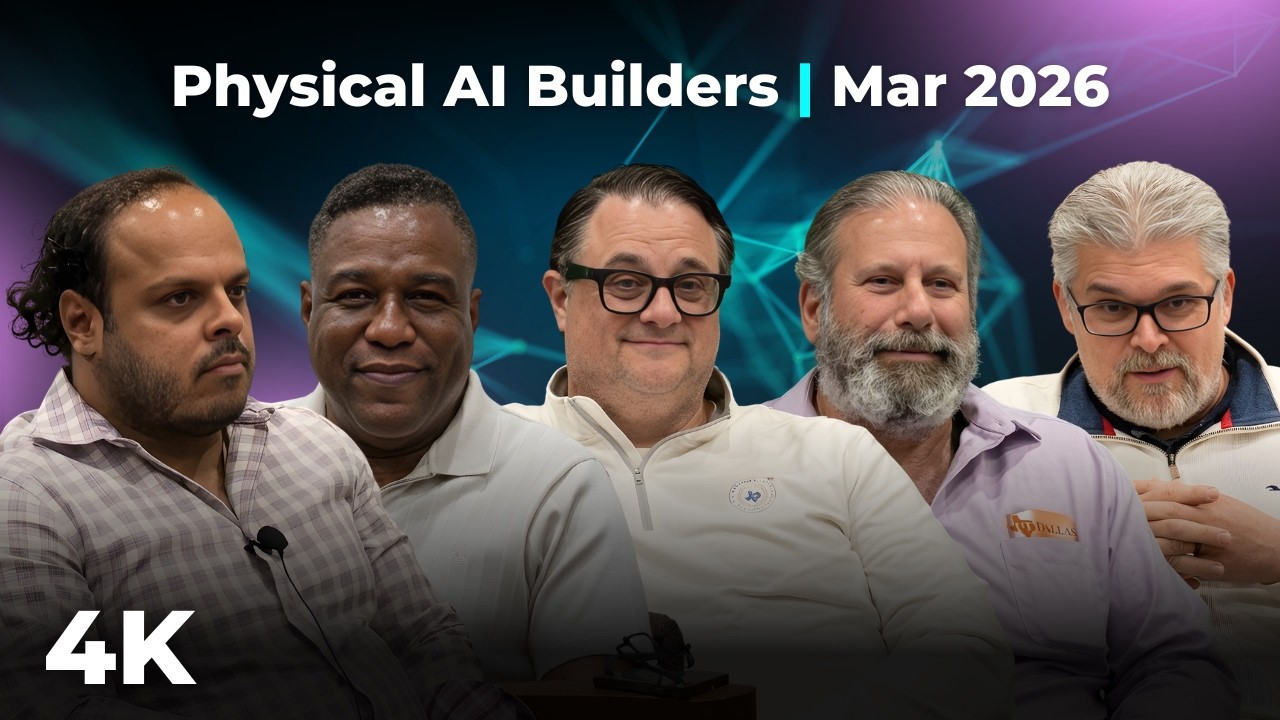
The conversation among AI builders and founders reveals a clear focus on practical, real-world applications and the strategic frameworks required to build successful businesses by 2026. The panelists share their playbooks, moving beyond the hype to discuss the architectural nuances, go-to-market strategies, and critical skills that define the next wave of AI innovation.
The Fundamental Difference: Physical AI vs. Generative AI
A critical distinction is drawn between generative AI and physical AI. Skip Howard, with a background in robotics and computer vision, articulates this difference with precision.
- Generative AI is a batch process: It operates with a distinct beginning and end, iterating on prompts and data to produce an output.
- Physical AI is “always on”: It functions as a persistent sensor, constantly observing the world and throwing off asynchronous messages. This “never off” nature requires a fundamentally different architecture and problem-solving approach.
Howard refers to the simultaneous development of the physical data collection infrastructure and the digital algorithms as “co-development,” a complex but necessary process for building robust physical AI systems that can debug both the physical and digital environments.
The Power of Context: From Frame AI to Scene AI
Alex Siskos, a veteran in retail analytics, explains the critical evolution from “Frame AI” to “Scene AI.”
- Frame AI: Is compared to blinking rapidly while watching a moving hand—you get snapshots but miss the context and the full story.
- Scene AI: Provides the necessary context by analyzing the entire sequence of events. This allows a system to understand not just what is happening, but why, and what the implications are.
The core purpose of this technology in the enterprise is to “protect people, process, and profitability.” By understanding the full scene, businesses can move beyond simple alerts to achieve real speed-to-value, reduce false positives, and build trusted, scalable solutions. This involves fusing data from multiple sensors—computer vision, LiDAR, RFID—to get a complete picture of the physical world.
Building the Modern AI Professional
The panel agrees that while AI is a powerful tool, it does not replace fundamental human skills. The most valuable professionals in the AI space will possess a blend of technical knowledge and critical thinking abilities.
- Critical Thinking and Creativity: AI is not truly creative; it cannot invent a cake if it has only ever been trained on cookies. The ability to think critically, dream up new applications, and remain curious is paramount.
- Domain Expertise: Understanding the “ontology” of a specific business vertical—be it insurance, retail, or motorsports—is essential. AI can help accelerate the acquisition of this knowledge, but it cannot replace the deep understanding that comes from experience.
- Perspective: The ability to see a problem from multiple viewpoints (e.g., as both a race car driver and a track owner) is crucial for innovation. AI can act as a tool to synthesize these varied perspectives into a coherent roadmap.
Real-World Playbooks for 2026
The discussion highlights how these concepts are being applied to build and scale businesses.
AI in Business Operations and Strategy
Sanjay Kalluvilayil shares his own experience of using his domain expertise to guide AI for his podcast, focusing on “Generative Engine Optimization (GEO)” and adhering to Google’s E-E-A-T (Experience, Expertise, Authoritativeness, and Trust) principles to create content that AI crawlers will favor.
Victor Perry provides concrete examples from his motorplex project, where AI is used for:
- Site Development: Analyzing LiDAR data to identify floodplains and optimize drainage.
- Architectural Design: Generating plans for building structures, including specialized needs like soundproofing. This direct application saves significant money and time by preempting engineering challenges.
Crafting Immersive Customer Experiences
Steve Deeb explains that for products where the “product is the experience,” multimodal conversational AI is key. By using a combination of voice, audio clips, video, and images, a business can create an “emotional anchor” that brings the experience to life for a customer before they even make a purchase. For a racetrack, this means conveying the sound, wind, heat, and exhilaration of the event during the ticket-buying process.
A Case Study: The AI-Powered Motorplex
The panel synthesizes these ideas into a vision for an AI-powered motorplex:
- Safety and Security: Computer vision can monitor crowds for medical emergencies—like a person having a diabetic episode or a stroke—and automatically dispatch EMS, providing a faster response than human reporting.
- Operational Efficiency: AI can manage queue lengths, track pit stop speeds, and even use robotics for concierge services.
- Enhanced Fan Engagement: Biometrics and facial recognition can be integrated to create immersive, personalized experiences for spectators and valuable telemetry data for race teams. All this data, from how much soda a fan drinks to their emotional response, can be collected and analyzed to continually optimize every aspect of the business.