Knowledge graph

Agentic SDLC at Uber — Uday Kiran Medisetty & Adam Huda, Uber

Agentic SDLC at Uber — Uday Kiran Medisetty & Adam Huda, Uber

Uber has transformed its software development with an agentic AI-powered factory, leading to a dramatic increase in engineer productivity. The presentation details six key infrastructure components: a unified model gateway with strict PII and safety guardrails, an MCP gateway for streamlined agent tool access and token optimization, agentified dev pods for rapid execution, a managed skills marketplace, a comprehensive context graph, and the Cortana AI assistant. Adam Huda then demonstrates an end-to-end feature development workflow, highlighting a critical shift to inner-loop validation (stopping short of CI) and automated, managed maintenance loops. The ultimate takeaway is that the bottleneck has moved from technical execution to strategic decision-making: "should we build it?" rather than "can we build it?"

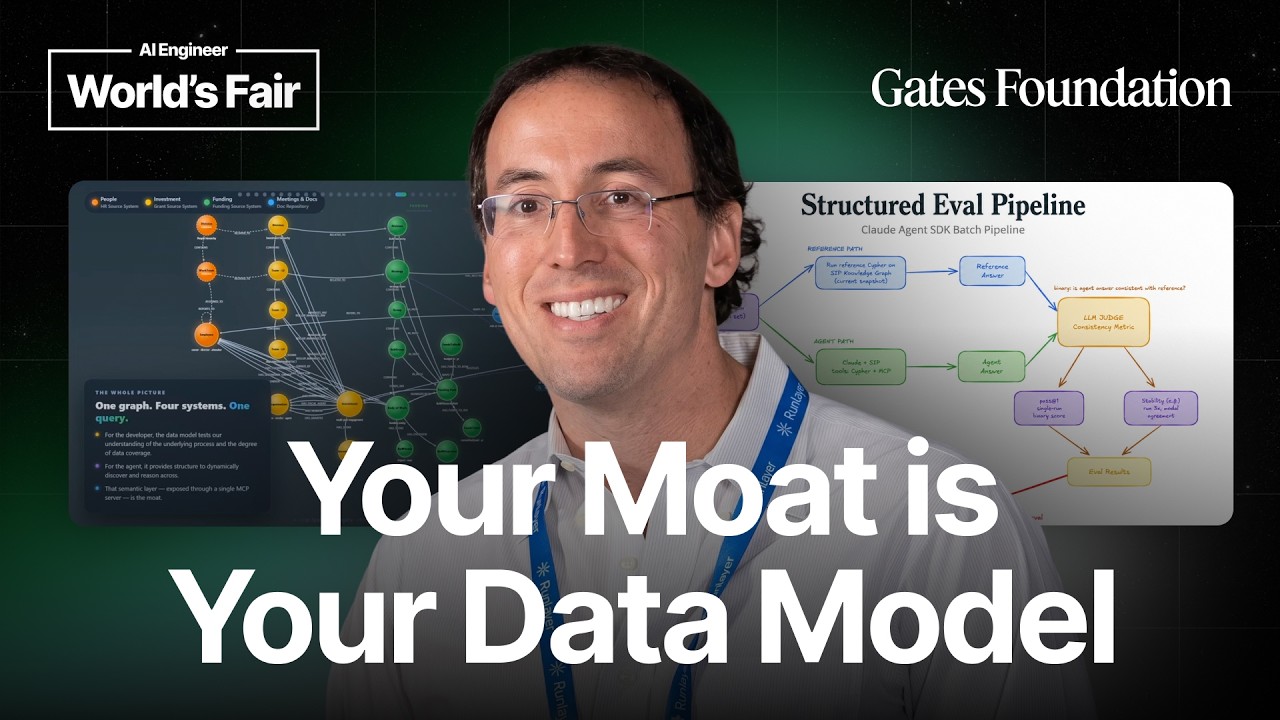
Your Moat Is Your Data Model — Mike Phipps, Gates Foundation

Your Moat Is Your Data Model — Mike Phipps, Gates Foundation

Mike Phipps from the Gates Foundation details how they built a Strategic Intelligence Platform (SIP) using a Neo4j knowledge graph to serve AI agents. He argues that the true "moat" in an AI-commoditized world lies in an organization's unique data model and tacit knowledge, not in generic AI tools. The platform unifies 25 years of siloed grantmaking data, integrating structured and unstructured information through a rigorous curation pipeline, and is refined via continuous retrieval evaluations to ensure alignment with organizational reporting standards.

Ex-Google Cloud AI Boss: Your Data Is the Real Moat

Ex-Google Cloud AI Boss: Your Data Is the Real Moat

Andrew Moore, CEO of Lovelace AI, discusses YottaGraph, a rapidly growing, automatically constructed knowledge graph designed as a context engine for enterprise AI agents. He highlights Lovelace's differentiation from public knowledge graphs by focusing on integrating private enterprise data, the engineering challenges of entity resolution and fast multi-hop reasoning, and the critical importance of graph amendability and auditability for mission-critical applications. Moore also touches upon the future of computer science education, advocating for product management skills and emphasizing the strategic importance of domestically developed open-weights models.

Distilling 200+ Hours of NeurIPS: What’s Next for AI // Nikolaos Vasiloglou // MLOps Podcast #336

Distilling 200+ Hours of NeurIPS: What’s Next for AI // Nikolaos Vasiloglou // MLOps Podcast #336

Nikolaos Vasiloglou, VP of Research ML at RelationalAI, shares his extensive analysis of the 2023 NeurIPS conference, distilling over 200 hours of content. Key themes include the dominance and evolution of agentic AI, the state of open-source vs. frontier LLMs, the first signs of deep learning models outperforming XGBoost on tabular data, and the critical rise of verification systems. He also explores the future of AI with data attribution for monetization and the concept of composable, LEGO-like language models.

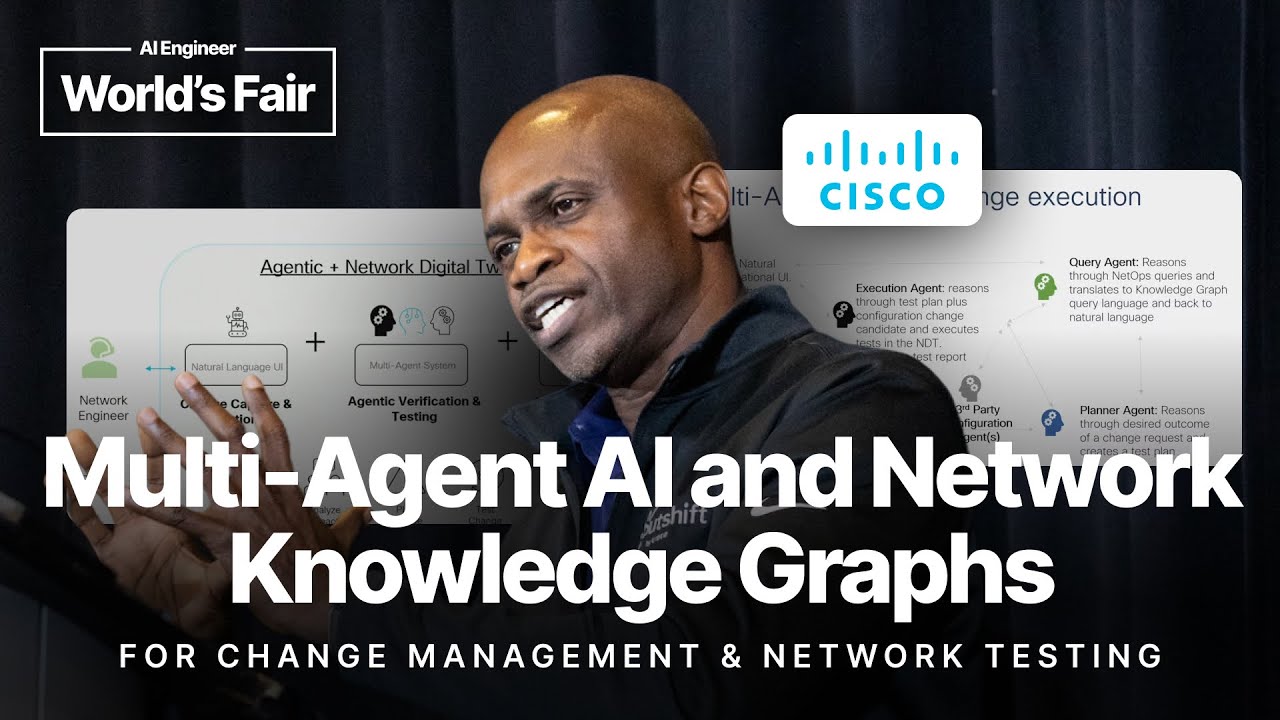
Multi Agent AI and Network Knowledge Graphs for Change — Ola Mabadeje, Cisco

Multi Agent AI and Network Knowledge Graphs for Change — Ola Mabadeje, Cisco

A product manager from Cisco's incubation group, Outshift, details a solution that uses a multi-agent AI system combined with a dynamic network knowledge graph to solve critical issues in IT change management. The system integrates with ITSM tools like ServiceNow to automate impact assessment, test plan generation, and pre-production validation in a "digital twin" environment, significantly reducing production failures.

How Grounded Synthetic Data is Saving the Publishing Industry // Robert Caulk

How Grounded Synthetic Data is Saving the Publishing Industry // Robert Caulk

Robert from Emergent Methods discusses how grounded synthetic news data can solve the publisher revenue crisis in the AI era. He details the process of 'Context Engineering' news into token-optimized, objective data for high-stakes AI agent tasks, covering their open-source models for entity extraction and bias mitigation, and the on-premise infrastructure that protects publisher content.