Coding Agents Are Secretly General Agents

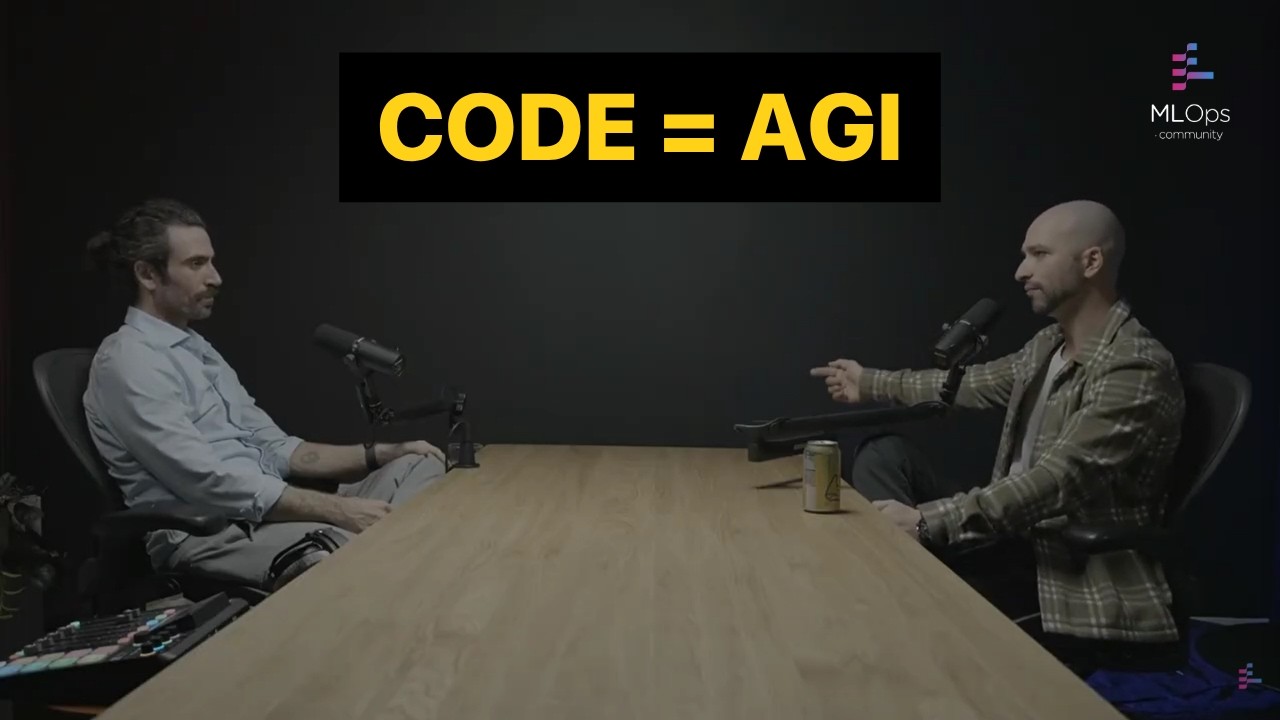
Jay Hack, head of AI at ClickUp, discusses the evolution of AI from early computer vision to generalist coding agents, highlighting how 'positive transfer' makes coding an 'AGI-complete' domain. He delves into the brutal economics of AI startups facing foundation model giants, ClickUp's strategy for convergence and first-party data as a moat, and the challenges of verifiability and catastrophic forgetting. The conversation also explores LLMs at the scientific frontier, the 'car wash test' revealing limits of world models, and speculative future applications like LLM resorts and game integration.
2 min read
Coding Agents Are Secretly General Agents
source: https://www.youtube.com/watch?v=LuE1YptpfXs

Jay Hack, with a background in AI dating back to 2008, traces the evolution of artificial intelligence from early computer vision techniques (Sift features, SVMs) to the transformative impact of large language models. He notes that early code generation companies like TabNine and Kite, though visionary, were too early, demonstrating that momentum is key for startup success. GitHub Copilot’s integration into VS Code and Cursor’s innovative ‘composer mode’ with sidebar chat using Claude Sonnet 3.5 marked significant inflections by seamlessly injecting AI into workflows.

Hack’s personal journey into AI was driven by a fascination with recursive self-improvement and systems of self-reference, inspired by books like “Gödel, Escher, Bach.” The release of GPT-3 in 2020, with its few-shot learning capabilities, convinced him of the technology’s potential. His

Share post

Stay In The Loop! Subscribe to Our Newsletter.

Get updates straight to your inbox. No spam, just useful content.

Recommended for You

Understanding the inner thoughts of AI

Understanding the inner thoughts of AI

Neel Nanda, head of Google DeepMind's language model interpretability team, discusses the critical field of interpretability, likening it to the "neuroscience of AI." He explains why understanding the internal workings of "grown, not designed" neural networks is crucial for AI safety and scientific discovery. The episode explores cutting-edge techniques like Chain of Thought monitoring, mechanistic interpretability (steering and probing), and Sparse Autoencoders, highlighting their strengths and limitations in debugging, detecting deception, and uncovering hidden model objectives. Nanda emphasizes interpretability's role in building safe, aligned, and trustworthy AI as we approach AGI, acknowledging its pragmatic necessity despite inherent limits to full understanding.

The future of intelligence | Demis Hassabis (Co-founder and CEO of DeepMind)

The future of intelligence | Demis Hassabis (Co-founder and CEO of DeepMind)

Google DeepMind CEO Demis Hassabis discusses the path to AGI, focusing on the scientific frontiers of the next decade. He covers the importance of solving 'root node' problems like fusion energy, the challenge of 'jagged intelligence' in current models, and the promise of world models and simulations like Genie and SimA. The conversation also explores the balance between scientific rigor and commercial competition, and the profound societal and philosophical questions AGI will force us to confront.