Catastrophic forgetting

Rich Sutton and Khurram Javed: Why AI Models Stop Learning, and How to Start It Again

Rich Sutton and Khurram Javed: Why AI Models Stop Learning, and How to Start It Again

Rich Sutton and Khurram Javed discuss their radical vision for AI at Oak Lab, advocating for truly continual learning agents that learn from their own experience, rejecting synthetic data due to the "Big World Hypothesis," and outlining a path to overcome catastrophic forgetting with "continual backprop" for a trillion-parameter, self-maintaining mind, while critiquing LLMs as only a fraction of intelligence.

Coding Agents Are Secretly General Agents

Coding Agents Are Secretly General Agents

Jay Hack, head of AI at ClickUp, discusses the evolution of AI from early computer vision to generalist coding agents, highlighting how 'positive transfer' makes coding an 'AGI-complete' domain. He delves into the brutal economics of AI startups facing foundation model giants, ClickUp's strategy for convergence and first-party data as a moat, and the challenges of verifiability and catastrophic forgetting. The conversation also explores LLMs at the scientific frontier, the 'car wash test' revealing limits of world models, and speculative future applications like LLM resorts and game integration.

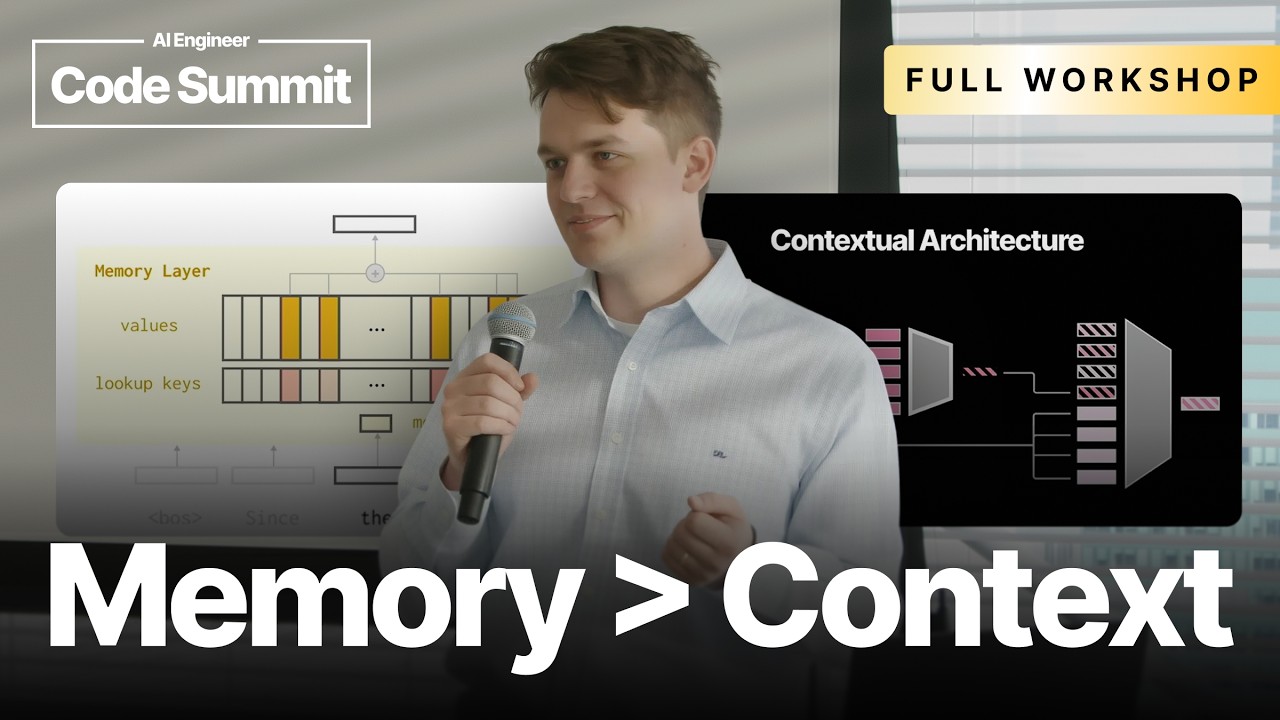
Memory in LLMs: Weights and Activations - Jack Morris, Cornell

Memory in LLMs: Weights and Activations - Jack Morris, Cornell

This talk explores the limitations of current methods for providing knowledge to LLMs, such as large context windows and Retrieval-Augmented Generation (RAG). The speaker argues that the future lies in training knowledge directly into the model's weights. This is achieved through a combination of generating large synthetic datasets from small amounts of source material and using parameter-efficient fine-tuning (PEFT) techniques like LoRA to avoid catastrophic forgetting. The goal is to create more capable, personalized, and efficient models by fundamentally altering how they store and access information.