Why Your AI Agent Needs a Wallet: USDC and Nanopayments — Harshal Bhangale, Circle
Harshal Bhangale from Circle demonstrates how AI agents equipped with a digital wallet, powered by USDC and Circle's Nanopayments, can autonomously pay for microtransactions at high frequency. He contrasts this with traditional payment methods and blockchain limitations, showing how funded agents successfully execute complex tasks (like trip planning with email and phone calls) that unfunded agents cannot, emphasizing the need for real-time, low-cost payment infrastructure for the agentic economy.
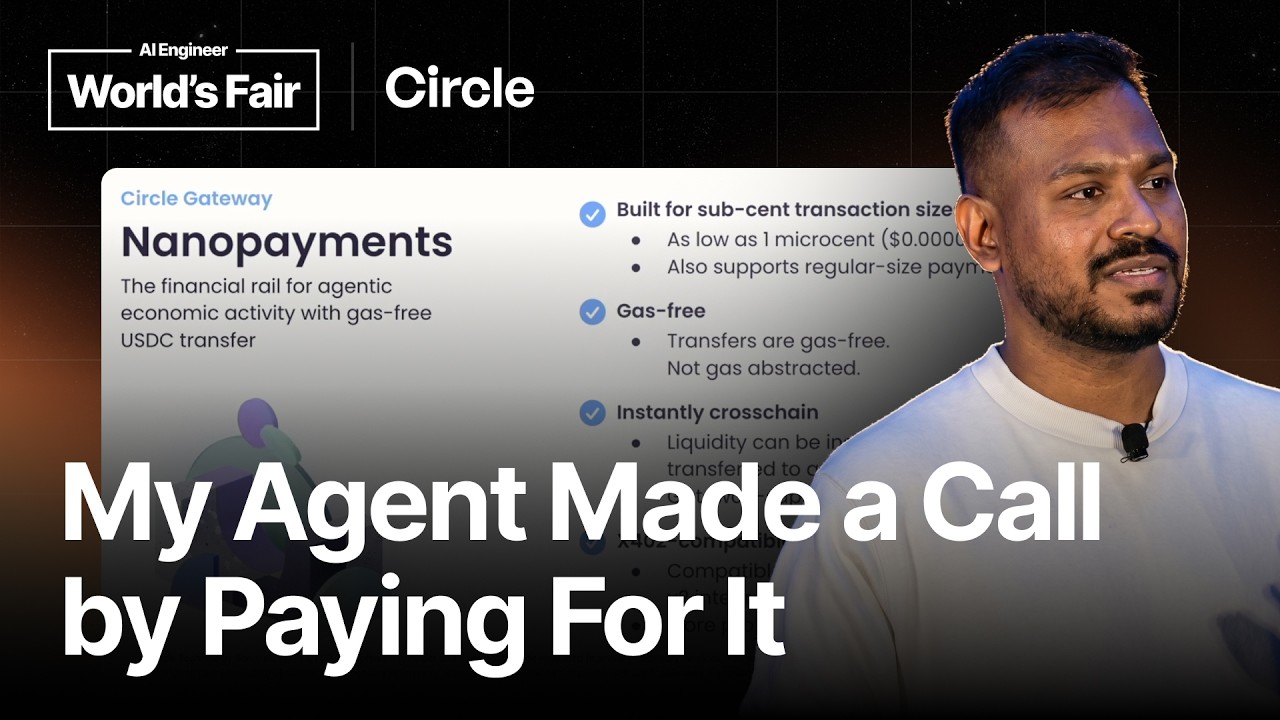
Harshal Bhangale, an engineer on Circle’s agentic product team, opened by addressing the common question of why a stablecoin company like Circle was present at an AI engineering conference. He explained that Circle, as the issuer of USDC—the world’s largest regulated stablecoin—has developed expertise in making payments simpler and cheaper. This expertise directly addresses a critical bottleneck for AI agents: the inability to pay for services.
While advancements in AI agents often focus on better models, more tool calls, and complex orchestration, Bhangale argued that agents frequently stall when encountering a paywall. Traditional payment systems, designed for human interaction over the last 30 years, require steps like account creation, sign-ups, and API key management, which are incompatible with the autonomous operation of AI agents.
The Rise of the Agentic Economy and Payment Challenge
Bhangale posited that the “agentic economy is already here.” He traced the evolution from prompt-based interactions (2023) to workflows (2024), and then to multi-component architectures (MCPs), skills, and orchestration (2025). For 2026, he asserted, agents will begin to autonomously pay for services. He provided compelling evidence: in the last 30 days, agents transacted approximately $24 million with paid API endpoints via “X402”, with 99% of these transactions settled in USDC. He described X402 as an HTTP status (402 Payment Required) that a server returns, detailing how payment should proceed. The agent then signs an authorization from its crypto wallet, pays, and retries the request.
Traditional payment methods, particularly credit cards, are unsuitable for agents due to their consumption pattern. Agents consume data in “fractional amounts, so tiny amounts, but at a very high frequency.” Credit card fees, typically around 3%, render 1-cent transactions economically unfeasible. This microtransaction model is driven by sellers offering granular data access to agents, bypassing human-centric paywalls. Agents require payments that are real-time, low cost, programmable, and always on—qualities that the Circle Agent Stack aims to deliver.
Live Demonstration: Funded vs. Unfunded Agents
To illustrate this, Bhangale conducted a live demo with two identical Claude-based agents. Both were tasked with planning a trip to the FIFA World Cup final, including researching flights, hotels, logistics, team odds, ticket prices, fan experiences, and then summarizing the findings via email and a phone call.
- Unfunded Agent: This agent, without a Circle wallet, was able to conduct research but ultimately stalled when attempting to fulfill the communication requirements. It drafted an email into Bhangale’s Gmail inbox but could not send it, and confessed on screen its inability to make a phone call.
- Funded Agent: Equipped with a Circle agent wallet, this agent autonomously paid for premium data (e.g., using a provider called Block Run for poly market data). It successfully sent a detailed email and, crucially, made a live phone call to Bhangale on stage, even answering a follow-up question about stadium access from his hotel. Bhangale highlighted that agents with wallets can operate within pre-set “guardrails,” such as maximum spending per transaction or session, eliminating the need for human approval for every microtransaction.
The Nanopayments Solution
Bhangale then delved into the underlying technology, explaining why even direct blockchain settlements fall short for agentic use cases. While blockchains offer theoretical possibilities, their inherent gas fees can swamp microtransactions, and shared block space leads to unpredictable latency and degraded performance under load—a critical issue for agents operating at speed.
Circle’s solution is Nanopayments, an infrastructure layer built on top of their “Gateway” product. Designed for sub-cent transaction sizes (as low as one microcent), Nanopayments are gas-free for the seller and instantly cross-chain. The process involves:
- Funding a wallet with USDC (Circle facilitates USD-to-USDC on-ramps).
- Depositing funds into a smart contract.
- The agent signing off-chain authorizations (cryptographic signatures for specific amounts).
- The server (merchant) relaying these authorizations to Circle.
- Confirmation and resource release within a few hundred milliseconds, bypassing the latency of on-chain settlement for every transaction.
Conclusion: The Circle Agent Stack
In summary, the Circle Agent Stack empowers agents with autonomous spending capabilities through Circle Agent Wallets, operating within defined guardrails. On the seller side, merchants can monetize their endpoints and resources with minimal code using Circle’s SDKs. The entire system is underpinned by USDC and Nanopayments, ensuring sub-second transaction settlement speeds essential for agent operation. Bhangale invited attendees to explore this technology at agents.circle.com.