Payment infrastructure

What Happens When AI Agents Can Spend Your Money?

What Happens When AI Agents Can Spend Your Money?

Terry Angelos of VGS and Alex Rampell explore how AI agents are moving from giving recommendations to completing purchases, and what payment infrastructure must change to support that shift safely. They cover network tokenization, the wallet wars, Stripe's walled-garden approach, the new agentic token standard, liability and delegated authority, merchant resistance such as Amazon's block, and how agents could reshape rewards, subscriptions, and customer relationships.

Agent Spending Without Controls — Rodrigo Coelho & Pranav Maheshwari, Edge & Node

Agent Spending Without Controls — Rodrigo Coelho & Pranav Maheshwari, Edge & Node

Ampersand presents the critical need for a new payment infrastructure for AI agents, moving beyond traditional human-centric rails to address machine-speed transactions and stringent enterprise compliance requirements. The presentation highlights how agents require access to paid tools via a "skill file" and demonstrates agentic e-commerce, culminating in a crucial demo of real-time sanctions screening for wallet addresses.

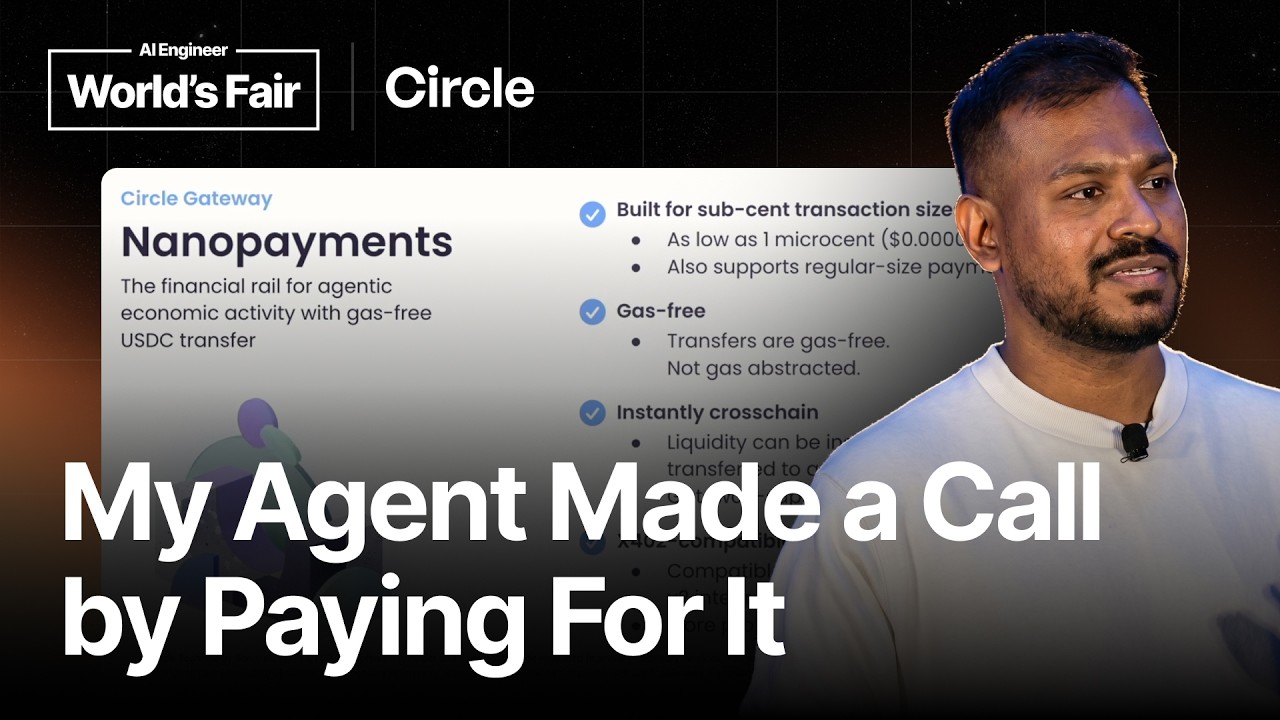
Why Your AI Agent Needs a Wallet: USDC and Nanopayments — Harshal Bhangale, Circle

Why Your AI Agent Needs a Wallet: USDC and Nanopayments — Harshal Bhangale, Circle

Harshal Bhangale from Circle demonstrates how AI agents equipped with a digital wallet, powered by USDC and Circle's Nanopayments, can autonomously pay for microtransactions at high frequency. He contrasts this with traditional payment methods and blockchain limitations, showing how funded agents successfully execute complex tasks (like trip planning with email and phone calls) that unfunded agents cannot, emphasizing the need for real-time, low-cost payment infrastructure for the agentic economy.

Building safe Payment Infrastructure for the autonomous economy — Steve Kaliski, Stripe

Building safe Payment Infrastructure for the autonomous economy — Steve Kaliski, Stripe

This talk addresses the challenge of enabling AI agents to spend money autonomously and safely. Steve Kaliski from Stripe presents a framework for separating non-deterministic discovery from deterministic transactions. He introduces three key components of Stripe's solution: Shared Payment Tokens for secure credential sharing with enforced spending limits, the Machine Payments Protocol for paying for API tool calls, and the Agent to Commerce Protocol (ACP) for structured, API-driven e-commerce checkouts. Through code examples, the talk demonstrates how these primitives create a secure and auditable payment infrastructure for the emerging autonomous economy.