How AI Agents Will Transform the Financial System with Circle Co-Founder and CEO Jeremy Allaire
Circle CEO Jeremy Allaire delves into how programmable money and the Arc blockchain will power the emerging AI agentic economy. He explains how stablecoins like USDC offer an internet-native financial infrastructure for micro-transactions and large settlements, addressing the limitations of traditional banking for AI agents. The discussion covers the foundational principles of full-reserve banking, the unique attributes of Arc blockchain for machine-driven economic activity, the tokenization of real-world assets, and a bold vision for AI's potential to drive double-digit GDP growth and foster new on-chain organizational structures within the next decade.
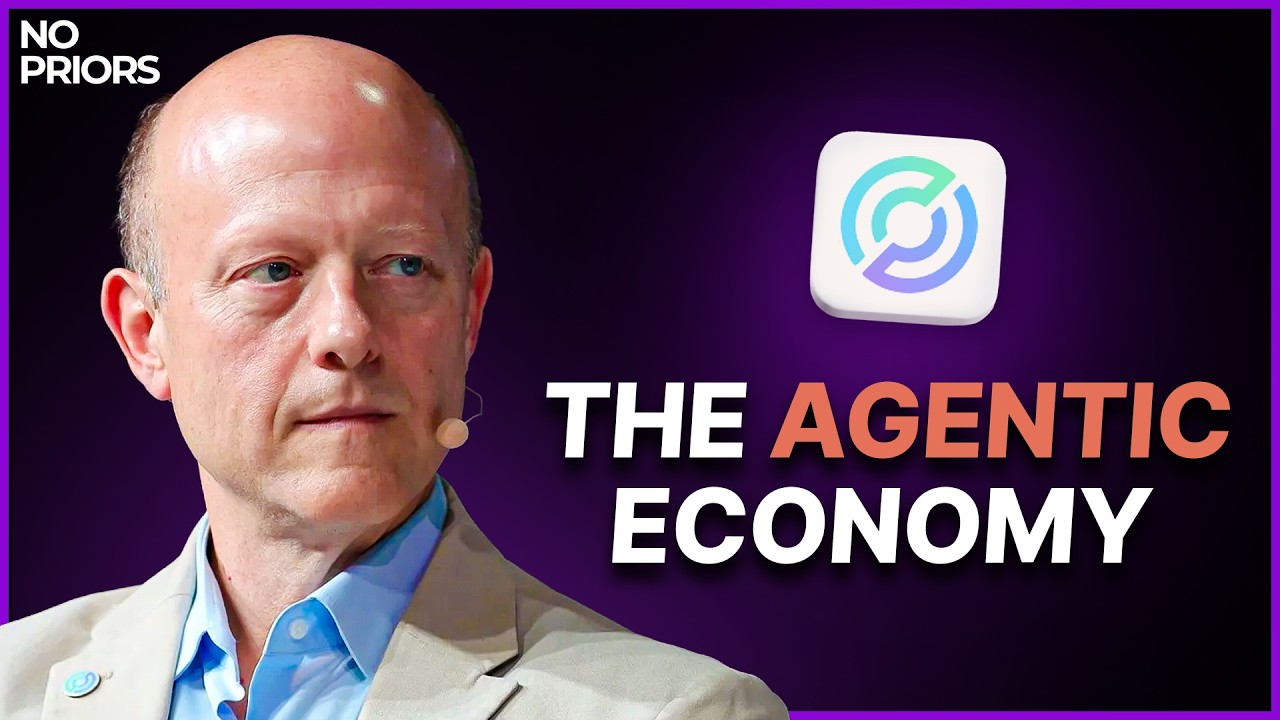
Jeremy Allaire, co-founder and CEO of Circle, discusses the evolution of financial systems, the role of stablecoins, and the emergence of an AI-driven “agentic economy” facilitated by blockchain technology, specifically Circle’s Arc blockchain. The core idea is to create an internet-native protocol for dollars and programmable money, moving towards a future where machines drive economic activity.
Circle’s Origin and the Vision for Programmable Money
Circle was founded over a decade ago with the vision of establishing a “protocol for dollars on the internet.” Inspired by technologies like Bitcoin, the goal was to enable instant, global, frictionless, and ultimately cost-free value transfer. A key early concept was “programmable money,” envisioning blockchains as operating systems where autonomous software machines could intermediate economic and financial activity. This foundational idea aimed to create a safer, more accessible, and efficient financial system, deriving new utility from money.
Full Reserve Banking and the Role of Stablecoins
Allaire emphasizes that his interest in creating a safer financial system was rooted in Austrian economic thought and the concept of full reserve money, drawing parallels to the Chicago Plan debated during the Great Depression. Unlike fractional reserve banking, full reserve money involves currency fully backed by underlying assets, preventing leverage and risk-taking inherent in traditional banking. Stablecoins, particularly dollar stablecoins like USDC, embody this model. USDC is backed primarily by short-duration US government treasuries and cash, held in secure custodial institutions like Bank of New York. Recent legislation, such as the Genius Act, has codified these requirements, ensuring that stablecoins operate as “narrow money” and providing regulatory clarity.
USDC: Use Cases and Advantages
USDC is designed as a general-purpose, internet-native architecture for money, operating on internet protocols. Its use cases span from micro-transactions (e.g., 25 cents for a digital object in a game, or AI agents paying for output from other AI agents) to multi-hundred-million-dollar capital market settlements by large electronic trading firms. Key advantages include:
- 24/7 Accessibility: Transactions can occur at any time, eliminating the constraints of traditional banking hours.
- Low Transaction Costs: The cost to transact has become reliably sub-cent, enabling a higher velocity of money and more frequent transactions.
- Global Access: USDC facilitates the “export” of the dollar, providing global access to US dollars for individuals and businesses who might not have direct access to traditional banking.
- Programmability: As programmable money, USDC allows developers to connect to its public API (smart contracts) without permission, enabling the creation of applications with global digital dollar utility.
Blockchains as Economic Operating Systems for the Agentic Economy
Allaire views blockchain networks as robust operating systems. They offer unique attributes crucial for a future driven by AI agents:
- Tamper-Resistant Code: Once published, software running on a blockchain is effectively tamper-resistant.
- Perfect Auditability: Every input and output of a blockchain-based machine is auditable in real-time.
- Transaction and Compute Integrity: Blockchains provide assurances that machines perform as intended, with provable inputs, outputs, and state. This integrity is vital for autonomous actions in the economy.
This framework is essential for the emerging “agentic economy,” where AI agents collaborate, consume services, and require a trustworthy, interoperable, and globally accessible financial infrastructure that traditional banking cannot provide. This infrastructure must support potentially billions or trillions of transactions, including micro-scale payments, in real-time between any hardware or software globally.
Circle’s Arc Blockchain: An Economic Operating System for Machines
Circle’s Arc blockchain is designed as an “economic operating system” specifically for this moment, where machines play an increasingly central role in economic output. Arc distinguishes itself from earlier blockchain designs through:
- Known Validator Set: The infrastructure is run by a known set of major financial infrastructure companies, ensuring high standards for security, compliance, reliability, and availability. This provides assurances against malicious actors and guarantees deterministic settlement finality.
- Real Money as Foundation: USDC, a regulated electronic money, is the native token, eliminating volatile gas tokens. This provides a stable and understandable budgeting model for corporations.
- Built-in Primitives: Arc incorporates primitives for payment systems, capital markets, and privacy requirements, allowing for compliance while enabling open, interoperable infrastructure. This design reflects insights gained from working with leading financial institutions and governments globally.
Broader Crypto Trends: Scaling, Privacy, and Real-World Asset Tokenization
Allaire highlights several impactful trends beyond stablecoins:
- Scaling Models: Technologies like ZK (zero-knowledge) rollups and zero-knowledge proofs are critical for scaling blockchain networks. They enable off-chain computation with on-chain verification, supporting a future with billions of AI agents.
- Privacy Tech: Research and development in privacy-enhancing technologies are moving into production, allowing for privacy within open, permissionless infrastructure – crucial for corporate and individual users.
- Real-World Asset (RWA) Tokenization: The tokenization of assets like stocks and treasuries is accelerating, with increasing regulatory clarity and adoption by major financial institutions (e.g., DTCC, Nasdaq, NYSE). This aims to unlock new utilities beyond mere digitization, such as fractionalization, new borrowing/lending models, and novel packaging of assets. Circle itself offers tokenized treasury products and is seeing growth in tokenized stocks (e.g., tokenized Circle stock).
- Productive Proof of Work: The concept of using GPU inference as a form of “productive proof of work” for cryptocurrencies is discussed as a potentially more efficient and purposeful alternative to energy-intensive mining, aligning energy consumption with useful computational tasks.
The 10-Year Future Vision: AI, New Economic Structures, and GDP Growth
Looking ahead 10 years, Allaire predicts an accelerating pace of AI diffusion that will profoundly reshape society. He envisions a renegotiation of the “social contract” globally, leading to the emergence of new social, political, and economic organizational structures. Specifically, he expects a proliferation of “on-chain organizations” that blend human and AI actors, featuring novel governance and contracting mechanisms. These corporate forms could be “the most productive corporate forms that we’ve ever seen in economic history.” Allaire believes that AI’s impact could lead to “double-digit GDP numbers in the 2030s” in many parts of the world, a significant discontinuous jump in productive output, though acknowledging the need for new societal frameworks to manage this transformation.