How Bots, Deepfakes and AI Agents Are Forcing a New Internet Identity Layer | Alex Blania on a16z
Alex Blania, cofounder and CEO of Tools for Humanity (Worldcoin), details the critical challenge of proving human uniqueness in the AI era. He explains Worldcoin's iris biometric approach, its sophisticated privacy architecture using Multi-Party Computation and Zero-Knowledge Proofs, and the pervasive impact of AI agents and deepfakes on social media, dating, gaming, and government. Blania also outlines Worldcoin's strategy to scale this proof-of-human network globally, particularly in the US.
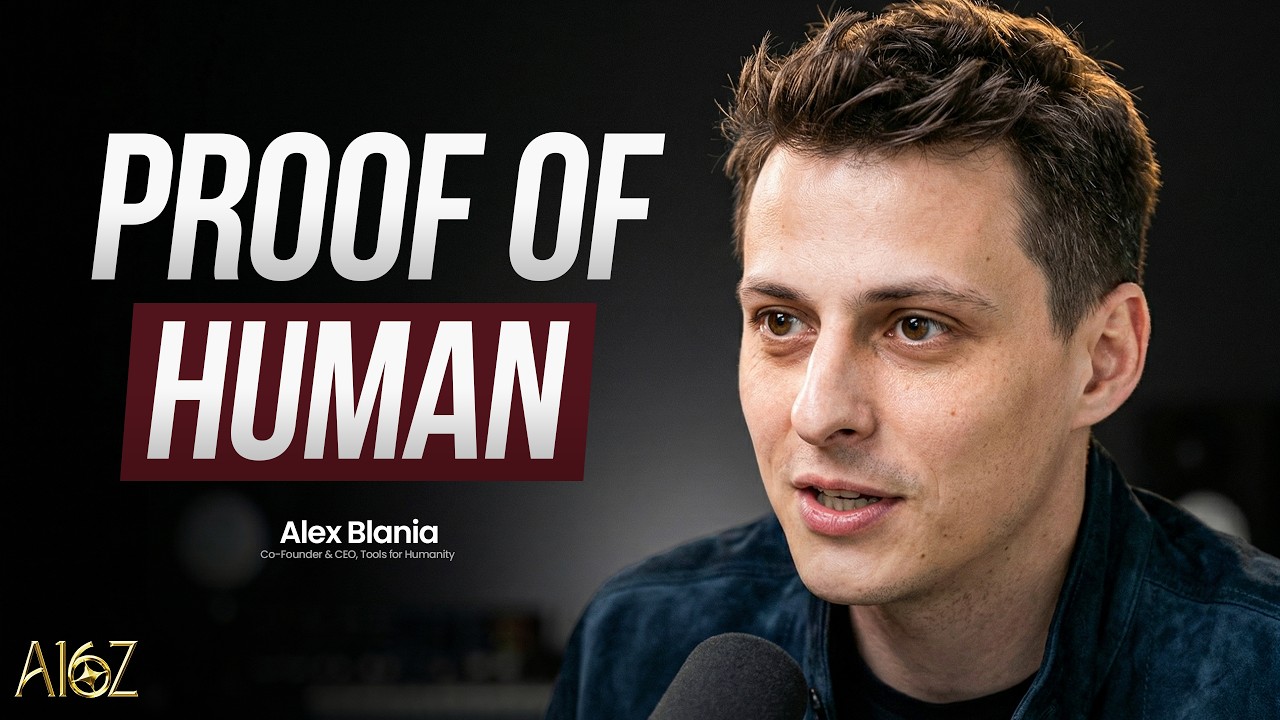
Alex Blania, cofounder and CEO of Tools for Humanity (Worldcoin), discusses the burgeoning challenge of proving human uniqueness in an age increasingly dominated by AI. He emphasizes that the current prevalence of bots is a mere glimpse of what’s to come, with AI’s ability to program humans far exceeding humans’ capacity to program AI. The core problem, dubbed “Proof of Human,” revolves around distinguishing genuine human interaction from that of agents acting on behalf of humans, or autonomous AI agents.
The Uniqueness Problem and Rejected Solutions
Blania explains that the fundamental difficulty of Proof of Human lies in uniqueness: verifying that an individual has only one account and remains its sole owner. This requires not just authentication (one-to-one comparison) but verification against all existing individuals (one-to-N comparison) — an exponential problem demanding high mathematical entropy.
Three main approaches were considered initially:
- Web of Trust: This relies on digital behavior and attestations from known individuals. It was quickly discarded because “an AI will be able to have a GitHub account and will be able to post and own an account and like also attest to five other AI’s that these are in fact humans and even though they’re not.” Anything purely digital can eventually be mimicked by AI.
- Government IDs: Rejected due to concerns about government control over fundamental infrastructure (free speech), loss of anonymity, and the impracticality of a global solution. Existing government ID systems are not designed for global, real-time proof of human verification across billions of users.
- Biometrics: While often eliciting a “sick reaction,” biometrics emerged as the most viable path, specifically iris recognition due to its high entropy. Blania notes that iris ID is already integrated into devices like Apple’s Vision Pro, suggesting future normalization.
Worldcoin’s Iris Biometric Approach and Privacy Architecture
To address the challenges of biometric verification, Worldcoin developed the Orb – a custom hardware device designed to prevent replay attacks. The Orb uses multiple sensors across the electromagnetic spectrum to ensure a live human iris is being scanned, not a display or photograph.
Worldcoin meticulously engineered its privacy architecture, focusing on two advanced cryptographic techniques:
- Multi-Party Computation (MPC): When a user verifies with an Orb, their iris images are processed on the device to create an “iris code.” This code is then broken into multiple pieces and distributed across several independent computers. No single entity holds the complete iris code, preventing the formation of a central database and ensuring privacy during the uniqueness check. The parties collaborate to confirm uniqueness without reconstructing the full data.
- Zero-Knowledge Proofs (ZKPs): This technology allows a user to prove their uniqueness to a platform (e.g., a social network) without revealing their secret identity or any personal information to Worldcoin or the platform. The user’s phone holds a unique secret, and through ZKPs, they can attest to being a unique, verified human without compromising anonymity. Blania summarizes this as: “no one knows anything about you, but you can actually together make a statement about you.”
For ongoing authentication, a signed face image is sent to the user’s phone after Orb verification. While new iPhones can securely re-authenticate with this, older Android devices are vulnerable to deepfake injection, potentially requiring more frequent re-verification with an Orb.
The Widespread Impact of AI and Need for Proof of Human
Blania highlights numerous domains where the distinction between human and AI will become crucial:
- Social Media: Current bot issues are minor compared to future AI-driven psyops and propaganda. Platforms will struggle to function without clear human verification.
- Dating Apps: Ensuring users are interacting with real, authentic people. Tinder, for instance, is already using Worldcoin verification to badge users and confirm profile authenticity.
- Video Conferencing: Real-time, photorealistic deepfakes will make it impossible to know who is on the other end of a call, especially for high-value interactions.
- Gaming: Players want to compete against humans, not superhuman AIs, particularly when money or competitive integrity is involved.
- Creator Economy & Video Platforms: AI can generate vast amounts of content at scale (e.g., 100 AI YouTube videos daily), leading to questions about monetization models (human vs. AI views) and the value of human-created content. People often connect with creators on a personal level, which would be undermined by AI impersonation.
- Government & Economic Systems: The ability to send money to unique humans (e.g., stimulus checks, social security) and prevent massive fraud will be critical. Without cryptographically strong identity, democratic processes (e.g., voting verification) could be compromised by large-scale impersonation.
Blania underscores the urgency: “If you don’t take it serious now, then I think you just you you should get a different job or something. They’re just like not thinking about problems in the right way.”
Worldcoin’s Go-to-Market Strategy and Future
Worldcoin is navigating a “multi-sided problem” involving platform adoption, Orb distribution, and user engagement. With 18 million verified users out of 40 million app users, the project is now entering a new phase.
Key Strategic Shift: US Focus: After being cautious due to past crypto regulations, Worldcoin is now going “all in on the US” for the next year, aiming to deploy around 50,000 Orbs to make verification accessible within 15 minutes of any user. This shift is driven by anticipated integrations with large platforms that can bring massive user demand.
Distribution Challenges: Scaling Orb distribution involves:
- Product Scalability: Making Orbs operate autonomously without supervision, which presents significant engineering challenges.
- Deployment Locations: Establishing partnerships for large-scale distribution (e.g., Walmart, Starbucks, DMV) or individual deployments in places like coffee shops.
Orb on Demand: A future initiative involves delivering Orbs via motorbikes in dense urban areas like the Bay Area or New York, treating it as a service to overcome high CAPEX and accessibility issues.
Different Levels of Verification
Worldcoin recognizes that different applications may require varying levels of assurance:
- Face Check: A camera-based face biometric solution, still utilizing MPC for anonymity. While less accurate than the Orb (e.g., limiting a user to 10-20 accounts instead of 100), it serves as a temporary rate-limiting solution, though it is acknowledged that deepfakes will eventually render this insufficient.
- Government IDs: Worldcoin also supports verification using NFC-chip-enabled government IDs, employing MPC to maintain anonymity. However, this method has seen limited adoption due to public stigma.