How Forward Deployed Engineering is done at Factory — Eno Reyes
Eno Reyes discusses Factory's unique approach to Forward Deployed Engineering, positioning FDEs as the "tip of the spear" for product feedback rather than professional services. He introduces the "software factory" concept, an AI-driven, automated pipeline from signal to deploy, enabled by Droid—a model-independent, air-gappable agent harness. Reyes emphasizes "agent readiness" through robust validation loops as key to achieving autonomy, citing successes like migrating massive codebases. He frames the FDE's role as a balancing act, demonstrating the future of autonomous engineering without alienating customers, akin to Disney's Epcot analogy.
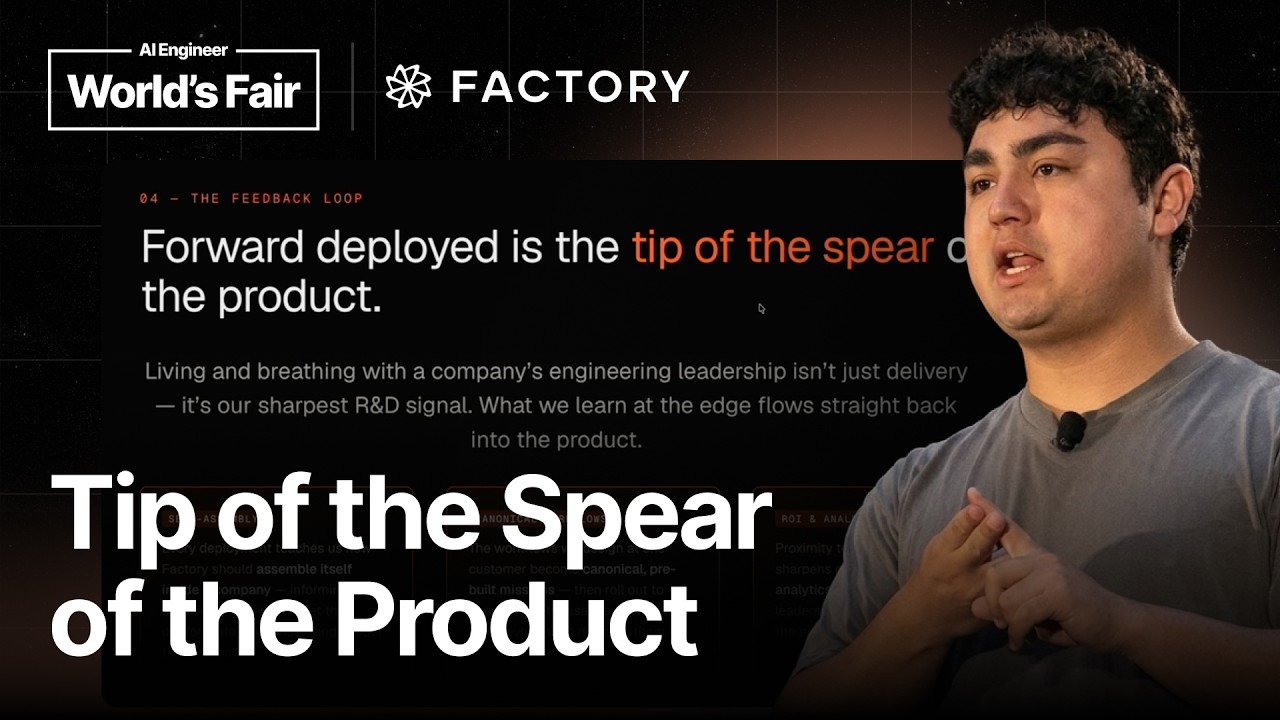
Forward Deployed Engineering (FDE) has evolved significantly from its Palantir-era origins. While early FDE often involved embedding engineers to directly access customer codebases for integration, Factory’s approach redefines the role: FDEs are the “tip of the spear” for product development. They serve as a vital information stream from the largest and most critical customers, gathering insights from engineering leadership and tactical engineers. This real-world feedback is then rapidly flowed back into Factory’s product development to enhance its fit and self-assembly within complex enterprise environments. Factory explicitly avoids traditional professional services, focusing instead on ensuring a clear Return on Investment (ROI) story that links the “software factory” output to core business goals, such as reduced bugs or increased customer satisfaction.
At the core of Factory’s offering is the concept of a “software factory”, an automated pipeline where external signals (customer conversations, bug reports, executive directives) are transformed into deployable outcomes. This process involves prioritization, planning, code changes, and rigorous validation through various stages like code review, QA, security analysis, SAST tools, linters, and type checkers. AI is leveraged to transform each stage, aiming for a “flow through from signal to deploy that has no human intervention,” though human engineers remain crucial for evolving and scaling the system.
A non-negotiable component of this vision is Droid, Factory’s model-independent agent harness. This harness is designed to prevent vendor lock-in, allowing customers to own their data and traces, and offering centralized governance. Droid can even operate in highly secure, air-gapped environments (e.g., finance, healthcare, government, or even “in a submarine”), enabling customers to run their software factories entirely contained.
A key challenge FDEs address is guiding organizations through their autonomy maturity model. This involves helping engineers transition from directly manipulating software to managing systems that build software. Central to achieving autonomy is “agent readiness”, a measure of the deterministic validation loops present in a codebase (e.g., linters, type checkers, end-to-end tests). A high volume of such feedback loops allows agents to operate for extended periods on complex tasks without human intervention. Factory’s “Missions” product exemplifies this by providing an elaborate harness for difficult, validatable knowledge work, where success is achieved by pushing “a lever of inference until the task is complete.” This approach has enabled autonomous solutions for daunting problems like migrating 30 to 50 million line codebases, optimizing equity research, and advancing deep learning strategies in biomedicine. The critical insight here is that success with AI systems hinges on preparing the environment for robust verification, as models thrive on “dense reward” provided by these validation signals.
The FDE role is a delicate balancing act, reminiscent of Walt Disney’s Epcot analogy: an exemplary “city of the future” built too far ahead becomes a theme park rather than a place people live. FDEs must demonstrate the achievable future of autonomous engineering without overwhelming customers with a pace of transformation that seems impractical. While some codebases achieve high levels of constrained autonomy (e.g., Factory’s “legal droid” is 100% autonomous for legal workflows), challenges remain for visual or context-dependent problems that lack clear verification systems.
Ideal Factory FDEs are typically former founders, skilled technical communicators with business acumen and executive presence, or systems thinkers who excel at designing complex, closed-loop systems. They are crucial in shaping the future of autonomous software engineering and defining the nature of billion-dollar product areas like code review, incident response, and QA.