How Forward Deployed Engineering is done at Decagon — Sunny Rekhi
Sunny Rekhi, CTO of Forward Deployed Engineering at Decagon, explains how his company builds and scales AI customer service agents. He delves into the dual nature of forward-deployed work – agent configuration and product development driven by customer asks – and how this role blends with core product engineering. The discussion covers critical strategies for scaling from 50 to 500 employees, emphasizing restraint, early success definition, industry specialization, and the ethos of turning custom solutions into self-serve, reusable product features.
Decagon, a company specializing in 24/7 AI customer service agents, offers a human-like solution to replace traditional support channels. These AI agents handle complex inbound support workflows, and expand into proactive outreach and revenue-generating tasks, as exemplified by their work with Hertz. The application of these agents varies significantly based on enterprise size and industry vertical.
Sunny Rekhi, CTO of Forward Deployed Engineering at Decagon, outlines two core aspects of their forward-deployed work:
- Agent Configuration: This involves tailoring the AI agent’s “brain” for specific enterprise needs. Engineers work with customers to define success metrics, desired brand tonality, and integrate with backend systems for actions like password resets. This process includes setting instructions for user interactions and rules for human handoffs.
- Product Development from Customer Insights: Forward-deployed engineers act as the frontline for customer product requests. A key responsibility is to anticipate future needs, ensuring that a solution developed for one enterprise, like a Fortune 20 client, is built to scale and benefit subsequent customers. This approach blurs the line between traditional “forward deployment” and “product engineering,” often making them identical in practice at Decagon.
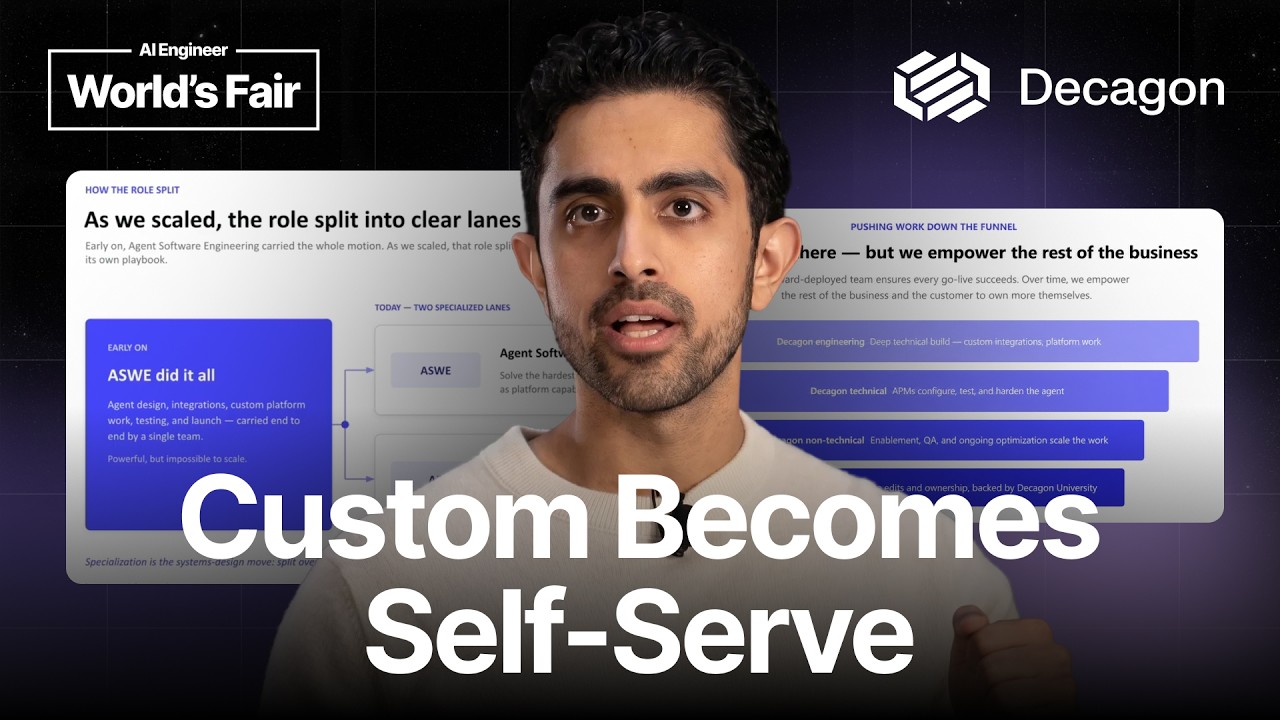
As Decagon scaled rapidly from 50 to 500 people, the “agent software engineer” role, which initially encompassed all tasks, evolved into specialized lanes:
- Agent Builders: These are Decagon pros deeply intuitive with the platform’s underlying models, configuring agents for specific use cases primarily within the UI, while identifying and flagging requirements for new product features.
- Agent Software Engineers: Focused on integrating customer product requests back into the core product, ensuring scalability and reusability.
Rekhi highlights several critical principles for effective forward-deployed engineering at scale:
- Restraint and Scalability: The temptation to provide quick, custom, one-off solutions for high-value customers must be balanced with the need for scalable, future-proof architectures. The goal is to avoid brittle “black box” solutions and ensure that every build benefits a broader customer base.
- Defining Success Upfront: Early in the customer engagement, it is crucial to establish clear success metrics, desired channels (phone, email, text), and pain points. Documenting these requirements in writing prevents miscommunication and aligns expectations, especially in the context of advanced AI coding capabilities.
- Leveraging Industry Expertise: Staffing forward-deployed teams with industry-specific experts (e.g., financial services) accelerates deployments, builds credibility, and compounds knowledge, making each subsequent deployment faster.
- Productization (“Custom becomes Self-Serve”): Any manual task performed by an engineer should ideally be upstreamed into the product, enabling self-service or configuration by agent builders. An example cited is the evolution of custom integrations into a self-serve platform feature after numerous repeated requests. This “custom becomes self-serve” ethos is a guiding principle.
- Proving Value Rapidly: Especially in enterprise settings, the focus is on demonstrating value as quickly as possible, avoiding prolonged “time to prove value” cycles. While customer relationships are multi-year, trust is established in the initial weeks.
- Advisory Role: Forward-deployed engineers are not merely executors but advisors. Leveraging their broad experience across multiple customers and Decagon’s data-driven insights (e.g., historical support data), they can guide customers to the highest ROI automation solutions, even if it differs from the customer’s initial request.
Decagon’s success is attributed to its rapid response to customer asks, its trusted advisor status, and its rigorous approach to productizing custom work. The company’s growth has intensified its focus on designing scalable systems, sharing knowledge across deployments, and ensuring that improvements for one customer’s AI agent “compound” to benefit all future interactions. The overarching themes are configuration, product feedback, and scaling field insights for continuous improvement.