Demis Hassabis on Building DeepMind, AlphaFold, and the Final Stretch to AGI
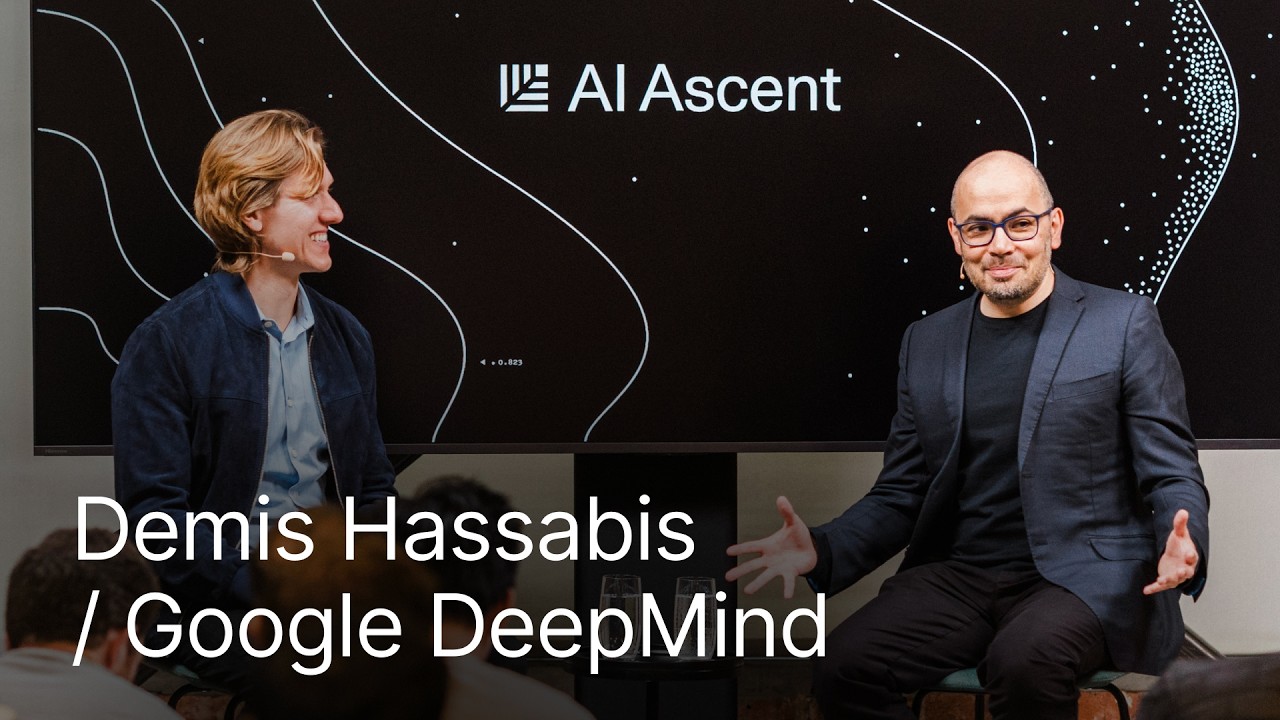
Demis Hassabis, CEO of Google DeepMind, outlines the path to AGI, which he predicts by 2030. He discusses the profound impact of AI on science, particularly in revolutionizing drug discovery with systems like AlphaFold, and posits that AI will enable new forms of simulation-based science. Hassabis also delves into the philosophical underpinnings of his work, viewing information as the universe's most fundamental quantity and advocating for developing AGI as a powerful tool before tackling the deeper questions of consciousness.
The Path to DeepMind: A Common Thread
The journey to founding DeepMind was guided by a long-held interest in AI, which served as a common thread through seemingly disparate fields like chess, game development, and neuroscience.
- Games as a Proving Ground: In the 1990s, the video game industry was at the forefront of technology, particularly in graphics and the development of GPUs. Games like Theme Park were essentially complex economic and AI simulations. The delight people took in interacting with these AI systems reinforced the potential of the field.
- A Lesson in Ambition: The first startup, Elixir Studios, aimed to simulate an entire country on a home PC in the late 90s. The experience taught a crucial lesson: “You want to be 5 years ahead of your time, not 50 years ahead.” Being too far ahead means the enabling technology and market may not be ready.
- Neuroscience for Inspiration: Studying the brain provided key algorithmic ideas and principles, including the concept that reinforcement learning could eventually scale to AGI.
Founding DeepMind and the AGI Mission
DeepMind was founded in 2010 with a clear, two-step mission statement: “Step one, solve intelligence, i.e., build AGI. Step two, use it to solve everything else.”
At the time, the idea of pursuing AGI was met with skepticism in both academia and industry. The core insight was to combine two siloed fields: deep learning, which had recently emerged, and reinforcement learning. This novel combination, along with the increasing power of accelerated computing (GPUs), created a sense that “we were keepers of a secret.” The conviction was that even if the approach failed, it would fail in a new and original way compared to the symbolic AI efforts of the 1990s.
AI for Science: The Ultimate Tool
The primary motivation for building AGI has always been to use it as the ultimate tool to advance science and medicine. The victory of AlphaGo was the crucial turning point, demonstrating that the algorithms were powerful and general enough to be applied to major scientific challenges. This led to the formal creation of the AI for Science division at DeepMind. The goal is to use AI to cure diseases, create healthier lifespans, and make breakthroughs in materials science, energy, and the environment.
Revolutionizing Biology and Drug Discovery
AI is poised to fundamentally reshape biology, a field perfectly suited for machine learning.
- AlphaFold: This system solved the 50-year-old grand challenge of protein folding, a critical step in understanding biological mechanisms.
- Isomorphic Labs: This newer venture builds on AlphaFold’s success, developing adjacent technologies to design chemical compounds that bind to specific protein targets.
- The In Silico Dream: The ultimate goal is to shift 99% of drug discovery exploration into the digital realm (“in silico”). This would reduce the process from a 10-year average down to months, weeks, or perhaps even days. Such a breakthrough would put all diseases within reach and make personalized medicine a practical reality.
The Emergence of New Sciences
Beyond accelerating existing fields, AI may create entirely new sciences.
- AI-Powered Simulations: Many fields, like economics and social sciences, are not as rigorous as physics because it is impossible to run repeated, controlled experiments. AI can create highly accurate “learned simulators” for complex, emergent systems where the underlying mathematics is unknown or too complex.
- A New Language for Biology: Machine learning is the “perfect description language for biology,” just as mathematics is for physics. Biological systems involve countless weak signals and correlations in vast datasets, a structure that machine learning is uniquely equipped to analyze. A “virtual cell” is one such simulation being explored.
- Extracting New Equations: Once an accurate, implicit simulator is built, it may be possible to sample it rigorously to extract explicit, fundamental equations that govern these emergent systems, much like Maxwell’s equations for electromagnetism.
Philosophical Foundations and Future Directions
- Information as Fundamental: The universe can be understood as having three inter-convertible quantities: matter, energy, and information. However, information may be the most fundamental. Viewing the world through the lens of information processing reveals the profound nature of AI, which is an engine for organizing, understanding, and constructing information.
- The Power of Classical Computation: Alan Turing’s work laid the foundation for computer science and AI. The success of AlphaFold—a classical system built on a Turing machine model—in solving a quantum-level problem like protein folding suggests that classical computers may be able to model many systems previously thought to require quantum computation.
- AGI as a Tool First: The immediate mission is to build AGI as an incredibly intelligent and precise tool. The more profound questions of agency, sentience, and consciousness should be a second step, ideally explored with the help of the AGI tool itself.
- On Consciousness: While a full definition remains elusive, necessary components for consciousness likely include self-awareness, the concept of self and other, and continuity over time. A key philosophical challenge will be the “substrate problem.” We infer that other humans are conscious because we share the same biological substrate. An AI, running on a different substrate, could behave like a conscious being, but confirming its internal, experiential reality will be difficult, if not impossible.