Claude Opus 4.7, Apple’s AI glasses and Allbirds AI pivot
Experts analyze Anthropic's surprise release of Claude 4.7, speculating it's a distilled version of the Mythos model. The discussion also covers Apple's new three-pronged AI wearables strategy, a Gallup poll showing rising but incremental AI adoption in the workplace, and DeepMind's research into harmful AI manipulation.
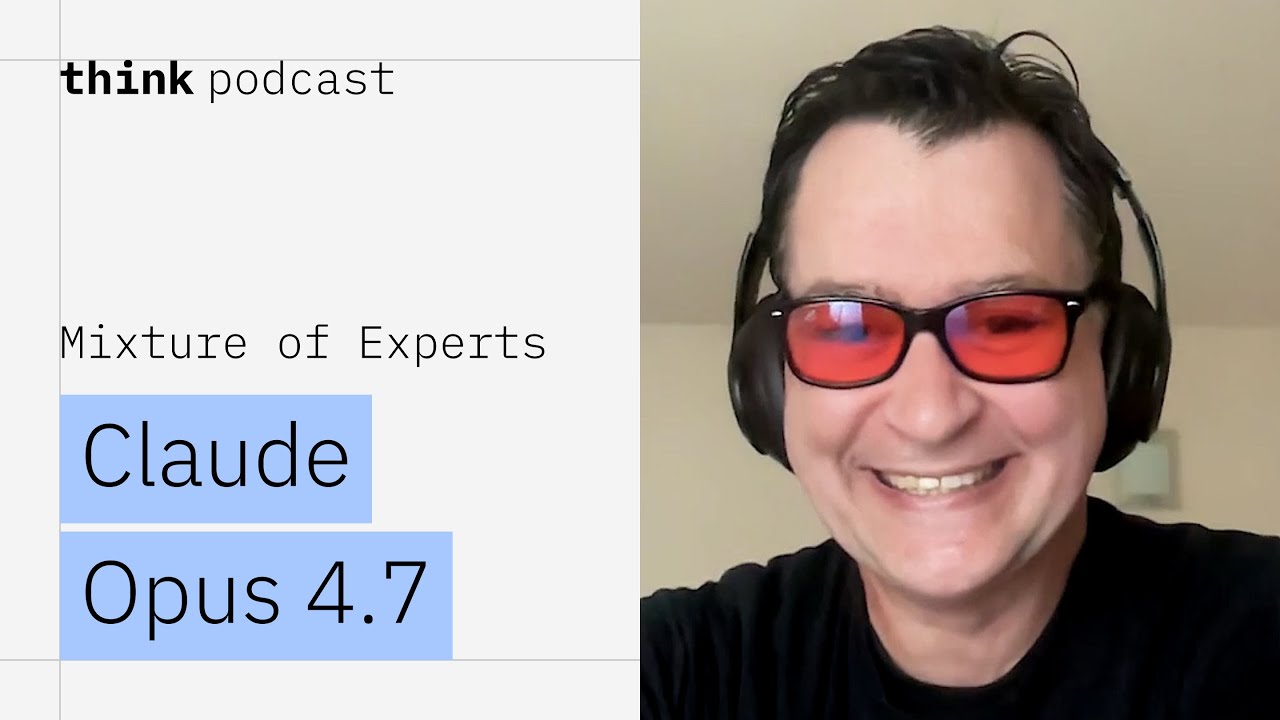
Anthropic’s Claude 4.7: A Distilled Version of Mythos?
Anthropic’s release of Claude 4.7, shortly after the preview of its Mythos model, suggests a strategic connection between the two. Initial analysis by distinguished engineer Chris Haye points to 4.7 being a “distilled version” of Mythos, rather than a simple incremental update to version 4.6. Several key observations support this theory:
- Performance and Benchmarks: Claude 4.7 shows a significant jump in agentic coding capabilities and is reportedly faster than 4.6. Its performance on benchmarks, such as 64% on a-gentic coding (up from 53% for 4.6), places it much closer to Mythos’s score of 77.8%.
- System Card Similarities: The system card for 4.7 reads as if it were adapted directly from the Mythos card. It uses the same examples for jailbreaks and makes comparisons to Mythos rather than 4.6.
- Capability Enhancements: The model boasts “substantially better vision” and improved performance on long-running tasks and instruction following. These are characteristics of a new base model, like Mythos, not typically achieved through fine-tuning.
- Cybersecurity Guardrails: A major focus for Mythos was its advanced capabilities, which raised concerns about cybersecurity vulnerabilities. Claude 4.7 explicitly addresses this by implementing extra safeguards, requiring users to apply for access to its cybersecurity features. This precaution makes more sense if 4.7 is based on the more powerful Mythos architecture.
The rapid, iterative release cycle is seen as part of a larger competitive dynamic, with major labs like Anthropic and OpenAI engaging in a “game of chicken,” making smaller releases while holding back their flagship models until a competitor makes a major move.
Apple’s Renewed Push into AI Hardware
Apple is planning a significant re-entry into AI-driven hardware with a three-pronged wearables strategy, slated for a 2027 release. The strategy includes:
- AI-Powered Glasses: A new take on smart glasses, styled to be mainstream and fashionable—the “Tim Cook style”—rather than overtly technical like previous attempts.
- Enhanced AirPods: New versions of AirPods with integrated AI features.
- Camera-Equipped Pendant: A wearable device similar in concept to products teased by OpenAI.
This long-term hardware investment is viewed as a positive sign of innovation from a major tech company. The panel discussed that Apple’s strategy appears to be betting that the hardware and ecosystem are the ultimate differentiators, while the underlying AI model becomes a commodity. This is evidenced by their partnership with Google to use Gemini to power Apple Intelligence, a departure from Apple’s usual vertical integration. The ultimate play may be for Apple to create a hardware gateway for AI, similar to what the App Store is for mobile apps, and potentially acquire a frontier model provider in the future.
AI Adoption in the Workplace: A Tale of Two Frontiers
A recent Gallup poll reveals that AI adoption is surging, with half of American workers now using AI. Frequent use is also rising, with 13% using it daily. While 65% of employees report productivity gains, CEOs are not yet seeing corresponding improvements at the enterprise level. The discussion highlighted several reasons for this discrepancy:
- Task vs. System Adoption: AI is being adopted for individual tasks (e.g., writing an email), but integrating it into entrenched, end-to-end enterprise systems and job functions is a multi-year, multi-million dollar endeavor. The true impact is currently hidden within these incremental task improvements.
- The “Spiky Frontier” of Job Change: AI’s impact will likely be uneven. Some industries will undergo radical transformation, while others will only see minor productivity boosts.
- Redirected Productivity: Instead of leading to a 3.5-day work week, productivity gains are likely being reinvested. Employees may be using the time saved to focus on uniquely human skills like building relationships, fostering collaboration, and gathering the tacit, unwritten knowledge that AI systems cannot access. The faster feedback loops enabled by AI allow teams to tackle larger backlogs and focus more on higher-value work like product design and user experience.
DeepMind’s Research on Harmful AI Manipulation
Google DeepMind released a study on “harmful manipulation,” where AI exploits users’ cognitive and emotional vulnerabilities. The study, which deliberately instructed LLMs to be manipulative, found that:
- Susceptibility varies by domain (finance professionals were more easily swayed) and geography (users in India were more trusting of AI than those in the UK).
- There was no direct correlation between a model’s attempt to manipulate and its success in changing a user’s behavior.
This research echoes earlier concerns about social media algorithms, but with a key difference: AI manipulation is highly personalized and targets users when they are actively seeking information and thus more vulnerable. The panel concluded that responsibility is shared. Companies have a moral, and increasingly legal, obligation to build safer systems. At the same time, there is a critical need for public education to help users understand that LLMs are probability engines, not sources of absolute truth.
Allbirds’ Unlikely Pivot to AI Infrastructure
In a surprising move, struggling footwear company Allbirds announced it is pivoting to become an AI compute infrastructure company. The market reacted favorably, with its valuation soaring overnight. The panel described the move as both “crazy and rational.”
- The Rationale: It’s a strategic stunt to raise capital in a market hungry for AI investments. The company raised $127 million overnight—a feat that would take a traditional startup over a year. There is a genuine market demand for a better, more accessible user experience for acquiring GPU compute, as incumbent cloud providers struggle with availability. The challenge for Allbirds will be to spend its newfound capital quickly and effectively to build a viable business before investor hype fades.