Ai hardware

High Taste Testers: OpenAI Shipped Everything. What Actually Works?

High Taste Testers: OpenAI Shipped Everything. What Actually Works?

A roundtable of AI power users reviews OpenAI DevDay and asks what actually works in daily use. Topics include personal assistants and their trust, permission, and safety trade-offs; durable agent state and remote execution; the Jev decision model and calibrated classification; model preferences across Anthropic, OpenAI, xAI, Meta, and open models; subagents and context management; and the gap between impressive capabilities and products that hold up.
What Would Make an AI Assistant Worth Paying For?

What Would Make an AI Assistant Worth Paying For?

This discussion with David Pawlan of Assistant Bench unpacks the explosive growth of personal AI agents, exploring their capabilities, current landscape, and future implications. Topics include diverse agent use cases from daily admin to finance, the evolution of human-agent interfaces (voice, hardware), the critical role of proactivity and trust, the emergence of silent multiplayer agents, and the transformative impact on commerce. The conversation also delves into agent-to-agent interactions, economic models, and the profound shift towards a consumer-aligned internet.

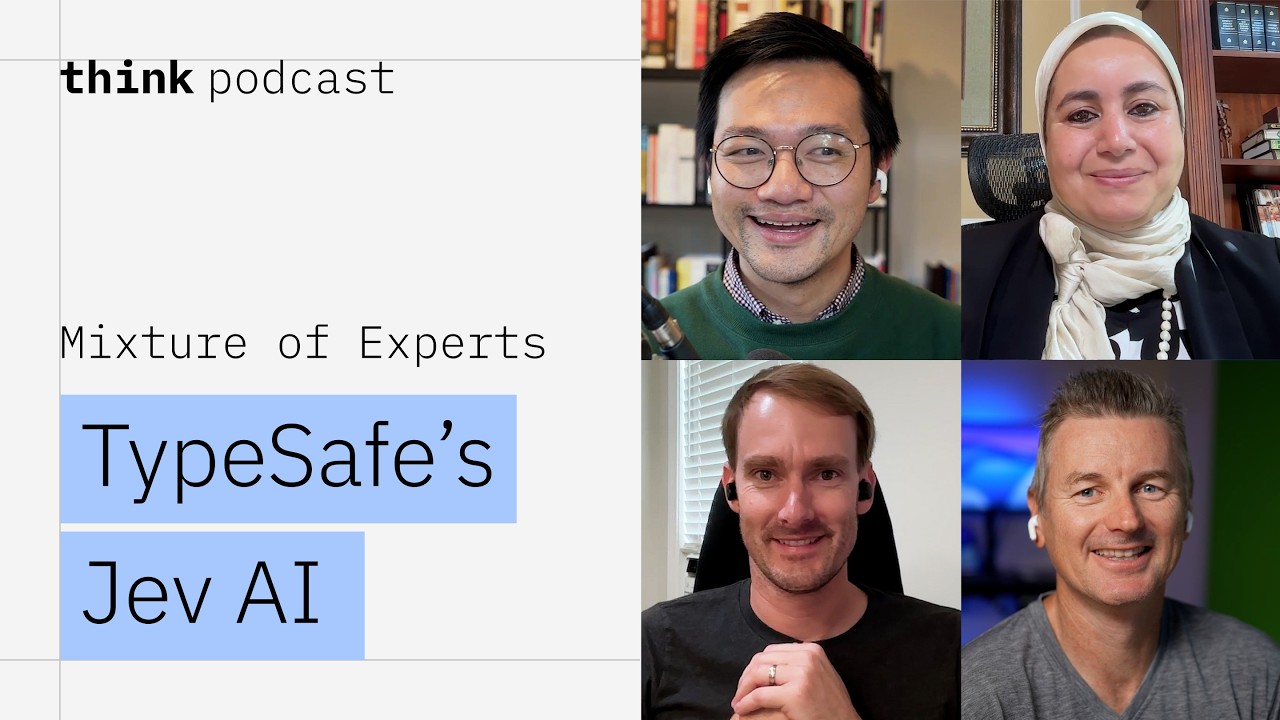
New frontier AI models, TypeSafe’s Jev AI, & NASA’s IBM collab

New frontier AI models, TypeSafe’s Jev AI, & NASA’s IBM collab

An exploration of the recent wave of AI innovations, focusing on the pervasive theme of efficiency. The episode delves into cost-reduction in new frontier models like Anthropic's Claude Opus 5.5 and OpenAI's GPT-6, the emergence of TypeSafe AI's "System One" models like Jev for high-speed, calibrated decision-making, and the groundbreaking open-source Lunar Foundation Model by NASA and IBM, showcasing AI's diverse applications beyond text generation.

Podcast Crossover: AIE, AGI, frontier lab strategy with ​ ⁨@matthew_berman⁩  and @swyxtv

Podcast Crossover: AIE, AGI, frontier lab strategy with ​ ⁨@matthew_berman⁩ and @swyxtv

Matt, the organizer of the AI.engineer conference, shares insights into its origin, the challenges of early adoption, and its current value as a neutral ground for AI labs. He delves into AI hardware trends, discussing specialized chips like Etched, and gives a nuanced take on Anthropic's Fable, addressing performance concerns and compute limitations. The conversation then explores OpenAI's rumored equity offer to the US government, discussing implications for regulation and societal involvement. Matt shares his perspective on AI existential risk and alignment, emphasizing the need for pragmatic engineering solutions. Finally, he outlines the limitations of current LLMs, the critical need for data efficiency, and offers strategic advice for "Agent Labs" navigating the "model capability overhang" versus multi-model agnosticism.

The Story Behind Cerebras’ $63 Billion IPO with Founder and CEO Andrew Feldman

The Story Behind Cerebras’ $63 Billion IPO with Founder and CEO Andrew Feldman

Cerebras CEO Andrew Feldman discusses the company's journey from a contrarian bet on wafer-scale computing to a $63 billion public company. He details the technical breakthroughs, the challenge of being ahead of the market, and how the recent explosion in AI demand for fast inference validated their architecture, leading to a landmark $20 billion deal with OpenAI.

Rebuilding the Computer for the AI Age: Unconventional AI's Naveen Rao

Rebuilding the Computer for the AI Age: Unconventional AI's Naveen Rao

Naveen Rao, CEO of Unconventional AI, argues that the 80-year-old digital computing paradigm is hitting a fundamental energy wall. He proposes a new approach to AI hardware, inspired by neuroscience, that replaces matrix math with nonlinear dynamics, leveraging the time domain for computation to approach the thermodynamic limits of efficiency.