NVIDIA’s USD 100bn investment and Google's AP2
The panel discusses NVIDIA's $100 billion investment in OpenAI, analyzing the trend towards vertically integrated AI 'tribes'. They also explore the rise of specialized open-source models like Tongyi DeepResearch, Google's new AP2 agent protocol for secure e-commerce, the ongoing debate on AI existential risk, and Apple's practical approach to wearable AI with the new real-time translation feature in AirPods.
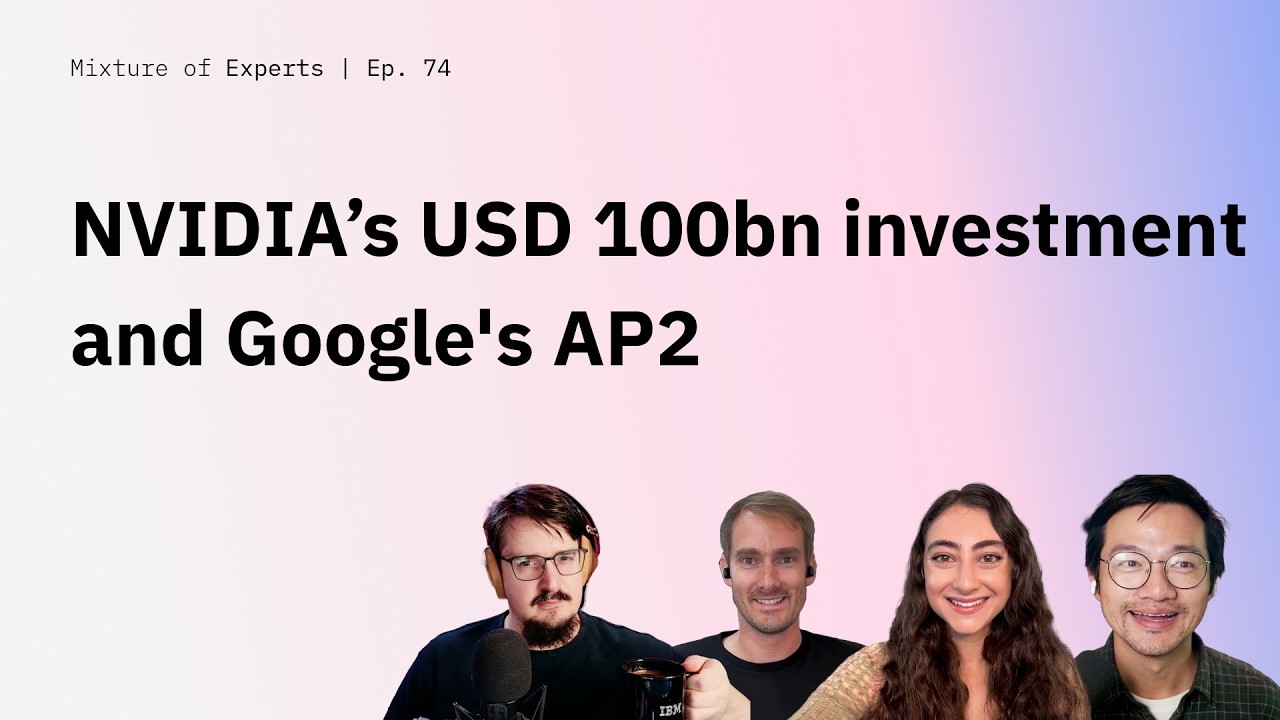
The panelists explore the increasingly complex dynamics of the AI industry, from the role of open-source models to the formation of massive, vertically-integrated alliances.
Tongyi DeepResearch and the Open Source Frontier
The conversation begins with Tongyi DeepResearch, a new open-source model from Alibaba that has quickly gained prominence. It’s a 30-billion parameter Mixture of Experts (MoE) model, with 3 billion parameters active per token, specifically trained for deep, long-horizon information-seeking tasks.
Key takeaways on its significance include:
- Purpose-Built Ecosystem: The model’s novelty lies not just in its architecture but in its tight integration with a software ecosystem designed for iterative, recursive search. This pairing of a purpose-built model with a specific agent-like architecture represents a significant step forward in open-source capabilities.
- Diverging Use Cases: The panel suggests that open-source and proprietary models are increasingly serving different markets. While frontier models push the boundaries of general capability, open-source models are finding a “sweet spot” in applications that demand privacy, lower costs, and on-device or behind-the-firewall deployment. For tasks like deep research that can be slow and expensive on large proprietary models, smaller, specialized open-source alternatives offer a compelling solution.
- Influence Over Benchmarks: A model’s importance shouldn’t just be measured by its benchmarks, but by its influence on industry trends. Just as the DeepSeek paper popularized distillation, Tongyi DeepResearch might popularize its “triathlon of training” methodology, which involves continual pre-training, fine-tuning, and on-policy reinforcement learning.
AP2: A Protocol for AI-Powered Commerce
Google’s announcement of AP2, a protocol for AI agents to conduct commerce and payments, is seen as a major development. Built on existing frameworks, AP2 aims to provide a common structure for authorization, authentication, and accountability in online transactions. A key feature is the “intent mandate,” a cryptographically signed record of a user’s request, enabling agents to act securely and asynchronously.
The panel views this as:
- A Strategic Move by Google: AP2 solves a critical security problem that other protocols don’t fully address: handling sensitive payment data outside the direct context of the LLM. By leveraging its existing ecosystem (Google Pay) and relationships in finance and advertising, Google is positioning itself in a nascent market.
- Forcing a Standard: Since AP2 is built on Google’s A2A (Agent-to-Agent) framework, its adoption for secure payments would inherently drive the adoption of A2A, potentially establishing it as a de facto standard and increasing Google’s market share in the agent ecosystem.
- An Enabler for New Applications: A secure payment protocol could be the catalyst that makes “computer use” agents more practical, moving them from information-gathering tools to autonomous agents that can complete transactions, such as checking out items in a shopping cart.
The Existential Risk Debate
Discussing the book “If Anyone Builds It, Everyone Dies,” the panel addresses the fear of superintelligent AI.
- Systems vs. Models: A key counterargument is the distinction between AI models and AI systems. Gabe Goodhart notes, > “AI models fundamentally do nothing except predict the next token. AI systems do things, and somebody has to turn them on and turn them off.” The risk is not a spontaneously autonomous AI but a complex system of humans, companies, and software where human oversight is critical.
- The Inevitability of Competition: The pressure to innovate often outweighs caution. As Mihai Criveti puts it, “if we’re careful, then our competition is not going to be careful and they’re going to get ahead of us.” This dynamic suggests that progress will continue rapidly, making the establishment of clear guardrails on how AI interacts with the physical world—especially in critical areas like medicine—essential.
- Fiction Informing Reality: The fear of AI takeover is a long-standing trope in human culture and fiction. Since current AI models are trained on this data, they are inherently informed by these narratives, creating a strange feedback loop where the fiction of AI’s potential behavior could influence its actual development and deployment.
Apple’s Practical AI with AirPods Translation
Apple’s announcement of a real-time translation feature for its new AirPods is highlighted as a significant and different kind of AI application.
- Solving a Real Problem: Unlike many AI features that feel like “a solution in search of a problem,” real-time translation addresses a tangible, everyday challenge in a globalized world.
- The Power of User Experience (UX): Apple’s strength lies in integrating powerful technology seamlessly into its existing ecosystem. By building the feature into a stylish and widely adopted product like AirPods, they remove the friction of adoption. The technology becomes invisible to the user, which is the hallmark of great UX. This focus on practical application and seamless integration is seen as Apple’s most viable path to a “comeback” in the AI race.
NVIDIA’s $100B Bet on OpenAI and Vertical Integration
The episode concludes with the staggering news of NVIDIA’s $100 billion investment in OpenAI.
- A Self-Fulfilling Investment: The panel immediately notes the circular flow of capital: NVIDIA invests in its biggest client, who will then use that money to buy more of NVIDIA’s GPUs. It’s a strategic move to lock in a key customer and prevent them from diversifying to competitors like AMD or Intel.
- A Bet on “Bigger is Better”: This move is interpreted as a massive bet by NVIDIA that raw computational scale remains the primary driver of AI progress. As innovation begins to shift towards building sophisticated systems around existing models, the demand for new hardware could level off. This investment is a push to ensure the industry continues to pursue ever-larger models, thus securing the demand for NVIDIA’s next generation of chips.
- The Formation of “Tribes”: This investment solidifies the trend of vertically integrated alliances or “tribes” in the AI industry (e.g., OpenAI-Microsoft-NVIDIA). This raises questions about market structure and the future of competition, as these alliances could span from chip manufacturing and cloud infrastructure all the way to energy sourcing, given the immense power requirements of next-generation data centers.