What Actually Makes an Algorithm Terrifying (with Cathy O'Neil)
Dr. Cathy O'Neil, author of "Weapons of Math Destruction," asserts that terrifying algorithms are defined by secrecy, unaccountability, and a lack of opt-out, not mathematical complexity. She details how Taylorism's labor degradation now extends to white-collar jobs via AI surveillance. O'Neil discusses her firms, ORCAA and OCEAN, which provide statistical evidence for lawsuits against tech giants and advocate for algorithmic accountability through "cockpits" of metrics and transparent auditing, urging collective action against unchecked technological power.
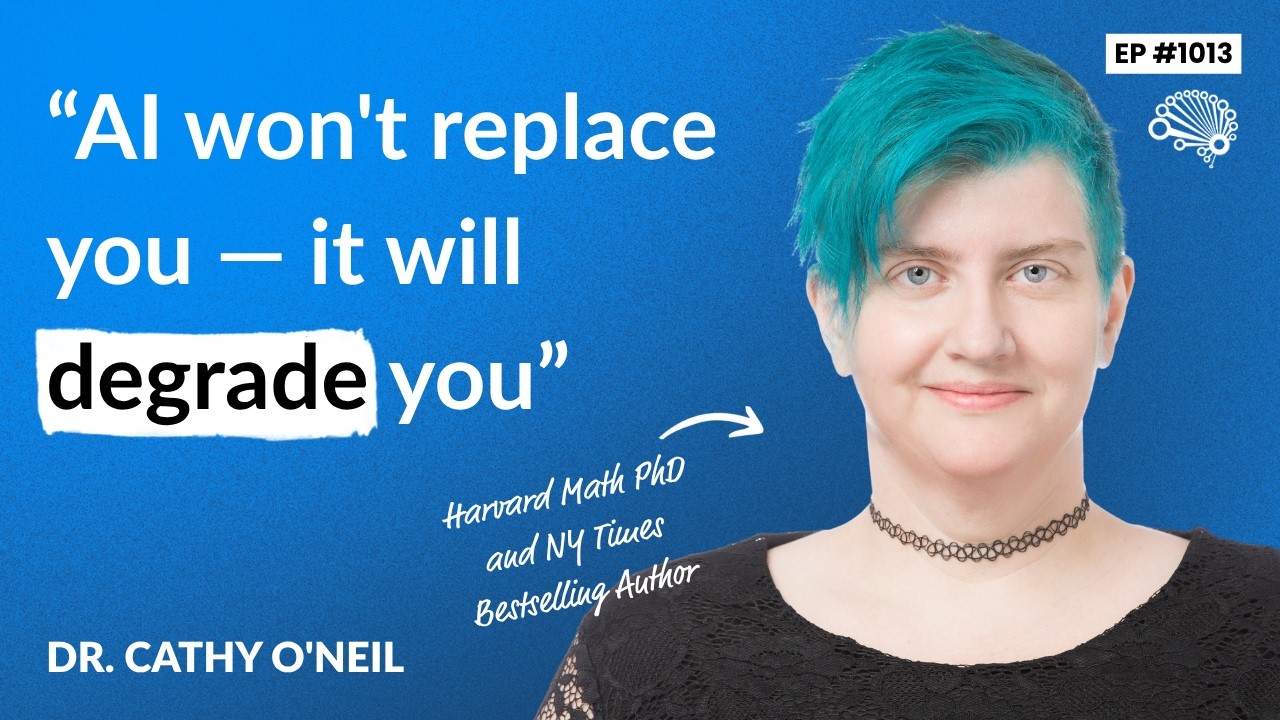
Dr. Cathy O’Neil, author of “Weapons of Math Destruction” (WMD) and host of the “AI Skeptics” podcast, critiques the true dangers of algorithms, emphasizing that it’s not their mathematical complexity but their secrecy, unaccountability, and the lack of an opt-out option that makes them terrifying. She highlights how simple algorithms, like recidivism risk assessments, can be profoundly unjust while wield immense power.
Challenging AI Hype and the Degradation of Work
O’Neil expresses deep skepticism about claims of imminent full automation of digital work, finding them “beyond what is reasonable or plausible.” She points out the blandness and often poor quality of AI-generated content (reviews, music, emails) and inefficient AI customer service, which is forced upon users out of desperation.
She connects modern AI trends to Taylorism, an early 20th-century management theory where artisan knowledge is extracted and turned into management-owned “science” to replace skilled labor with easily replaceable workers. O’Neil argues this degradation, historically applied to blue-collar jobs, is now extending to white-collar professions. She cites Meta’s “Model Capability Initiative” (MCI), which tracks employee keystrokes for AI training, as a contemporary example of Taylorism, subjecting white-collar workers to the same “humiliation and degradation and dehumanization” previously experienced by blue-collar counterparts. While AI may not fully replace digital work, she warns it will significantly “degrade” it.
Technology, Political Choices, and Accountability
O’Neil asserts that the outcomes of AI development are not technologically determined but are a result of “political choices” and “cultural choice[s]” regarding how people are treated. She contrasts the US approach with anecdotal examples from China, where there’s reportedly a policy against AI replacing workers. She views the concentration of power in a “small cabal of tech executives” as dangerous, akin to relying on unpredictable