Accountability

What Actually Makes an Algorithm Terrifying (with Cathy O'Neil)

What Actually Makes an Algorithm Terrifying (with Cathy O'Neil)

Dr. Cathy O'Neil, author of "Weapons of Math Destruction," asserts that terrifying algorithms are defined by secrecy, unaccountability, and a lack of opt-out, not mathematical complexity. She details how Taylorism's labor degradation now extends to white-collar jobs via AI surveillance. O'Neil discusses her firms, ORCAA and OCEAN, which provide statistical evidence for lawsuits against tech giants and advocate for algorithmic accountability through "cockpits" of metrics and transparent auditing, urging collective action against unchecked technological power.
AI, Corporate Responsibility & Democratic Legitimacy: Extended Q&A • Joanna Bryson • GOTO 2025

AI, Corporate Responsibility & Democratic Legitimacy: Extended Q&A • Joanna Bryson • GOTO 2025

Joanna Bryson challenges popular AI assumptions, positing current generative AI as powerful tools for cultural knowledge compression, not autonomous intelligences. She emphasizes that AI's capabilities are nearing the human knowledge frontier, requiring focus on human coordination and governance. Bryson critically examines AI's impact on mental health and law, advocating for data-driven regulation and comprehensible systems. She calls for engineering activism, asserting human agency over technological determinism and stressing the importance of transparency and critical thinking in shaping AI's future.

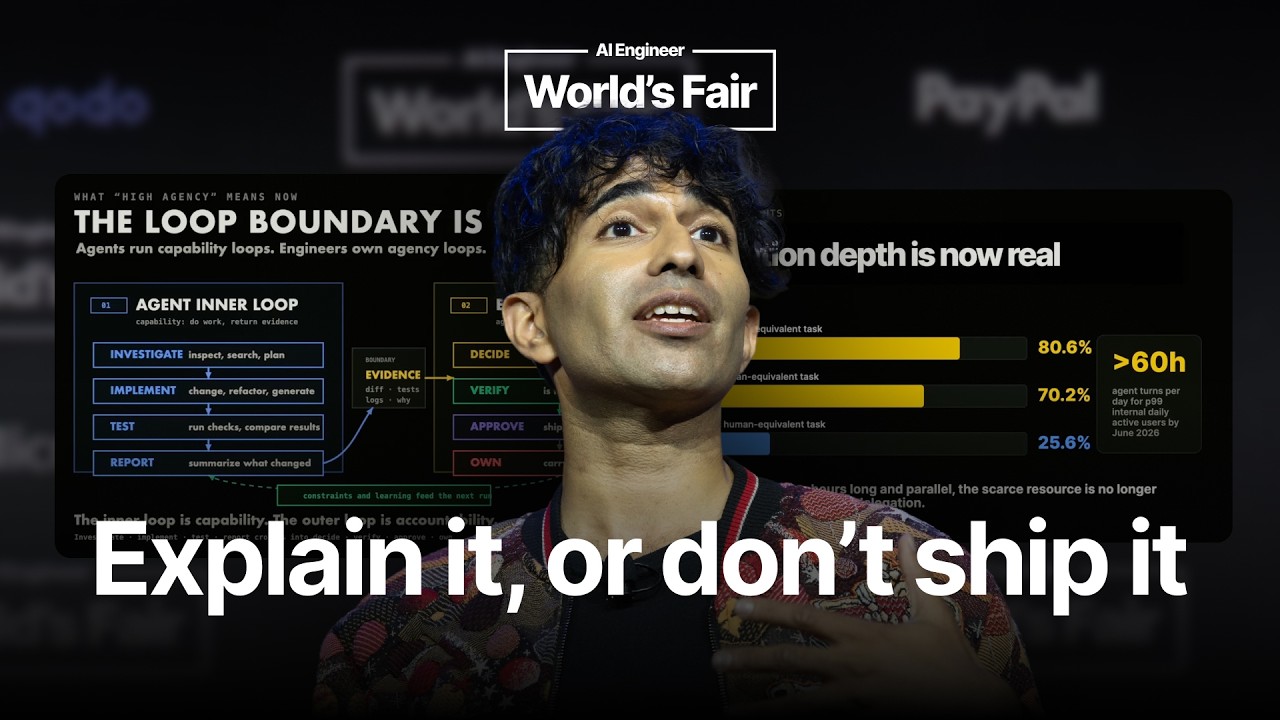
Don't Build Agents You Can't Answer For — Addy Osmani

Don't Build Agents You Can't Answer For — Addy Osmani

Addy Osmani discusses the evolving role of software engineers in the age of AI agents, emphasizing a shift from code production to human judgment, accountability, and system ownership. He highlights new challenges like cognitive debt and the "orchestration tax," proposing that the modern engineer's value lies in "answerability," taste, and discerning which paths warrant human investment and responsibility.

Why the Classroom Must Change in the Age of AI (with Zack Kass)

Why the Classroom Must Change in the Age of AI (with Zack Kass)

Zack Kass discusses how AI can revolutionize education through personalized learning, shifting the teacher's role to that of a guide. He outlines key principles from his book, "The Next Renaissance," drawing on the work of educational luminaries Eva Moskowitz, McKenzie Price, and Rudolph Steiner to advocate for a system based on accountability and self-discovery, ultimately aiming to restore the purpose of childhood beyond economic incentives.

The Forest & The Desert Are Parallel Universes • Kent Beck • GOTO 2025

The Forest & The Desert Are Parallel Universes • Kent Beck • GOTO 2025

Kent Beck introduces the 'Forest vs. Desert' metaphor to describe two parallel universes of software development. He contrasts the 'Forest' mindset, based on abundance, trust, and collaboration (akin to Extreme Programming), with the 'Desert' mindset, rooted in scarcity, control, and pressure. Beck argues that while the Desert is internally consistent and can be profitable, it settles for 'crumbs', whereas the Forest aims to realize the full potential value of software—the 'whole cake'.