The Forest & The Desert Are Parallel Universes • Kent Beck • GOTO 2025
Kent Beck introduces the 'Forest vs. Desert' metaphor to describe two parallel universes of software development. He contrasts the 'Forest' mindset, based on abundance, trust, and collaboration (akin to Extreme Programming), with the 'Desert' mindset, rooted in scarcity, control, and pressure. Beck argues that while the Desert is internally consistent and can be profitable, it settles for 'crumbs', whereas the Forest aims to realize the full potential value of software—the 'whole cake'.
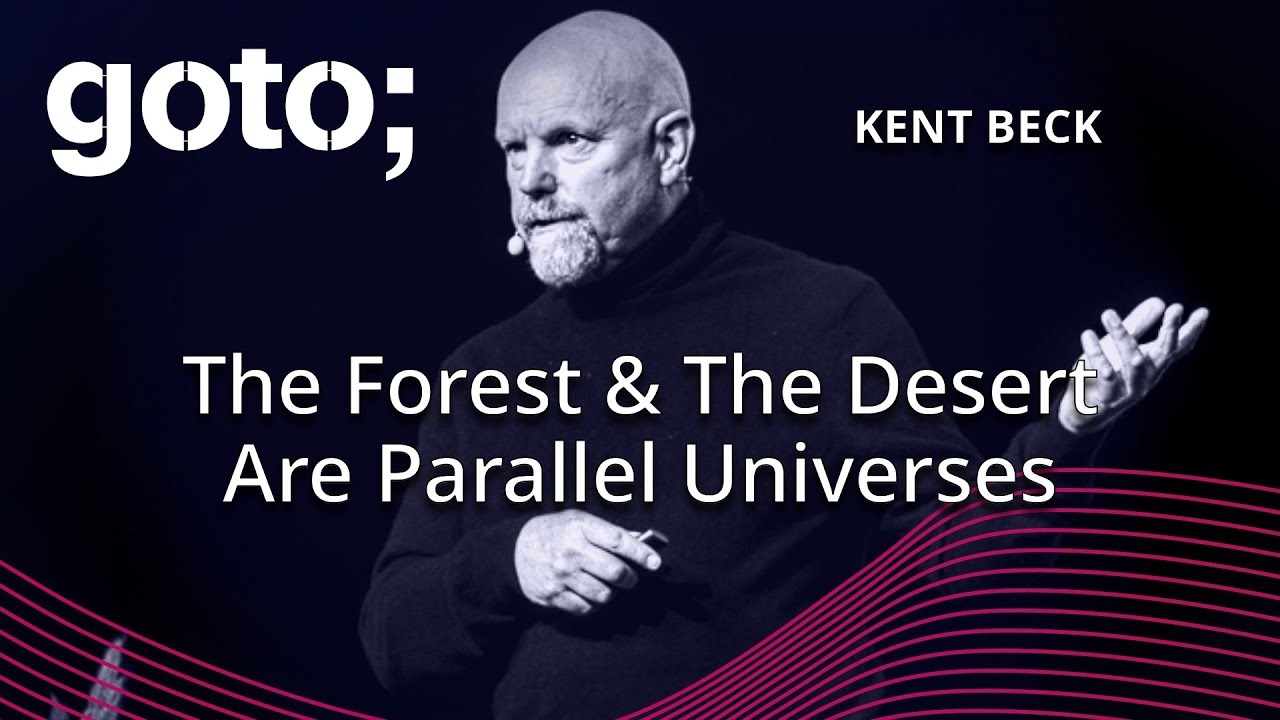
Kent Beck introduces a powerful metaphor to explain the deep-seated communication problems in software development: the Forest versus the Desert. This analogy, inspired by his daughter, highlights two parallel, internally consistent, yet contradictory universes of software engineering culture. It’s not just that people misunderstand each other; they use the same words to mean completely different things.
The Two Underlying Philosophies
The core difference between the Forest and the Desert lies in their fundamental assumptions about people and work.
-
The Forest (Abundance): This worldview, aligned with Extreme Programming, is built on an assumption of abundance. It operates on principles similar to those of philosopher Jean-Jacques Rousseau, believing that people are inherently good and want to create value. It fosters “power with” (Mary Parker Follett), where collaboration and community are key. Motivation is purpose-driven, pulling people together to achieve a shared goal. The Forest embraces change as a constant and aims to “eat the whole cake”—realizing the full, massive potential value that software can create.
-
The Desert (Scarcity): This worldview is based on an assumption of scarcity—a belief that there will never be enough time, resources, or skill. It aligns with the Hobbesian view that people are fundamentally self-interested and must be controlled by a central authority. This leads to “power over” management styles, as advocated by Frederick Winslow Taylor, where work is designed by a few smart people and executed by others. Motivation comes from pressure (a push model), and the primary goal is prediction and control to ensure survival. While this approach can be profitable and sustainable, it is content with the “crumbs” of the potential value, often fostering an environment where no one is truly happy.
Words with Opposing Meanings
Beck illustrates the chasm between these two universes by examining how common terms are interpreted in each.
Metrics
- In the Forest: Metrics are a tool for self-awareness, learning, and improvement. An individual developer might use them to understand where their time goes, and a team uses them to evaluate experiments. The data is kept at the level it’s collected (e.g., within the team) to prevent it from being weaponized.
- In the Desert: Metrics become a hammer for control and pressure. They are used to force certain behaviors (or, more accurately, the reporting of certain behaviors). When a metric becomes a target, it ceases to be a useful measure and often produces the opposite of the intended outcome, as people game the system to meet the numbers.
Dependencies
- In the Forest: A dependency between teams is seen as an invitation to collaborate. If one team needs something from another, they work together to build it, fostering a sense of shared purpose.
- In the Desert: Dependencies are a convenient excuse for failure and a mechanism for blame-shifting. “We could have shipped on time if only the security team had finished their review.” This mindset treats other teams as blockers rather than partners.
Compliance
- In the Forest: Compliance is a collaborative partner that helps the team better serve its users and sibling teams. By working with compliance and regulatory bodies, teams can increase the value they deliver and even accelerate their processes. Beck cites a Swiss insurance company that achieved a product launch, including regulatory approval, in a single weekend by simplifying their terms and conditions to make the auditors’ job easier.
- In the Desert: Compliance is a survival strategy and a necessary evil. It’s an “adult supervision” speed bump that exists because the culture assumes developers will cut corners to claim success. This creates an adversarial relationship, leading to long delays and frustration.
Accountability
- In the Forest: Accountability is an invitation to build trust. Its dictionary definition is “to render account.” A team accounts for the time and resources they were given, including mistakes and wrong turns. This transparency builds trust with stakeholders, leading to more resources and a positive feedback loop.
- In the Desert: Accountability is a synonym for blame and a mechanism for delivering pressure. “I’m going to hold you accountable for these sales numbers” translates to “If you don’t hit these numbers, you’re fired.” This is not true accountability but a tool of control.
Status Reporting
- In the Forest: Status reporting is a straightforward, honest assessment. If a team is behind, they say so and ask for help, knowing that the goal is shared success.
- In the Desert: Status reporting is a strategic game. Beck shares the “never report green” story, where teams intentionally report their status as “yellow.” Reporting “green” would mean losing engineers to “red” projects, ironically putting the “green” project at risk. This creates a theater of inflated estimates and feigned uncertainty that everyone knows is a game, wasting energy that could be spent creating value.
Choose Your Universe
Ultimately, Beck argues that we can choose which universe to inhabit. While being a Forest-like team in a Desert-like organization is challenging, it is a choice worth making. The Desert mindset, with its focus on prediction and control, squanders potential and leaves only tasty, but small, crumbs. The Forest, by embracing collaboration, trust, and purpose, allows us to create far more value and find more fulfillment in our work—to get the whole cake.