The Lean Tech Manifesto • Fabrice Bernhard & Steve Pereira • GOTO 2026
Fabrice Bernhard, co-author of 'The Lean Tech Manifesto,' discusses the limitations of Agile at scale and how Lean thinking provides a robust framework for growth. The summary explores the symbiotic relationship between the two methodologies, debunks common misconceptions, and introduces the concept of tech-enabled networks of teams as a modern organizational model, all while emphasizing a human-centric approach to achieving sustainable outcomes.
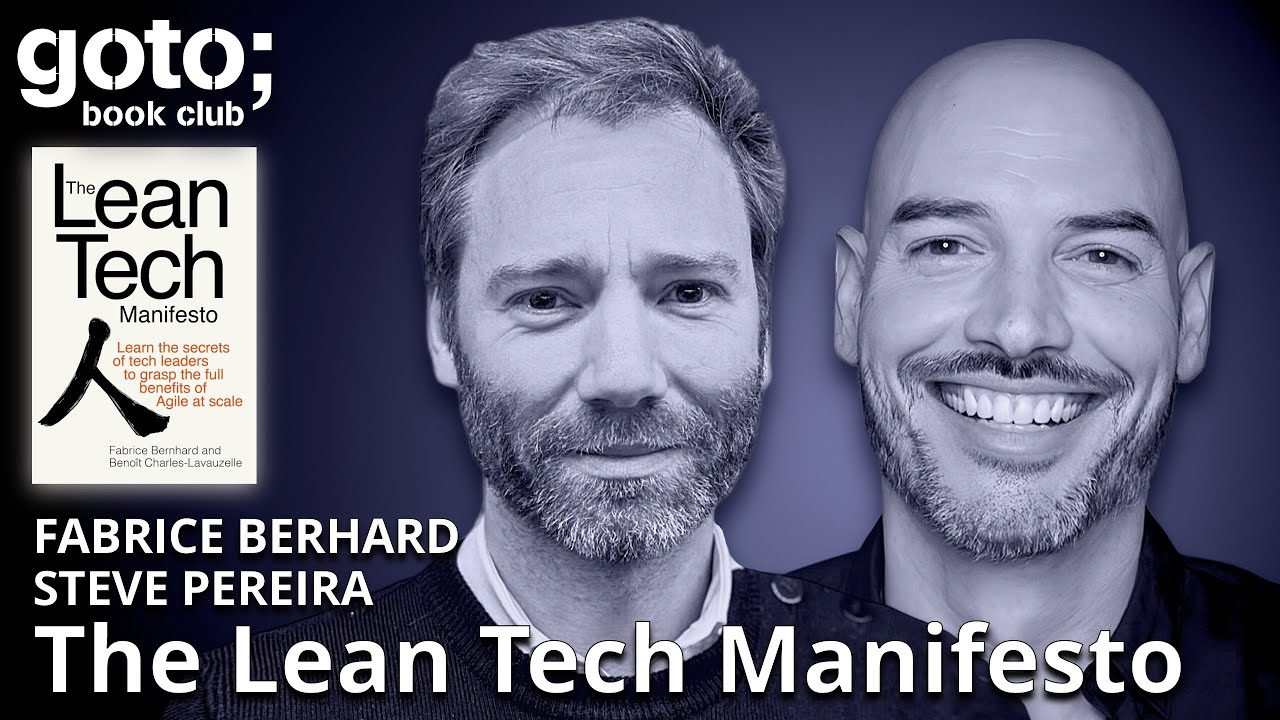
Fabrice Bernhard, co-founder of Theodo and co-author of “The Lean Tech Manifesto,” shares his organization’s journey from embracing agile principles to adopting lean thinking as a necessary framework for scaling effectively. The initial success with agile methodologies like Scrum and Extreme Programming transformed their work environment and fueled rapid growth. However, this expansion brought new challenges that agile principles, designed for individual teams, couldn’t address, such as recruitment, sales, and financial strategy for a multi-team organization. This inflection point led them to explore lean thinking, which provided the tools to scale while preserving an agile culture.
The Symbiotic Relationship Between Lean and Agile
A common perspective is to view agile as a subset of the broader, deeper body of knowledge that is lean thinking. The roots of agile are deeply intertwined with lean concepts; Scrum itself was inspired by a study of Japanese innovation management techniques, closely linked to Toyota’s lean principles.
However, agile, born from the tech world, contributes a unique and modern concept not explicitly found in traditional lean literature: tech-enabled networks of teams.
“There’s a part of agile that is outside of lean which is leveraging technology to enable topologies that are different more modern typically the the the network of teams topology.”
This model, inspired by the success of distributed, open-source projects like Linux, uses technology (e.g., Git, GitHub) to manage complex, collaborative work without imposing traditional hierarchical management layers. This idea is gaining traction, as seen in the popularity of concepts from books like “Team of Teams” and “Team Topologies,” which explore new ways of organizing and interacting. The focus is shifting from the structure of teams (the boxes) to the dynamics of the system and the interactions between them (the lines).
Debunking Common Misconceptions
Both agile and lean suffer from misconceptions that have led to pendulum swings in their application.
- Agile’s Misconception: It is often diluted to be only about people’s feelings and team morale, at the expense of competence and, crucially, outcomes. When market conditions tighten, agile initiatives that cannot demonstrate clear, positive outcomes are often the first to be challenged and cut by leadership.
- Lean’s Misconception: Lean is frequently misconstrued as a brutal, top-down methodology for “squeezing optimizations from processes at the expense of humans.” This perception stems from poor implementations by consultants who ignored the core principle of respect for people. Another myth is that lean is only applicable to repetitive manufacturing processes and is unhelpful in creative or engineering contexts. In reality, a factory floor is a highly dynamic environment requiring constant, creative problem-solving. Furthermore, the true secret to Toyota’s success was not just lean manufacturing, but lean engineering—using manufacturing insights to inform design and strategy.
The two methodologies are now converging. The agile community is realizing the need to focus more on sustainable outcomes, while the lean community is re-emphasizing that long-term success is impossible without investing in people. True lean is profoundly human-centric, built on pillars like “good thinking, good products,” which posits that better products come from investing in people’s training and deep understanding.
A Case Study in Scaling with Lean Tech
During the COVID-19 crisis, Fabrice’s team was tasked with building a national platform for state-guaranteed business loans in just five days. The initial launch was a massive success, a testament to agile, focused teamwork.
However, this success led to rapid scaling, growing the tech organization to 300 people. What initially took five days to build and deploy soon became the lead time just to push a change to production. This is a classic scaling challenge. To solve it, they applied lean tech principles:
- Visual Management with Kanban: They implemented a true Kanban system to visualize handovers between teams, immediately identifying bottlenecks and measuring the lead time for each work increment.
- Architectural Modularity: They focused on modularizing the architecture and implementing automated testing, enabling them to return to a high-velocity deployment cadence of 40 deployments per day without compromising quality.
- Systematic Bug Analysis (Datsu): A systematic, daily analysis of production defects was established. This rigorous problem-solving process allowed them to reduce the number of bugs by a factor of seven.
The core lesson for leaders is to start by going to the “gemba” (the shop floor, where work happens), observe the actual process, and coach teams on scientific problem-solving, always starting with a clear measure of customer value. Visual management is a critical tool for sustaining this culture, especially in a hybrid work environment. Ultimately, both lean and agile are about enabling humans to solve complex problems and deliver value.