AI Won't Take Your Job—It Will Make You the CEO | The a16z Show
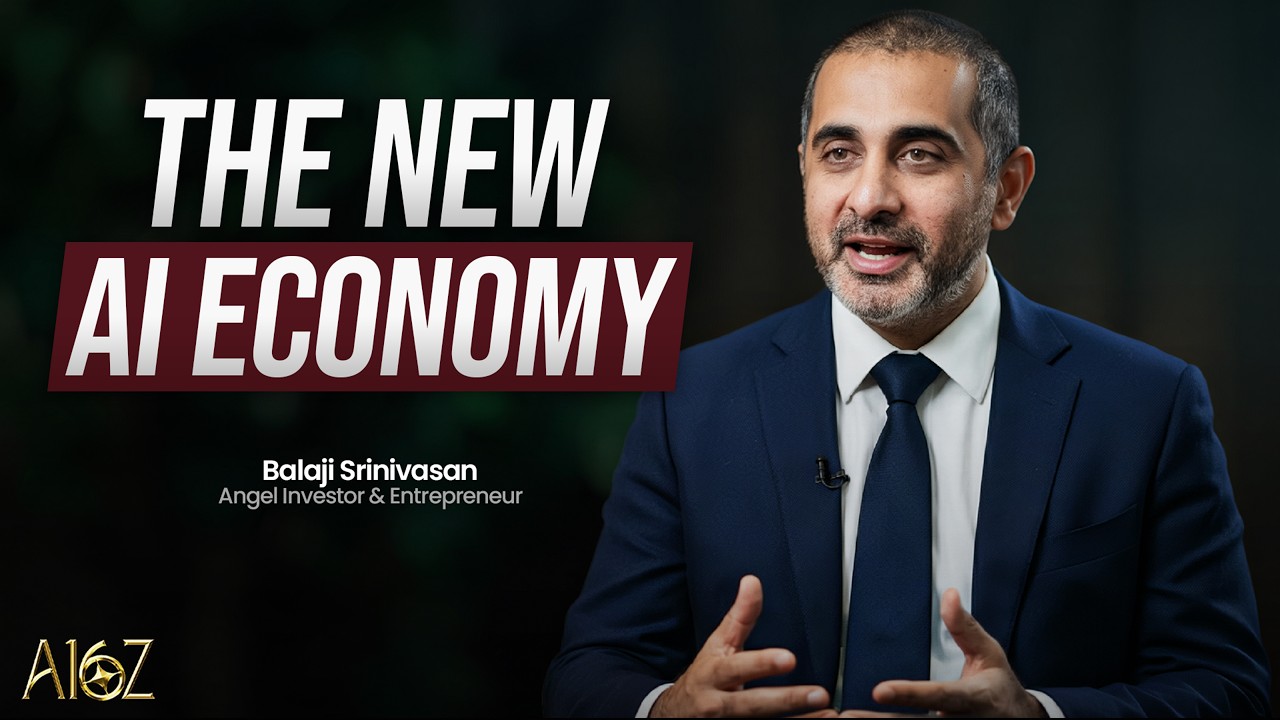
Balaji Srinivasan discusses the paradoxical nature of AI, which lowers creation costs while simultaneously raising verification costs. He argues this tension pushes society toward a "trusted tribe" model, similar to the Chinese internet, where AI excels within high-trust groups but struggles between them. The conversation covers why physical tasks are easier to automate than digital ones, how AI makes everyone a CEO rather than obsolete, and why crypto, particularly Zcash, serves as a necessary counterbalance for inter-tribe transactions in an AI-driven world.
The AI Dichotomy: Cheaper Creation, Costlier Verification
Balaji Srinivasan posits that the core tension of the AI economy is its dual effect: AI drastically reduces the cost of generation but exponentially increases the cost of verification. Generating a resume or a slide deck is now trivial, but verifying its authenticity and quality requires more effort than ever. This leads to a proliferation of what he calls “AI slop”—generic, low-effort content that signals laziness, ignorance, or malicious intent.
This dynamic shapes the entire ecosystem:
- Productivity Within Tribes: Inside a high-trust environment like a company, sharing data and code allows AI to supercharge productivity.
- Friction Between Tribes: In the public sphere or between organizations, the need to verify everything creates a “verification tax,” slowing down interactions and eroding trust. AI spam and deepfakes make the digital commons a “hall of mirrors.”
The Rise of the “Trusted Tribe” and Digital Autarky
This verification problem pushes the internet towards a model resembling the Chinese tech ecosystem, which evolved in a low-trust society. Companies will increasingly operate in a state of “digital autarky,” building their own internal tools with AI rather than relying on external SaaS products where data privacy and security are concerns. The build-versus-buy calculation shifts toward “build” for internal tooling.
AI is for use within trusted tribes, while crypto is for transactions between them.
Where AI Works Best
Srinivasan identifies three key areas where AI currently provides the most value:
- Visuals over Verbal: Humans have built-in “GPUs” (our visual cortex) that make it easy to spot flaws in AI-generated images and UI mockups. Verifying a wall of text is much harder.
- The Verifiable: Tasks with clear success criteria, like back-end code that can be unit-tested, are well-suited for AI assistance.
- The Physical: The physical world provides a single, verifiable ground truth. Tasks like moving a box from A to B or self-driving have clear, binary outcomes, making them easier to automate reliably through reinforcement learning compared to fuzzy digital tasks.
He warns that using AI as a shortcut is only effective for experts who understand the “long way around” and can debug the output. For novices, it’s a dangerous tool that creates a facade of competence.
Human-AI Synthesis: Sensor and Actuator
Instead of replacing humans, AI augments them in a symbiotic relationship.
- “Humans are the sensor, AI is the actuator.” Humans provide the “taste”—the sense of market, political, and social conditions. They articulate this sense into a prompt, and the AI executes the task.
- “AI can’t read your mind, but it can read your body.” While AI may not access our thoughts, it can use biometric data from wearables as a high-fidelity, non-verbal prompt to act on our behalf, such as by detecting illness before we feel symptoms.
Srinivasan argues that truly autonomous, Skynet-like AI is unlikely. Economically useful AI is designed “for the leash”—it must be controllable and switchable to be practical. Furthermore, self-replication requires control over the physical supply chain, which has numerous economic and political brakes.
The New Shape of Work: Everyone is a CEO
Srinivasan offers several reframes for AI’s impact on employment:
- “AI doesn’t take your job, AI makes you the CEO.” Using AI effectively requires the core skills of a CEO: sensing the environment, formulating clear instructions, and verifying the output. This democratizes the ability to manage complex tasks and build ventures, empowering a global “Jeffersonian natural aristocracy.”
- “AI doesn’t take your job, AI takes the job of the previous AI.” The market will constantly adopt the best-performing model for any given task. The role becomes managing a portfolio of AIs, “hiring” Claude to replace ChatGPT for a specific function.
- “AI doesn’t take your job, AI lets you do any job.” AI enables generalists to achieve a baseline level of competence (a “6 or 7 out of 10”) in many domains, a crucial skill for founders and managers.
The SaaS Apocalypse and Limits of AI Giants
- SaaS Apocalypse: Srinivasan believes this is overblown. While vulnerable incumbents will be disrupted, companies with strong distribution (e.g., Figma, Notion) can integrate AI to strengthen their moats. The primary threat comes from a user shift towards local-first applications (like Obsidian) that offer better data control.
- AI Hegemony: He is skeptical that today’s leading AI labs will grow to dominate governments. He criticizes them as “scalar thinkers” who model only AI disruption while ignoring simultaneous political, financial, and social shifts. They are not prepared for the inevitable political and legal backlash (e.g., copyright) that will act as a sigmoidal constraint on their growth. Decentralized, “Pirate Bay” AIs may ultimately be more resilient.
Crypto as the Defense
In a world saturated by AI-driven attacks on truth, crypto provides the defense.
- Bitcoin as Institutional Collateral: Srinivasan’s view on Bitcoin has evolved. He now sees it as “provable, global, institutional collateral.” Its transparency, while a risk for individuals in an age of AI chain analysis, makes it perfect for institutions needing to prove reserves across borders.
- Zcash as Digital Cash: This leaves a void for a true individual-focused digital cash. Zcash, powered by zero-knowledge proofs, fills this role. It provides the privacy and fungibility necessary for peer-to-peer transactions, fulfilling Milton Friedman’s 30-year-old prediction of a reliable “e-cash.” As AI becomes the attack vector, ZK-proofs are the defense.