Stop Renting Your AI's Memory — Dylan Couzon, Qdrant
Dylan Couzon, developer relations engineer at Qdrant, argues that frontier-class models now run on hardware people can own, but the memory that makes an assistant personal still lives in someone else's cloud. He covers why owning inference gives autonomy while owning memory gives continuity, the CPU, RAM, and disk model for LLMs, why retrieval beats stuffing everything into the prompt, and a live offline demo of a drone building searchable memory with Qdrant Edge, plus opt-in shared memory.
The frontier is coming home
Superintelligence will likely arrive within the next few years, and Dylan Couzon argues that the more pressing question is not when but who it belongs to. One version lives in someone else’s data center and is metered by the token. The other runs on hardware you own, learns from your life, keeps your context private, and cannot be switched off, throttled, or taken away.
Frontier-class capability is already closer to home than it appears. A machine under $2,500 can run what was roughly last year’s frontier, and open-weight models are closing the gap every quarter. Yet a model on its own is a brilliant stranger. What makes an assistant yours is the accumulated knowledge it has of you, and that part has not yet come home.
What renting really costs
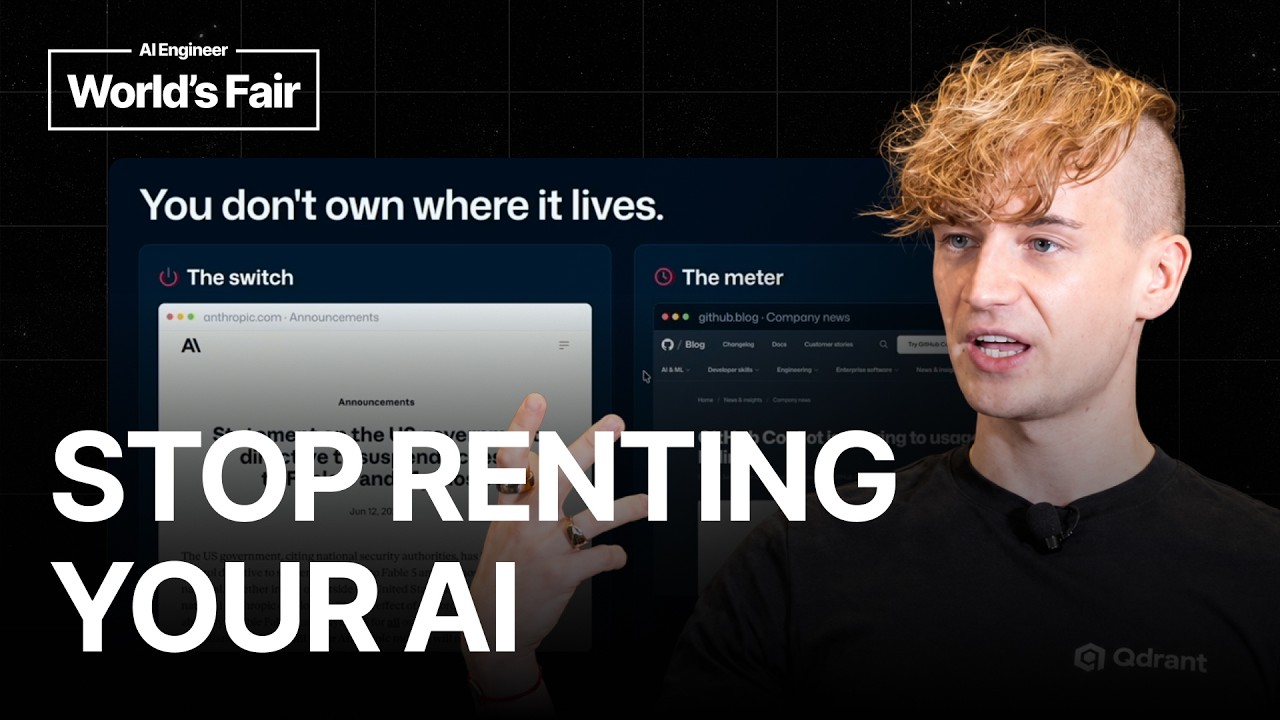
Most of today’s AI stack is rented: the compute, the models, the harness, and the memory that is supposed to compound over years. Renting the model means not controlling it. A government order recently cut access to two flagship models for every customer at once, whereas weights sitting on your own machine cannot be reached and switched off. Providers also retire versions and throttle capacity when economics tighten, so the model you depend on can quietly degrade or vanish. Agentic workloads make this worse. A single long-running task can consume thousands of times more tokens than a chat message, and some developers burn over $5,000 a month of compute on a $200 plan. Dylan treats that gap as a subsidy that will not last.
Autonomy versus continuity
Owning inference gives you autonomy, since no one can take the model away. But autonomy is not enough. Continuity, the sense that a system keeps learning you, is what makes intelligence feel personal. Every frontier lab has shipped a memory feature over the past year, not because the models got smarter but because they carry nothing between sessions. That gap is the product being sold back to users. A modest system that starts simple and keeps learning will feel smarter over time than a brilliant one that forgets everything about you.
Memory as write, retrieve, and forget
Memory is not a bigger prompt. It is a system built on three operations: writing, retrieving, and forgetting, which mirror what the brain does. Dumping everything into a folder of markdown files and hoping the model finds the right thing is weaker than structured retrieval. Retrieval gives control. You can filter by topic, decay by recency and frequency, and let relevance shift over time the way human memory does. The underlying infrastructure has been ready for years. HNSW indexing dates to 2016, and local embeddings have been practical since 2019. The hard part was never memory itself. It was that we pointed the memory at ourselves rather than at the people building it.
Model as CPU, context as RAM, memory as disk
Borrowing Andrej Karpathy’s framing, the model is the CPU, the context window is RAM, and memory is disk. RAM is fast but forgets when the session ends. Disk is what remembers you across every conversation, and for nearly every assistant today that disk sits in someone else’s data center. Dylan deliberately avoids arguing which memory architecture wins. His claim is narrower: the record of you should be fully yours, forever.
Embedded vector memory with Qdrant Edge
His answer is Qdrant Edge, a vector search engine that embeds directly into an application as a local store inside the process. Embeddings with payloads are written locally and queried offline in sub-millisecond time, using the same Rust core as Qdrant in the cloud. With quantization, a million memories fit in under a gigabyte, small enough for a phone or a Raspberry Pi. Each app gets an isolated store, and that folder is what follows you. Close the app, come back a year later, and the memory is intact.
Live offline demo: a drone that remembers
The demo shows a drone encountering a house for the first time. Running fully offline on a laptop, an object detection model (YOLO) labels what the drone sees, and each label and frame is turned into embeddings that form a live memory. A 2D projection of the vector space shows similar memories clustering together. At the point of the demo, the drone had recognized 92 distinct objects across more than 300 vectors, and the entire Qdrant Edge footprint was about 15 MB. A semantic search for coffee tables returned every one the drone had seen in under one millisecond, along with the image, first and last timestamps, a description, and the number of sightings. No network connection was involved.
Hive mind and shared memory
Memory need not stay isolated. Qdrant Edge can sync parts of a local store to the Qdrant cloud when the user opts in. A swarm of drones or robots could share a hive mind in which one unit’s learning benefits all of them. The same pattern applies to chatbots, agents, and code assistants. Dylan also envisions a family wearing glasses that each record their own day, keeping separate private memories that can be pooled into a shared, family-owned store. The same mechanism cuts both ways, though. Memory can be shared with consent or extracted without it, which is why it should begin local and why sharing should always be opt-in.
Memory for your whole day
Extend the same retrieval to everything you see and hear: where you left your badge, someone’s daughter’s name, what was written on a whiteboard, the song playing when you first met. Each is just a retrieval query. Smart glasses already shipping are early versions of this. Frontier models are already building an index of people’s relationships, habits, and inner lives, whether or not people opt in. The open question is whether that index is owned by the user or rented back to them as access to themselves.
Who should own your AI
The arrival of superintelligence is treated as settled. What remains open is ownership, and that fight is worth having while the architecture is still up for grabs. Dylan’s practical advice is to take a tool home and give it memory, then imagine that memory five years on: a private mind that never forgets, that nobody can switch off, and that knows you better than any system has because you were the only one who trained it. A personal intelligence of that kind is the one worth wanting.