Local llms

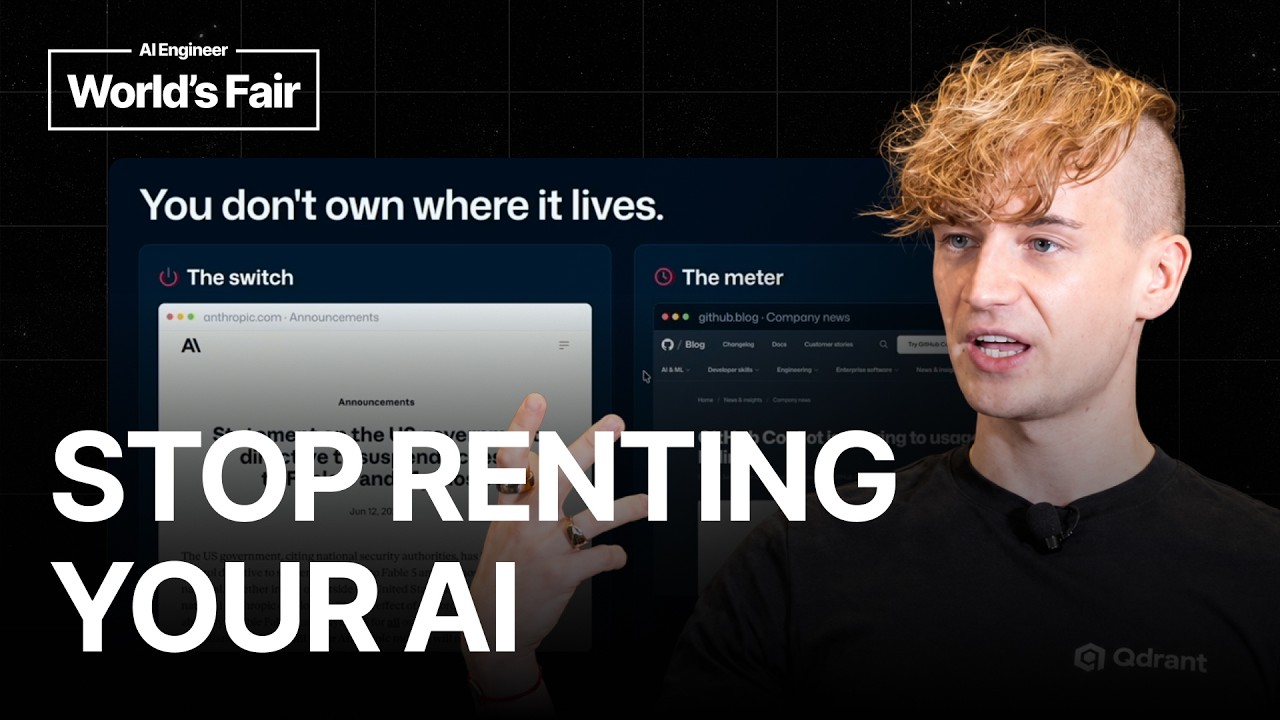
Stop Renting Your AI's Memory — Dylan Couzon, Qdrant

Stop Renting Your AI's Memory — Dylan Couzon, Qdrant

Dylan Couzon, developer relations engineer at Qdrant, argues that frontier-class models now run on hardware people can own, but the memory that makes an assistant personal still lives in someone else's cloud. He covers why owning inference gives autonomy while owning memory gives continuity, the CPU, RAM, and disk model for LLMs, why retrieval beats stuffing everything into the prompt, and a live offline demo of a drone building searchable memory with Qdrant Edge, plus opt-in shared memory.


Self-Improving Harnesses, Local Personal AI And YC's Agent For Work | YC Paper Club

Self-Improving Harnesses, Local Personal AI And YC's Agent For Work | YC Paper Club

A deep dive into the evolving world of LLM harnesses, demonstrating how they've transformed from simple prompt engineering into sophisticated self-improving systems. The discussion covers architectural advancements (e.g., Prime Agent's context as cache, Turing vs. Von Neumann), practical applications (auto-researchers, on-device personal AI like OpenJarvis, YC's QM for work), and the challenges and future directions of agentic AI. It emphasizes that harness innovation is key to unlocking significant performance gains and enabling LLMs to operate autonomously and adaptively.

Open Models Change The Economics of AI

Open Models Change The Economics of AI

Ollama Co-founder Jeffrey Morgan discusses the enterprise shift to open models, driven by cost, customization, and coding agents, leading to a 150X token growth. He highlights the dominance of Chinese models in cloud consumption, the hardware renaissance enabling local LLMs, and the rise of ultra-efficient "flash" models. Morgan also shares Ollama's journey, from its YC pivot to its monetization strategy, and reflects on lessons for building AI companies.

You Asked About AI: Agents, Hacking & LLMs

You Asked About AI: Agents, Hacking & LLMs

An exploration of the evolving AI landscape, covering the paradigm shift in cybersecurity due to AI agents, the practicalities of running local LLMs with tools like Ollama and vLLM, and the emerging stack for agent-to-agent communication.