Velocity Sickness: What Happens When Your Whole Team Gets 10x Faster — Matt Dailey, Ref.
Matt Dailey introduces "velocity sickness" – the stress of increased AI output without impact. He proposes shifting from ephemeral chat-based agent interactions to durable, shared documents as the "decision layer" to separate planning from implementation, enabling teams to own their code and prioritize ideas effectively.
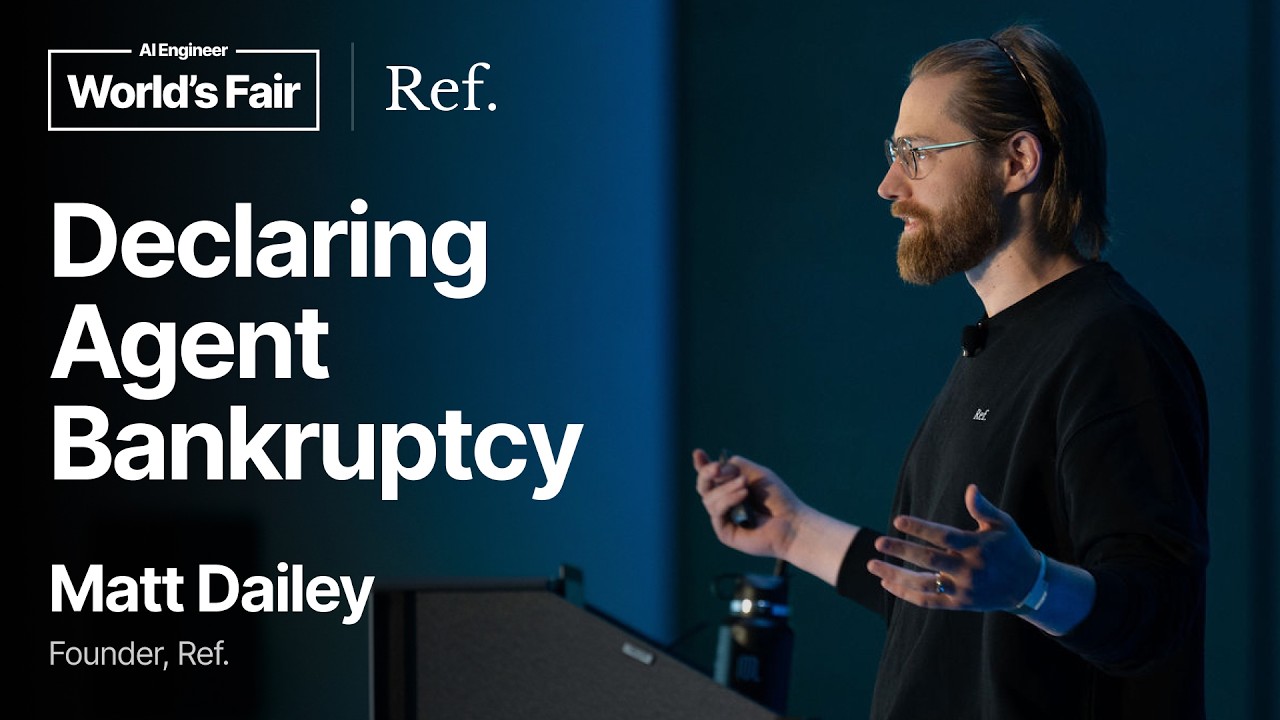
Matt Dailey, CEO and founder of Ref, addresses the critical issue of “velocity sickness” in AI-augmented engineering teams. While individual engineers can achieve 10x speed with AI, teams often struggle to scale this output, leading to what Dailey terms “output without impact.” This stress is caused by a sudden increase in output that doesn’t translate to meaningful results, akin to a newsletter writer producing a “book every week” that goes unread.
Dailey identifies four key problems stemming from this velocity sickness:
- Too many Pull Requests (PRs) to merge: Individual engineers push too much code, overwhelming the merge queue and creating conflicts.
- Moving in many directions at once: Teams lack cohesive focus as agents and engineers pursue disparate paths, leading to inefficiency and potential collisions.
- Declaring agent bankruptcy: Engineers repeatedly discard agent work, recognizing none of it the next day, and re-doing the same work, wasting tokens and time.
- Critical decisions made by agents: The most crucial problem, where engineers cede control of their code and, at scale, teams lose ownership of the product itself.
He argues that the traditional software engineering process, with its tools like IDEs, was built for individual implementation and polishing. With AI, the workflow has shifted: planning, agent implementation, and human polishing. The new “planning” stage, now a “decision layer,” is where engineers exercise their craft—exploring complex systems, expressing taste, and making key decisions. Existing tools, particularly chat interfaces, are ill-suited for this, being isolated, ephemeral, and optimized for execution rather than collaborative decision-making.
Dailey proposes a fundamental shift: separating the decision layer from the implementation layer and empowering the decision layer with its own primitive—a document rather than a chat.
- The Problem with Chats: Chats are ephemeral, isolated, and lead to decisions evaporating while only the code (often without shared context) survives. They foster a “brain-off” mentality where engineers might accept an agent’s recommendation without critical thought.
- The Solution: Docs as the Decision Primitive: Durable, shared documents are designed to bring key decisions forward, fostering alignment and providing a clear record. They serve as a “portal to the software system,” allowing AI to highlight relevant information for decision-making.
This approach conceptualizes the doc as the state and the agent as the action. Agents become effectively stateless, drawing all necessary context from the shared document. This allows for:
- Shared Context: New agents can easily start from identical context.
- Rebuilding Understanding: Humans can quickly regain context by simply re-reading the document.
- Context Engineering: The doc becomes the central point for engineering the context provided to agents.
When implemented, this leads to a shift from “code velocity” to “idea velocity.” The tell-tale sign is engineers writing plans they never implement, indicating better prioritization after ideas are explored and refined. This tackles velocity sickness by ensuring output has impact.
Benefits of the Doc-Centric Approach:
- Reduces Too Many PRs: Reviews shift earlier to align on key decisions, making code reviews simpler.
- Aligns Direction: Teams align on plans early, preventing engineers from sprinting in disparate directions.
- Eliminates Agent Bankruptcy: Human context is rebuilt by reading the durable doc, not by re-doing work.
- Humans Own Decisions: Engineers retain ownership of code and product, as critical decisions are explicitly made and documented by humans.
- More Parallel Agents: Shared context facilitates concurrent agent work.
- Durable Decision Log: Key decisions are captured upfront, not reliant on LLM summaries.
- Increased Collaboration: Encourages creative, multiplayer engineering, essential in a fast-paced AI era.
Dailey concludes with three immediate actionable steps:
- Notice Which Gear You’re In: Recognize the difference between planning and polishing phases, and whether current tools support the task.
- Treat the Plan as a Portal to the System: Use the plan as a powerful, malleable tool to understand what matters and guide decisions.
- Hand a Plan to a Teammate Before an Agent: Leverage human teammates for feedback and context before delegating to an agent, fostering collaboration and better outcomes.