How AI Is Changing Code Reviews & Software Development
This video explores the evolution of code reviews, tracing their history from manual Fagan inspections and pair programming to modern CI/CD automation. It highlights how AI is now transforming code review from a focus on implementation details to a validation of intent, business outcomes, and requirement fulfillment, emphasizing a collaborative model between AI for broad analysis and humans for context and judgment.
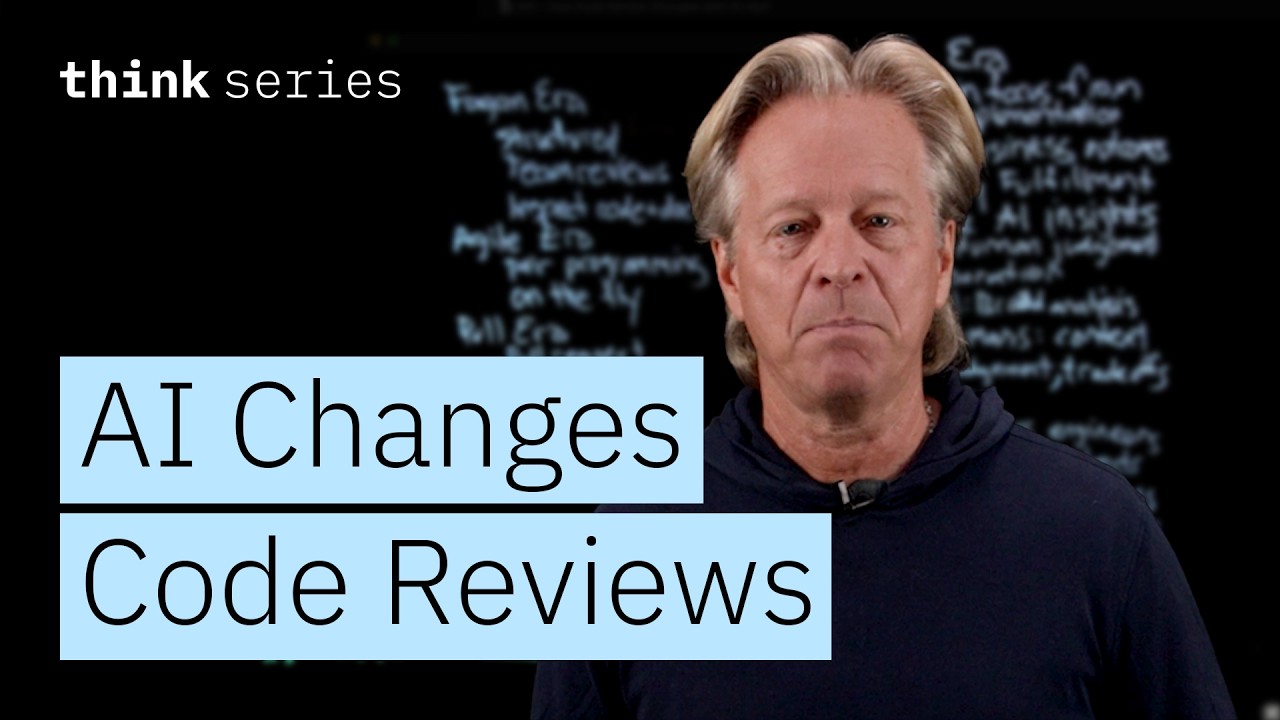
The Evolution of Code Reviews: From Manual Inspections to AI-Driven Outcome Validation
AI is fundamentally transforming development practices, particularly code reviews. Traditionally, building systems and applications has always revolved around three core components: code, documentation, and architecture. The history of code review reflects a continuous effort to ensure the quality and consistency of these building blocks.
Historical Phases of Code Review
The journey of code review has progressed through several distinct eras, each introducing new methods and shifting focus:
- The Fagan Era (Fagan Inspections)
- Pioneered by IBM engineer Michael Fagan, this was a highly structured, team-based approach.
- Teams would gather, often in a room, to conduct meticulous, line-by-line inspections of code and documentation.
- It was a time-intensive process, primarily focused on identifying errors in implementation details and syntax.
-
The Agile Era (Pair Programming)
- As development speed increased, the focus shifted to more agile methods.
- Pair programming involved two developers reviewing code and documentation collaboratively “on the fly” as it was being produced.
- While faster, this approach still largely retained the implementation and syntax-centric focus of earlier methods.
-
The Pull Era (Pull Requests)
- The rise of version control systems and repositories led to the “pull request” model.
- Developers submitted changes to a shared repository, requesting a merge. These changes, often viewed as “diffs” (differences), required approval.
- This era introduced “consensus reviews,” where multiple individuals reviewed proposed changes, focusing on integration, versioning, and collective approval. The scope broadened from just syntax to include how changes fit within the larger codebase.
-
The Automation Era (CI/CD Pipelines)
- The integration of Continuous Integration/Continuous Delivery (CI/CD) pipelines further automated aspects of review.
- This brought “system-assisted reviews” where automated tools checked for code quality, vulnerabilities, security issues, and compliance with internal, external, and governmental regulations.
- This phase established “system reviews,” where automated systems complemented human oversight in ensuring adherence to standards.
The AI Era: A Paradigm Shift to Outcome-Based Reviews
The current phase, driven by AI and Large Language Models (LLMs), represents the most profound shift in code review philosophy.
- Shifting Focus: The core transformation is a move away from scrutinizing implementation details (how code is written) towards validating business outcomes, requirement fulfillment, and the intent behind the development.
- Intelligence in Development: AI injects intelligence directly into the entire development process, from code generation to architecture design.
- AI-Human Collaboration: This new paradigm emphasizes a collaborative model:
- AI’s Role: Handles broad analysis across all development artifacts—generating code and documentation, suggesting architectures, managing merging conflicts, and integrating with existing automated checks for quality and compliance.
- Human’s Role: Provides essential context, applies critical judgment, evaluates AI-generated output against desired business outcomes, and makes strategic trade-offs. Humans now focus on the “what” and “why” of building, leveraging AI for the “how.”
- Evidence-Based Reviews: Reviews are becoming increasingly evidence-based, incorporating not only technical correctness but also direct links to business requirements, desired outcomes, and real-time runtime evidence.
- Outcome Reviews: The ultimate goal is to conduct “outcome reviews”—verifying whether “we built what we were trying to build,” rather than merely assessing the technical execution.
In conclusion, the emergence of AI in software development is propelling code review beyond mere implementation checks. The future lies in validating intent, desired outcomes, and overall business impact across increasingly AI-generated and AI-assisted systems.