Why AI Agents Will Need Their Own Bank Accounts — Lincoln Murr, Coinbase
Lincoln Murr, head of AI product at Coinbase, explains agentic finance, covering agents that pay and agents that grow money. He traces the path from AgentKit, an early experiment giving an AI a wallet, to x402, an open payment standard built on the long-unused HTTP 402 code. He also discusses microtransactions as a replacement for the ad economy, agents executing trades from simple instructions, the trust-building lessons from two years of development, and the vision of agents that can pay for their own upkeep.
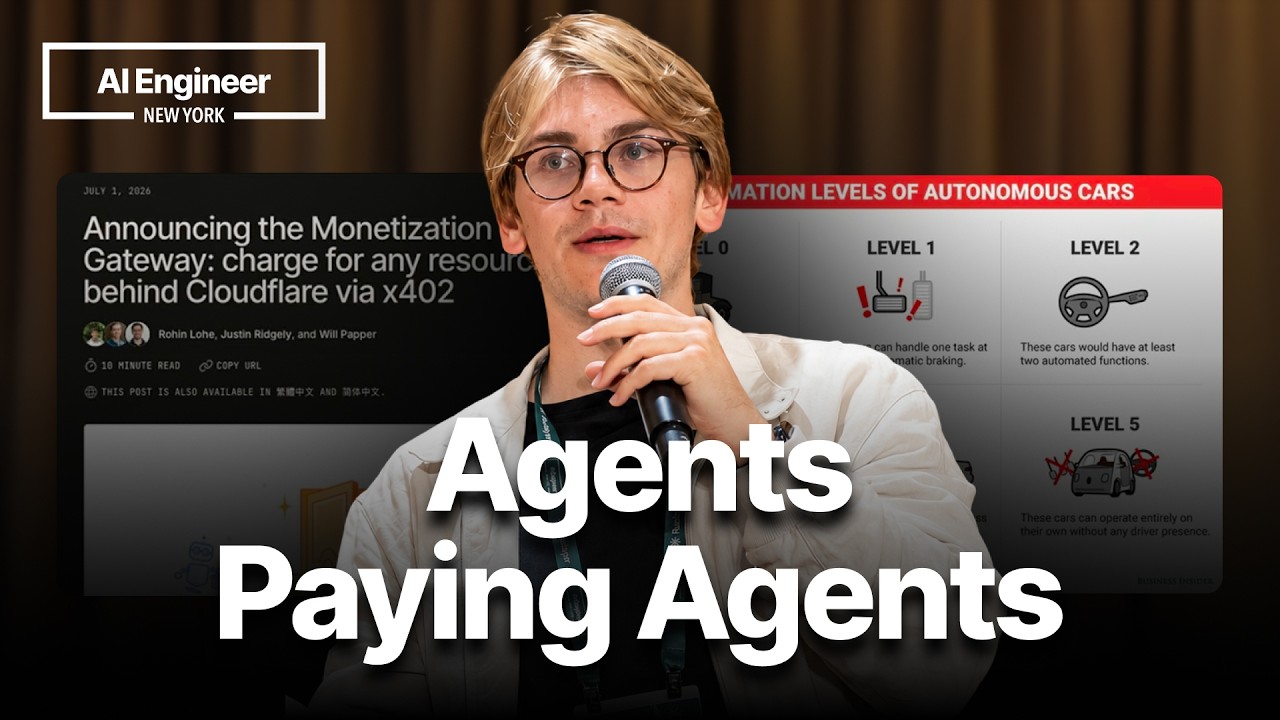
Lincoln Murr, head of AI product at Coinbase, frames agentic finance as anything involving an agent that can manage money or hold a financial account. He sees two use cases so far: agents that need to pay with money, and agents that need to grow it. He acknowledges that ‘Coinbase, crypto, AI’ can sound like a pile of buzzwords, and his goal is to show that this is a working product area and to share what two years of building taught his team.
From AgentKit to x402
The starting point was AgentKit, an early experiment built on LangChain before MCP or other standardized AI tooling existed. The team added a crypto wallet to an agent. Murr recalls typing ‘Hey, can you send money somewhere?’ at 2 a.m. and watching it work, which felt magical then and is unremarkable now. The real problem surfaced when developers got access: the AI could move money but had nothing to pay for. As he puts it, ‘We gave an AI access to money, but we didn’t really give it anything to pay for.’
The fix came from an old corner of the web spec. HTTP 402, ‘Payment Required,’ has been reserved for future use since the spec was written and was never really implemented, which he calls the original sin of the internet. Stablecoins offer a cheap, fast payment rail, and x402 is Coinbase’s open standard for internet-native payments, released around last May. The initial target was 25,000 agent transactions by year end. By year end they were happening roughly every 17 seconds. Today he cites tens of millions in volume and hundreds of millions of transactions every 30 days. Adoption extends well beyond crypto firms, with payments and card players such as PayPal, Visa, Mastercard, Stripe and Amex engaging, which he attributes to the open, use-anywhere design.
Microtransactions as a replacement for the ad economy
Murr argues that the web’s business model is breaking. People increasingly get answers through chat interfaces and AI overviews rather than visiting sites, which cuts off the ad revenue and human attention publishers depended on. He compares the current scraping to the LimeWire era and notes that bot traffic has recently overtaken human traffic for the first time.
His proposed answer is gating content behind tiny per-request payments aimed at agents. A Substack writer, for example, could charge an agent 1/10,000th of a cent to read a post, a cost that should be abstracted away much like an AI subscription. He points to AWS and Cloudflare, which together control roughly 40% of internet traffic and have enabled x402 gating across the sites they host. Adoption is still early, but he expects this to become a main way companies differentiate themselves and avoid being disintermediated.
Agents that grow money
Mmurr admits he first thought the idea of giving ChatGPT or Grok access to a bank account was ridiculous. His refined view is that the human still provides the agency, directing the agent to automate tasks that would otherwise be hard, rather than simply telling it to make money. He describes three use cases that exist today:
- Managed portfolios with guardrails, such as a low-risk allocation of 80% S&P, 5% Bitcoin and 15% T-bills, run hands-off.
- Autonomous execution on conditional instructions. He mentions trading around the Strait of Hormuz and oil news, so the agent acts when a stated scenario occurs instead of the user watching charts at 3 a.m.
- Translating high-level natural language ideas, like ‘invest in space’ or ‘invest like Warren Buffett’, into concrete financial strategies for people who lack the time or know-how.
He illustrates the second case with a weekend trade. After a frontier AI post (transcribed as ‘we must pace the frontier’) that Elon Musk publicly endorsed, he judged that it would move a particular stock on Monday. Since markets now run 24/7, he shorted the position by voice from his phone over the weekend. He has since set his agent to monitor weekend news for market-moving events and alert him. He admits this specific opportunity may not last, but the point is how little friction remains between an idea and an executed trade.
Lessons from two years of building
The first lesson is that trust and autonomy are earned one step at a time. The most common question he gets is what happens if the AI goes rogue. He compares this to self-driving cars: a few years ago no one would have used lane assist to parallel park, and now riding in a Waymo in San Francisco feels normal. Users tend to move from complete hesitation, to accepting that AI already spends credits as a kind of money, to allowing small microtransactions, and finally to funding isolated portfolios with the right guardrails and policies. He notes, anecdotally, that they have never seen a model wipe out a user’s account in an unrecoverable way.
The second lesson is that AI is the enabler, not the product. Coinbase Adviser, an SEC-registered AI financial adviser that asset managers tune, shows this. Its value is scaling trusted, regulated advice to hundreds of millions of users for free and making it available 24/7. Most users don’t care that AI sits behind it. He expects more generative UI in which agents work behind whatever interface fits.
He also describes a blank-canvas cold-start problem in chat: users don’t know what the product can do. Proactive widgets that surface insights and opportunities have converted well. Finally, next-gen agents come with a microVM, effectively a personal computer with storage and a file system. That lets Coinbase build CLIs and MCP servers that connect a user’s account, and handle requests like paper trading or backtesting by writing a skill directly onto the user’s machine instead of waiting through a long internal brokerage build cycle. He concedes this may not be the most efficient approach, but it matches the pace customers demand.
Where agentic finance is heading
His core thesis is that financial independence leads to greater agent autonomy, just as a person with a card can do far more online than one who can only browse. He imagines agents running long-horizon workflows and bringing humans in only at the edges, for regulated or inherently human tasks like forming a company or obtaining a legal opinion.
He closes with a thought experiment: can an AI sustain itself by earning money through its services and paying for its own inference, compute and upkeep? He suggests this could resemble a proto-digital life form. He connects it to DAOs, which have been discussed for nearly a decade without convincing implementations. The vision is automation at the core, with an AI managing a treasury and hiring humans for specific tasks at the edges. Self-driving taxis that earn fares to cover their own operation and maintenance are another example. He is unsure how long this will take, but he considers it inevitable, with machine-to-machine commerce becoming the main way money moves across the internet at unprecedented speed.
He encourages developers to experiment with x402 and the Coinbase MCP, arguing that they are easier to start with than people expect.