From Vibe Coding to Vibe Researching: OpenAI’s Mark Chen and Jakub Pachocki
OpenAI’s Chief Scientist, Jakub Pachocki, and Chief Research Officer, Mark Chen, discuss the research behind GPT-5, the push toward long-horizon reasoning, and the grand vision of an automated researcher. They cover how OpenAI evaluates progress beyond saturated benchmarks, the surprising durability of reinforcement learning, and the culture required to protect fundamental research while shipping world-class products.
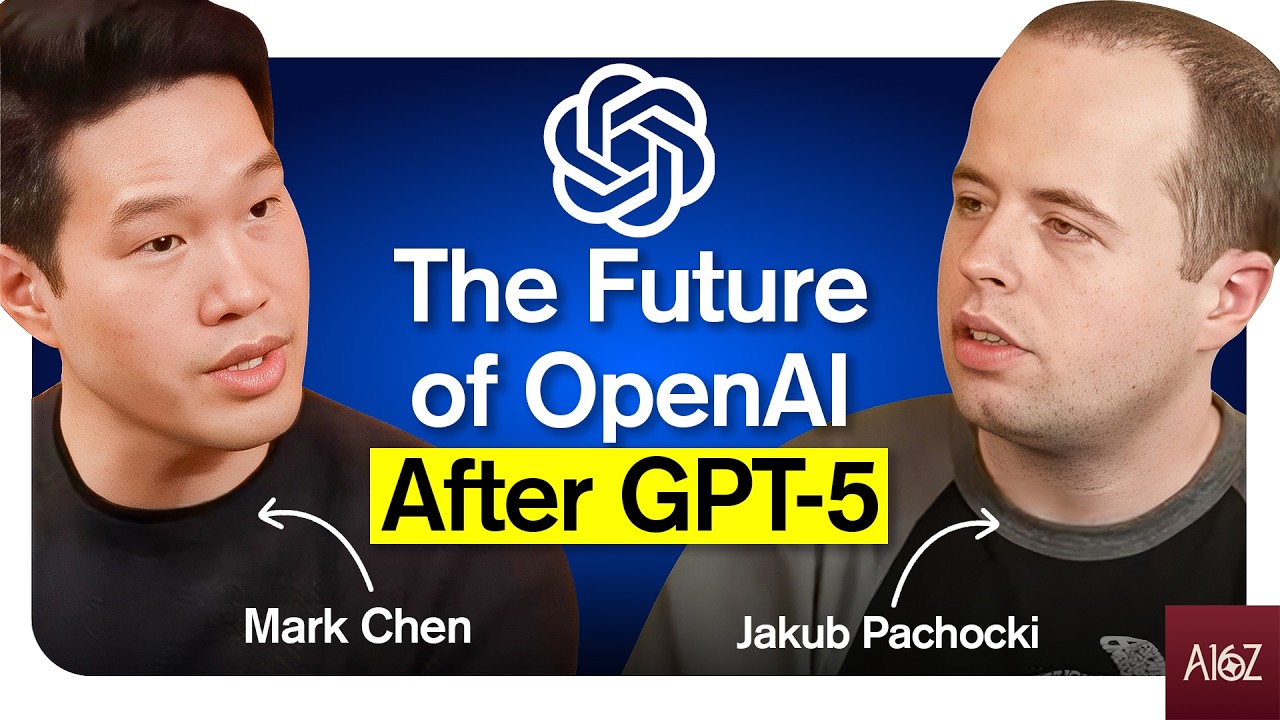
GPT-5: Integrating Reasoning into the Mainstream
GPT-5 represents a deliberate effort to merge two distinct lines of model development: the instant-response models of the GPT-2/3/4 series and the more contemplative “O series” models, which were designed to “think” for a longer time to produce the best possible answer. The goal was to eliminate the user’s need to choose a mode by having the model intelligently determine the appropriate amount of reasoning for any given prompt. This fusion is a foundational step toward delivering more agentic behavior and making advanced reasoning a default capability.
While the model features improvements across the board, the primary focus was to make this reasoning mode accessible to a broader audience, paving the way for more sophisticated agentic systems.
The Future of Evaluation: From Benchmarks to Economic Impact
Traditional benchmarks and evaluations are becoming saturated, and inching up from 98% to 99% is no longer the most meaningful measure of progress. The research paradigm has shifted. Previously, a single pre-training recipe was applied, and evals served as a general yardstick. Now, with reinforcement learning focused on specific reasoning domains, models can be trained to become experts in a narrow area. This can lead to exceptional performance on some evals but doesn’t guarantee broad generalization.
OpenAI acknowledges a “deficit of great evaluations” and is shifting focus to new frontiers:
- Real-World Competitions: The most exciting progress has been in mathematics and programming competitions (e.g., atcoder, IMO). These are seen as valid proxies for success in future research, as many top human researchers have backgrounds in these contests.
- Automated Discovery: The next generation of milestones and evaluations will focus on the model’s ability to make novel discoveries and achieve results that are “economically relevant.” The ultimate test is whether the model can generate new, valuable ideas.
The Grand Vision: An Automated Researcher
The central, long-term goal of OpenAI’s research is to create an “automated researcher”—a system capable of automating the discovery of new ideas. While this includes the self-referential goal of automating machine learning research, the vision extends to accelerating progress in all other scientific fields.
A key metric for tracking progress toward this goal is the time horizon over which a model can autonomously reason and work on a problem. Current models are approaching mastery on tasks that take one to five hours, such as high school math competitions. The research is now focused on extending this horizon by enhancing the model’s ability to plan over longer periods and retain memory. This vision transforms the nature of research from manual execution to a more intuitive process, which Jakub Pachocki calls “vibe researching.”
The Surprising Power of Reinforcement Learning (RL)
For years, skeptics have predicted that the performance gains from RL would plateau due to challenges like mode collapse or generalization failures. However, RL has proven to be the “gift that keeps on giving.” Its enduring success comes from combining the powerful, versatile learning paradigm of RL with the incredibly rich and nuanced environment provided by large-scale language pre-training.
For a long time, the main challenge for RL was finding the right environment. The breakthrough of language modeling provided a robust, complex world for RL agents to operate in, unlocking a vast number of new and promising research directions. For businesses looking to apply RL, the advice is to remain flexible; methods for tasks like reward modeling will evolve and become simpler, moving closer to “humanlike learning.”
The Evolution of Coding with AI
The latest GBT-5 Codecs model aims to translate the raw intelligence of reasoning models into practical utility for messy, real-world coding environments. Key improvements include:
- Better Presets: The model is now better calibrated for problem difficulty. It uses lower latency for easy problems and dedicates more time and higher latency to hard problems to find the best possible solution. This corrects a flaw in previous models which spent too little time on the hardest challenges.
- Handling Nuance: The model better handles “softer” aspects of coding, such as style, proactiveness, and other intricacies of complex codebases.
Even for expert coders, these tools are becoming indispensable for tasks like large-scale refactoring. While still in a bit of an “uncanny valley”—not quite as good as a human coworker—the productivity gains are undeniable. For the next generation of developers, “vibe coding” is already the default, where AI handles the mechanics and the human provides the high-level direction and intuition.
Building a Frontier Research Culture
Sustaining a high-performing research organization at the frontier requires a specific culture.
- Protecting Fundamental Research: A core responsibility of the leadership is to shield researchers from the short-term pressures of product competition. This creates the space for them to think one to two years ahead and focus on the big, unsolved problems rather than reactively chasing competitor releases.
- Hiring “Cave-Dwellers”: OpenAI looks for talent with a history of solving hard problems in any field, not just AI. They prioritize strong technical fundamentals and persistence, often seeking out the “cave-dwellers” who are doing deep, impactful work without necessarily being visible on social media.
- Avoiding the Learning Plateau: A key indicator of the culture’s health is that researchers never hit a “learning plateau.” The constant bubbling up of new results and ideas internally creates a dynamic environment where continuous learning is a necessity to keep up.
- Clarity of Vision: A shared, long-term goal—the automated researcher—provides a coherent direction for diverse research bets. While this goal is prescriptive at a high level, it leaves ample room for bottom-up idea generation and exploration across various domains.